If you don’t report problems to WordPress, how will they know about issues with their platform?
I am thrilled to inform you that the issue I reported regarding the ‘Email me new comments‘ checkbox when leaving a comment has been successfully resolved by WordPress.
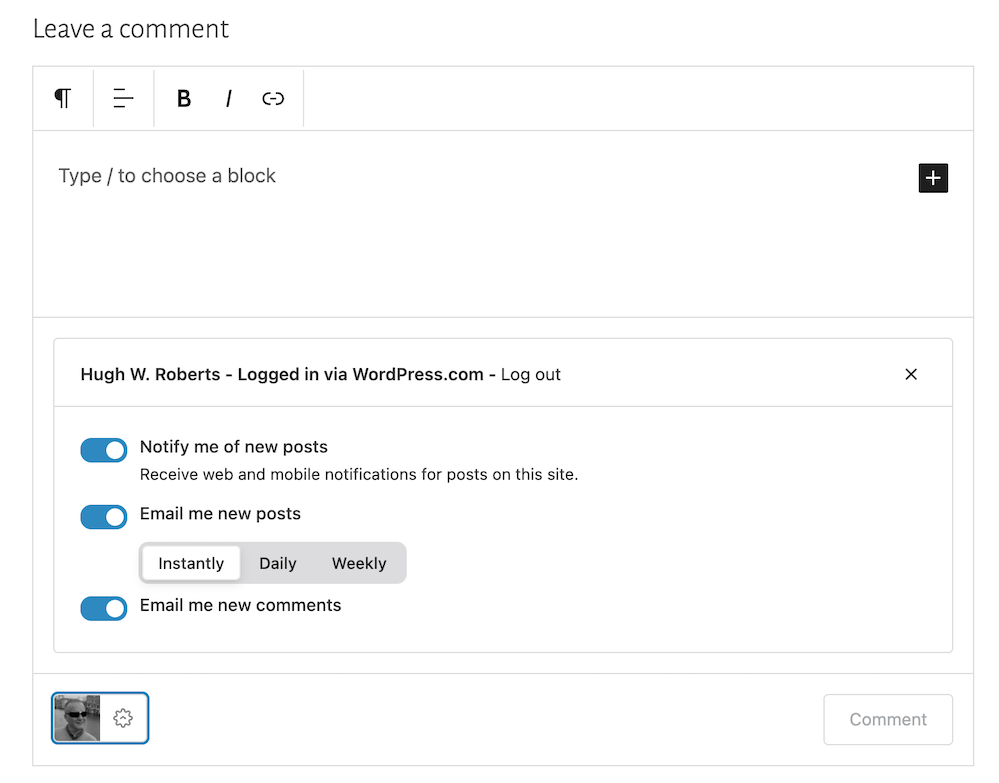
Click the ‘Email me new comment’ button to get an email notification of when somebody has replied to a comment you left them.
So here’s what happened: When you checked the ‘Email me new comments‘ box, things went a bit haywire. You not only started getting email notifications for comments on that specific post, but you also got bombarded with notifications for comments on other posts on that blog, even if you hadn’t left a comment or picked the ‘Email me new comments‘ option. Your inbox was basically drowning in a sea of WordPress emails. Crazy, right?
Now, when you select the ‘Email me new comments‘ option, rest assured that you will only receive email notifications for comments posted on the exact same post where you have left a comment.
Why do I tick the ‘Email me new comments’ box?
Not only do I get informed via email when I get a reply to a comment I’ve left, but reading other blog posts’ comments always helps me with ideas for new posts. Sometimes, comments can be as interesting as the post they’ve been left on.
I can also definitely lend a helping hand when bloggers reach out for assistance in their comments. Moreover, I take great pleasure in rectifying any misinformation that comes my way. Just the other day, I came across a comment where a blogger erroneously mentioned that having a WordPress account is a prerequisite for leaving comments. Allow me to assure you that this information is not accurate. Indeed, anyone can participate in the discussion without the need for a WordPress account.
One problem remains
The problem I reported concerning no longer getting email notifications when somebody leaves a comment on any of my posts has still not been fixed. However, WordPress has assured me that they’re still working on fixing it.
I’d be interested in knowing if anybody else is experiencing problems with not getting email notifications when comments are left on their posts. Please let me know in the comments section.
Are you experiencing any problems with leaving or receiving comments on blog posts? What are they, and have you reported them to WordPress?
Click the buttons below to follow Hugh on Social Media
You may already be acquainted with these exciting new features I’ve recently uncovered on WordPress. However, I wanted to discuss them in case some of you are still unaware of their existence or unsure about how they function. Let’s delve into these remarkable additions and explore their potential!
New features you may like to try out on WordPress.
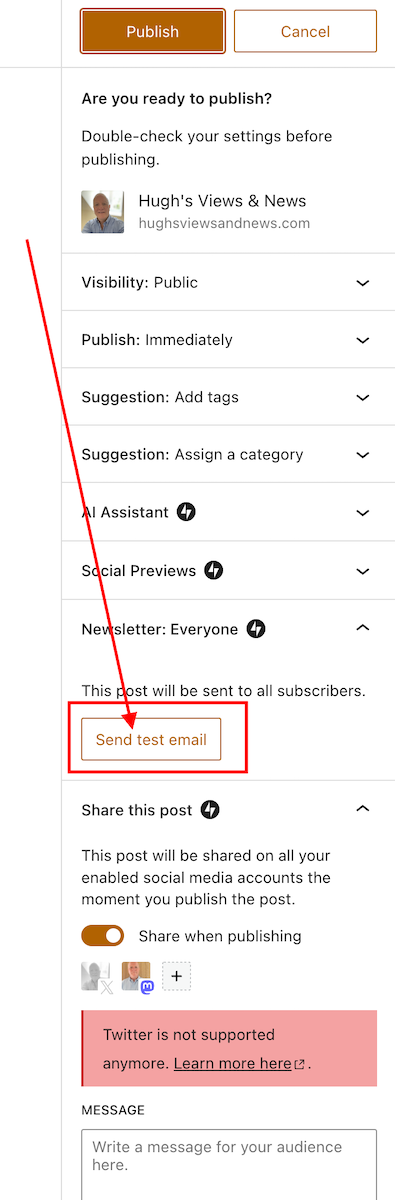
Send Test email.
I absolutely love this new feature! It’s incredibly handy because not only do I get to double-check my email notifications for my new blog posts before hitting the publish button, but it also serves as a safety net to ensure that my blog post is flawless and error-free. This is a game-changer for me!
Note – this feature may not be available to WordPress free plan users.
Before scheduling or publishing a new blog post, click the ‘Send test email‘ button, and WordPress will send you an email showing the excerpt and a link to the post.
Where can I find the ‘Send test email’ button?
Under the ‘Publish‘ settings of the draft of your post. Ensure you open the ‘Newsletter: Everyone‘ section to see it.
Here’s a screenshot.
Send test emails for all your WordPress new post notifications.
Not only can you check that the excerpt of your blog post is correct, but you can also click the link within the email to open the post and verify that everything is as it should be.
So, no more –
Missing images
Uncentred captions
Upsidedown images
Misplaced images
Images and text overlapping
Missing blog post titles
Missing headings
Missing words
Spelling mistakes
Forgetting to close comments
Broken videos or YouTube links
Broken links/pingbacks
Of course, spelling and grammar mistakes may still appear, but at least you now have another way of checking and editing a post before it’s published.
A new way to showcase previous blog posts.
Most bloggers like to showcase previous blog posts so those who missed them the first time can catch up.
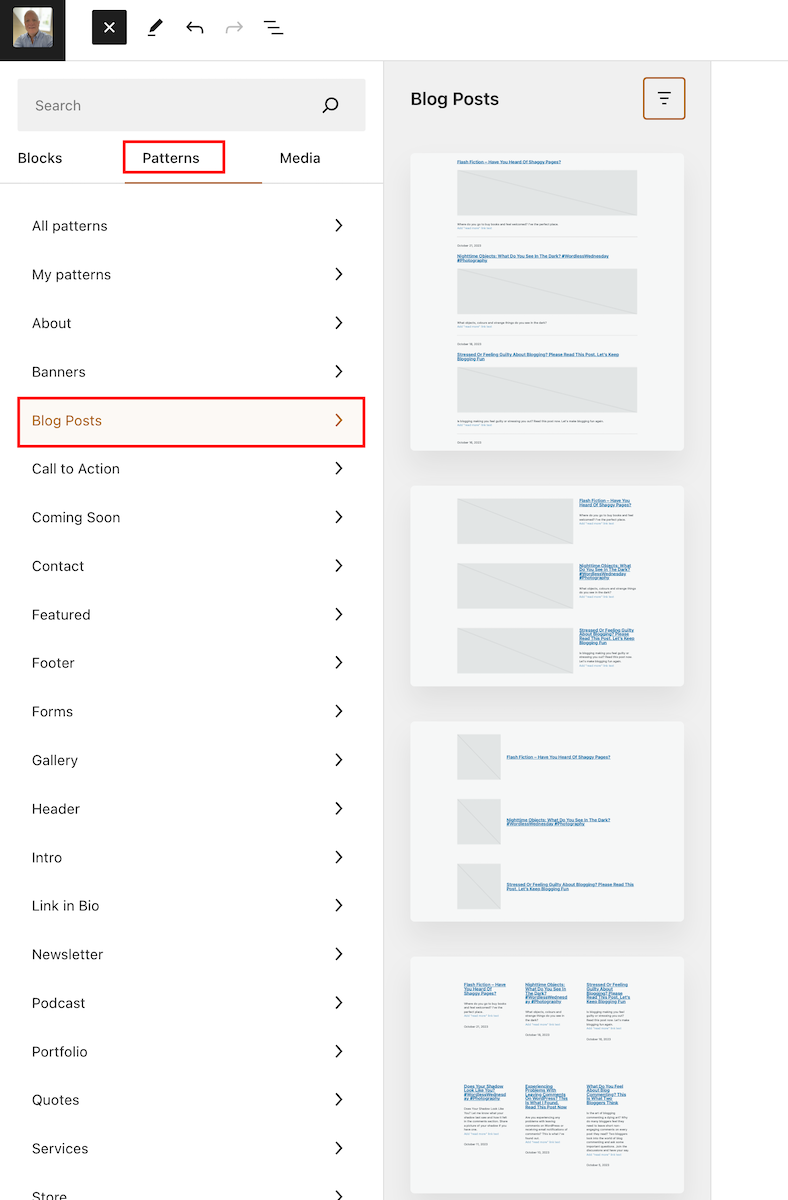
There are various ways to promote older blog posts on newly published posts. This is a new blog post template that WordPress has added to ‘Patterns‘ to help promote previous posts. In fact, WordPress has added lots of new ‘Blog Post’ templates. Here’s one I selected.
WordPress enables bloggers to add or remove snowfall effects on their posts during the festive season. But how do you toggle this feature on or off? My post contains all the details.
Where can I find Blog Post templates?
On a draft post, click the ‘+‘ symbol to add a new block and select ‘Patterns.’
On the menu that opens, click on ‘Blog Posts‘ and select from the many templates on offer.
Select a ‘blog posts’ template from the many on offer.
You can also select the ‘Blog Posts’ block for the same job.
Each template has many settings you can play around with. For example, I set the template I displayed above to two rather than three columns (displays as one column when viewing on a mobile phone). You can also change the background colour and text colour of the template.
On the template I used, up to six posts can be displayed, with new blog posts added as you publish them.
Unfortunately, I could not find a way of choosing which blog posts I wanted to feature in the template I chose, but some of the templates allow you to do this.
The one drawback I have noticed about my chosen template is the inability to set links to open in a new tab. As a result, users clicking on any of the links will lose their current page. To address this issue, I highly recommend including the ‘Blog Post Template‘ at the end of each post. This way, readers can easily navigate to related content without losing their place on the page.
Where did all my reusable blocks go?
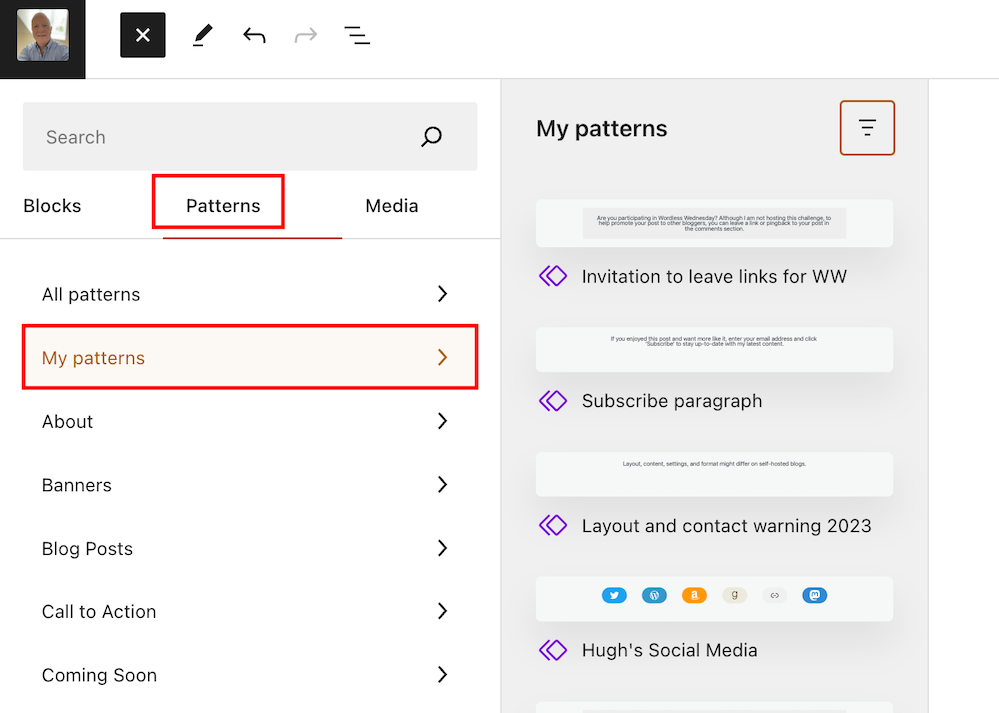
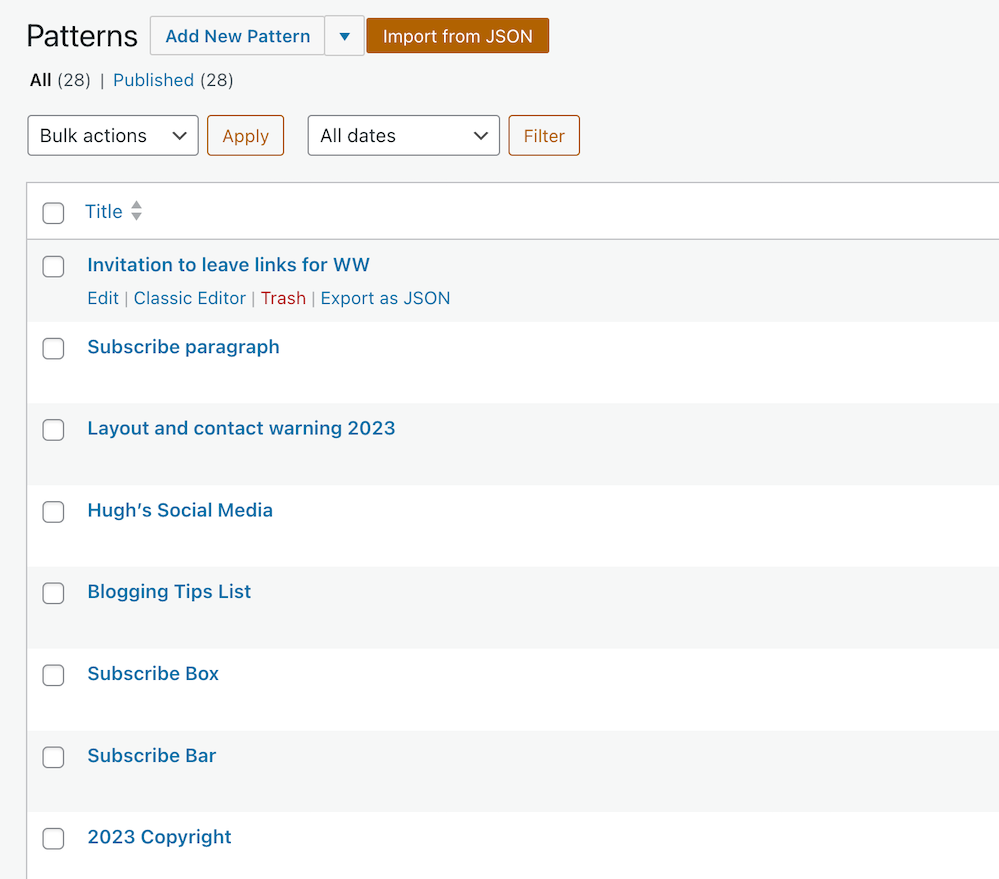
Synced patterns have replaced Reusable blocks, offering a unified creation experience for new pattern functionality on WordPress. Any reusable blocks you’ve created for your blog can now be found under ‘Patterns.’
Ensure you view your blog’s dashboard in ‘Classic‘ view. When writing this post, it won’t work when viewing in ‘Default‘ view (WordPress are aware of the problem).
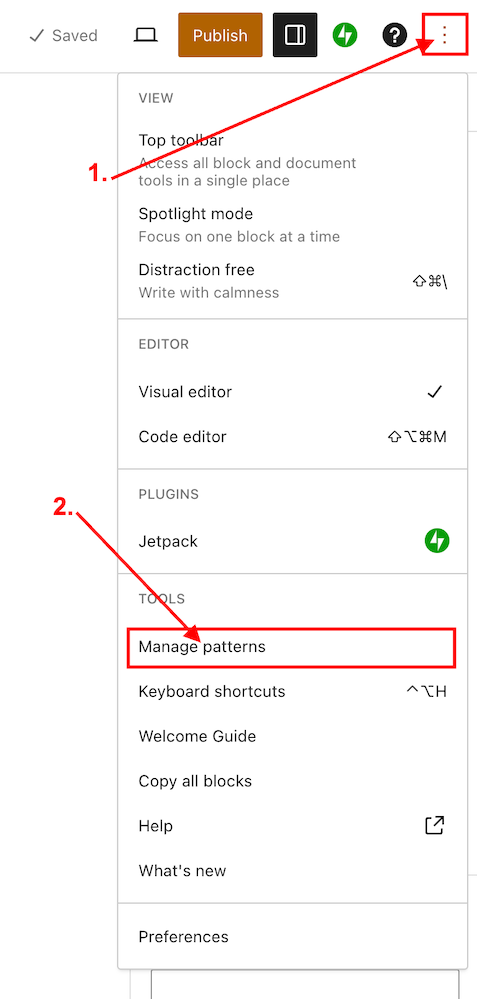
On the draft page of a post, click the three dots (options button) in the top right-hand corner of the page.
Click ‘Manage Patterns‘ in the new menu that opens.
Click ‘Manage Patterns’ to manage reusable blocks.
A page will open that lists all your reusable blocks. This is where you can edit or delete them.
A list of reusable blocks
IMPORTANT NOTICE – Please exercise caution when deleting a reusable block that has been previously used in your posts. Deleting a reusable block will result in its disappearance from all associated posts, and a notification will be displayed indicating that the block is no longer available. It is crucial to be mindful of this consequence to avoid any unintended disruptions to your content.
Have you explored any valuable new features on WordPress, or are you already utilising the ones I’ve mentioned? Are reusable blocks an essential part of your workflow? Feel free to share your thoughts in the comments section,and don’t hesitate to ask any questions.
Layout, content, settings, and format might differ on self-hosted blogs.
Follow Hugh on his social media platforms by clicking the buttons below.
I’ve written about comments a lot over the last few months, so this seems like the ideal opportunity to discuss some problems with commenting on WordPress.
First, I want to discuss a problem with getting email notifications from WordPress whenever comments are left on my blog posts.
Are you experiencing any of these problems with comments on WordPress?
I’ve stopped getting email notifications whenever anyone comments on one of my posts, so I have had to revert to checking for new comments on my blog’s dashboard.
It’s not a huge problem, but the email notifications act as a backup, so I know when comments have been left, and they also serve as a reminder that I have comments to respond to. I don’t delete an email notification until I’ve replied to a comment. That way, I don’t miss any.
I reported the problem on the WordPress Forum. That was over two weeks ago, and whilst I’ve had a lot of contact from WordPress staff, the problem is currently with their developers.
Is anybody else having problems getting email notifications of comments left on their blog posts? Or is it just me?
I’ve also reported another issue to WordPress. I’m wondering if any of the following are happening to you when leaving comments on other blogs?
Other problems with commenting.
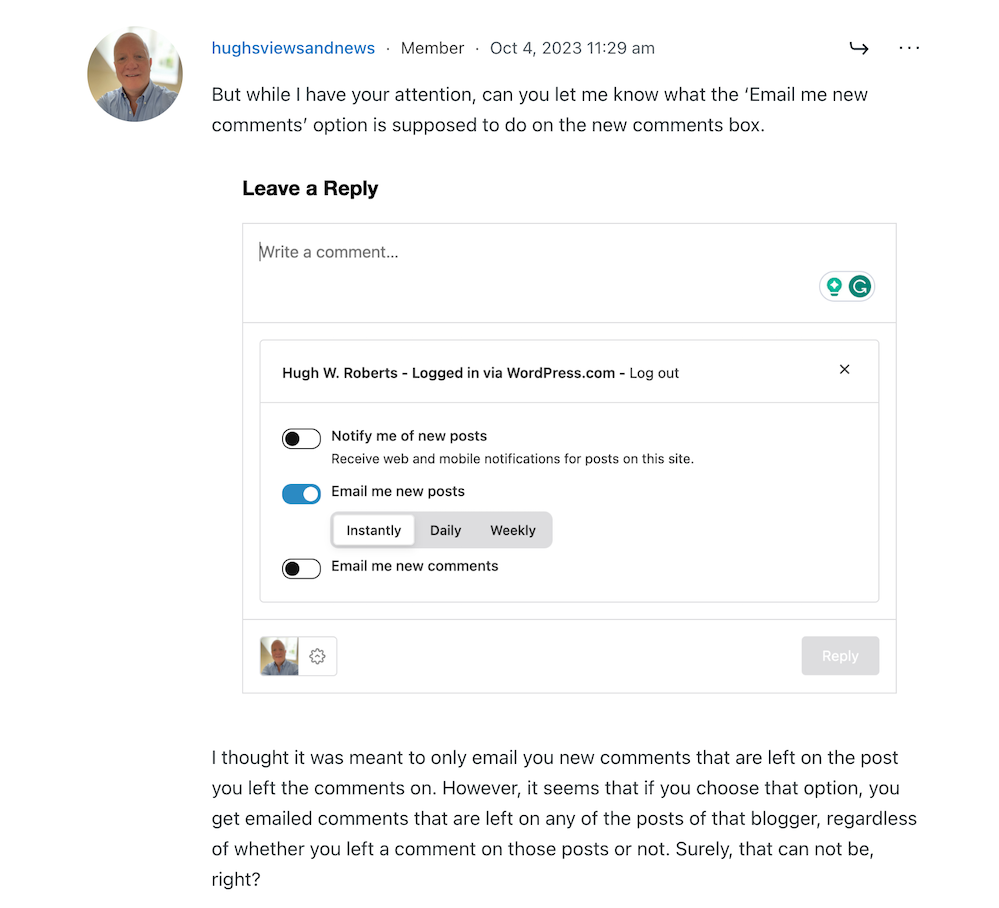
Have you noticed that the comments box on WordPress has changed? The old comments box has been replaced with a new one (see the following image), but it seems to be causing me a few problems.
Have you noticed the new comments box on WordPress?
The above new style comments box has gradually been introduced to most blogs on WordPress.
You can write a comment, press the reply button, and move on pretty swiftly, but my concerns are with something hidden behind the settings (cog) button next to the icon that displays your Gravatar image. When you press the cog, you’ll see this.
There are three options to choose from in the new-look comments box.
See those three new options at the bottom of the comments box? Not only can you now get web and phone notifications of new blog posts from the blog you’re leaving a comment on, but you can set how often you get notifications of new posts.
These are not new, though. They’ve been available for use on WordPress for a long time but were buried deep in our blogs’ dashboard settings. Now, they’re much easier to find and use.
So far, so good, you may think, but it’s the ‘email me new comments‘ button that is causing me concern.
You see, I’m one of those bloggers who like to receive an email whenever anyone replies to a comment I’ve left on their blog or when anyone else leaves a comment on the post I’ve already commented on. It’s my way of knowing that not only have they responded to my comment but also a way for me to either reply to or ‘like’ the comment. I do not like the thought of any blogger thinking I’ve ignored their comment.
The problem now is that when you slide the ‘email me new comments‘ button on, not only do you get emailed comments for the posts you’ve left comments on, but you’ll get email notifications of any comment left on any of the posts on that blog regardless of whether you left a comment or not.
If the blog you’ve left a comment on is huge and gets hundreds of comments, this could become a big problem with your email box filling up quickly.
Needless to say, that is something I do want. I only want email notifications of comments left on the posts I left a comment on. Why? Well, I find that reading comments can sometimes be as interesting as the post they’re left on, plus comments often give me new ideas for blog posts.
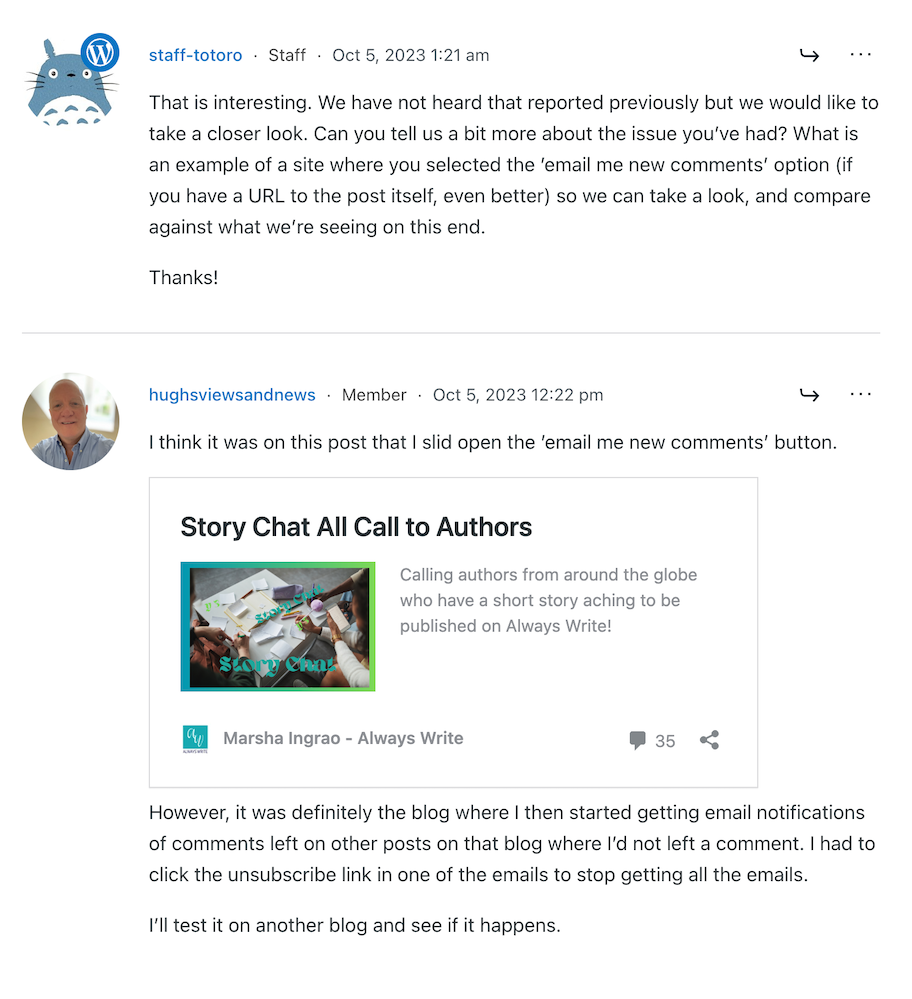
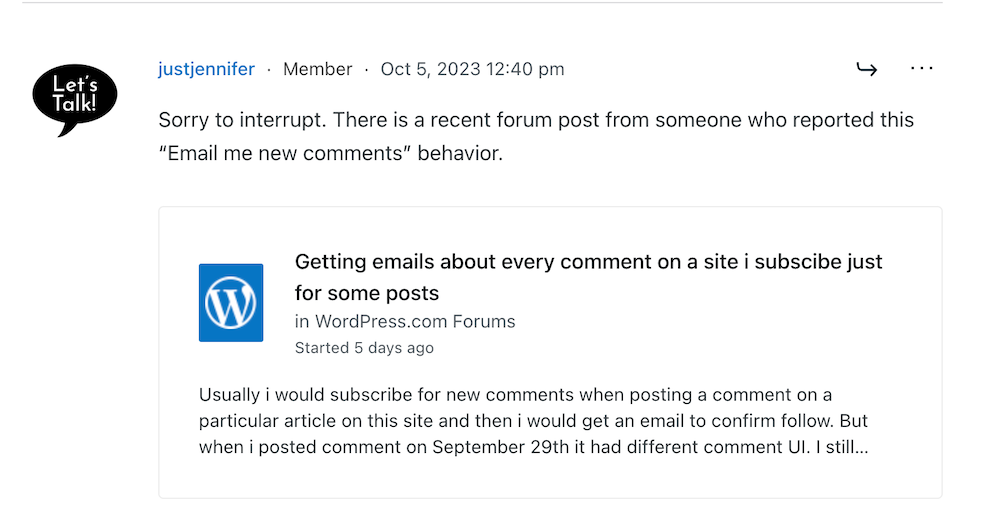
I’ve reported the issue to WordPress, and they’ve replied. See the screenshots below. However, I’m not the only one who reported this particular problem.
Somebody else has reported the same problem.
A response from a member of staff at WordPress
That was the last response from WordPress, but I’ll update this post with any developments.
Some good news – My spam box is empty!
Is it only me, or has anyone else seen a drastic reduction in spam since the new comment box appeared? I used to get hundreds of spam messages to scroll through every day, but now my spam box is empty almost every day – hooray!
So, there is no need to close comments off posts anymore if WordPress has waved a magic wand and stopped the spam once and for all. Hooray – that means I can leave comments on blog posts that are more than a month old.
Are you having any of the problems described in this post or any issues with leaving comments or receiving WordPress notifications as a whole? Has the amount of spam you’re getting plummeted? Let me know in the comments section.
Follow Hugh on Social Media. Click on the links below.
I’ve published many posts about the perils of using copyrighted images and photos. Several bloggers I know have been fined for downloading copyrighted images and photos, including when they reblogged posts.
Did you know that WordPress offers free, high-quality images and photos to enhance the visual appeal of your WordPress website or blog?
You’re searching for the right image for your new blog post. Rather than doing a Google search in a separate tab — and running the risk of using an image you don’t have rights to — use the free images and photos WordPress offers.
Did you know that WordPress offers users free photos and images?
To avoid any chances of being fined for using copyrighted images and photos, the best advice is to always try and use your own photos and images in your blog posts.
Of course, you could choose not to include any images or photos, but given that posts that include photos or images get 70% more traffic, you should add at least one image or photo to all your blog posts.
Where Do I Find The Free Images And Photos WordPress Offers?
Add an Image block to your blog post.
Click on the ‘Select Image‘ link to open a new menu.
The free images and photos are under ‘Pexels Free Photos‘ and ‘Openverse‘.
WordPress offers hundreds of free images and photos to all WordPress users.
Pexels Free Photos
When you click Pexels Free Photos, a new window will open that includes a search bar.
Add a description of the image or photo you are looking for in the search bar and click the ‘Search‘ button.
Look through the results, click the image you want to use and click the ‘Select‘ button.
Click the ‘Load More‘ button at the bottom of the page to see more results.
When you select an image from Pexels Free Photos, it is downloaded to your media library. Remember to add information about the image to help readers with sight impediments and who may use speech software on their devices.
WordPress will have already completed the title of the image or photo and added credit details, so the only information you need to add is Alt Text and Description.
Openverse
Openverse works like Pexels Free Photos. It’s a search engine for openly licensed media, which gives access to over 600 million Creative Commons licensed and public domain image and audio files. All files can be used free of charge.
You can use the search box to find content licensed for commercial use and content that may be modified.
If you use any images or photos from Openverse, they are downloaded to your media library. You’ll need to complete the Alt Text and Description boxes, giving the image/photo details.
It’s Not Only WordPress That Offers Free Images And Photos.
Several websites offer free images that you can use on your WordPress website. These websites curate collections of high-quality images that are free to use, often under various Creative Commons licenses. Here are some popular websites you can explore:
Review and respect the license terms associated with each image when using images from these sites. Providing proper attribution to the photographer or the source is always good practice.
WordPress Plugins
Another convenient way to find free images within your WordPress editor is by using plugins specifically designed for this purpose. These plugins integrate with popular free image websites, allowing you to search and insert images directly from your WordPress dashboard.
Some notable plugins for finding free images include:
Installing and activating these plugins will add additional options to your media library, making browsing and selecting free images for your content effortless.
Note: Plugins are not available on all WordPress plans.
Image SEO Best Practices
While finding free images for your WordPress blog is essential, optimising any images or photos you use for search engines is equally crucial. Following some basic image SEO best practices can improve your blog’s visibility and attract more organic traffic. Here are a few tips:
Use descriptive filenames and alt tags that reflect the image content.
Optimise image file sizes to improve site loading speed.
Add relevant captions and descriptions to provide more context.
Ensure images are responsive and look good on all devices.
By incorporating these strategies, you enhance the visual appeal of your content while improving your blog’s overall SEO performance.
Let’s Wrap It Up.
Finding free images and photos for your WordPress website or blog is easier than ever.
Whether you explore the WordPress options, leverage free image websites, or use dedicated plugins, the possibilities are abundant.
Adhering to image licensing requirements and optimising your images for SEO will ensure a visually appealing and optimised blog.
So go ahead and utilise the resources available to you, and make your WordPress blog shine with stunning images that complement your content!
Remember, a picture is worth a thousand words.
Disclaimer: Always review and respect each image’s terms and conditions and licensing rights. The information provided in this article is for educational purposes only and should not be considered legal advice.
Where do you get the images and photos you use on your blog? If you have any questions about using free images and photos on your blog, leave them in the comments section. Alternatively, please join the discussion and conversation if you’d like to add any information about using free images and photos.
Layout, content, settings, and format might differ on self-hosted blogs.
Follow Hugh on his social media platforms by clicking the buttons below.
Have you seen images and photos in the comments section of blog posts and wondered how they were left there? It’s something I’ve written about before and, given the many changes at WordPress since I last wrote about it, deserves an update.
Yes, it’s possible to leave photos and images in comments on WordPress blogs
When it comes to adding images and photos to comments, we have to be careful with what we add. We should always ensure the photo or image has a connection to the subject of the post we’re leaving the comment on. And not only that.
If a blogger invites readers to leave photos and images (such as in a photography challenge), then go ahead and leave them.
However, leaving an image or photo just for the sake of doing so is frowned upon by many bloggers, who will mark them as spam. And given that blogs are attacked by spammers daily, I don’t blame bloggers marking uninvited images and photos as spam.
I’ve added images and photos to the comments sections on my blog posts and the comments I have left on the blogs of other bloggers. However, unless I’ve been invited to leave an image or photo, I won’t leave them.
While many bloggers will be happy for you to leave images and photos, it’s always polite to ask first.
How to add images and photos to your comments
Add the image or photo to your WordPress media library.
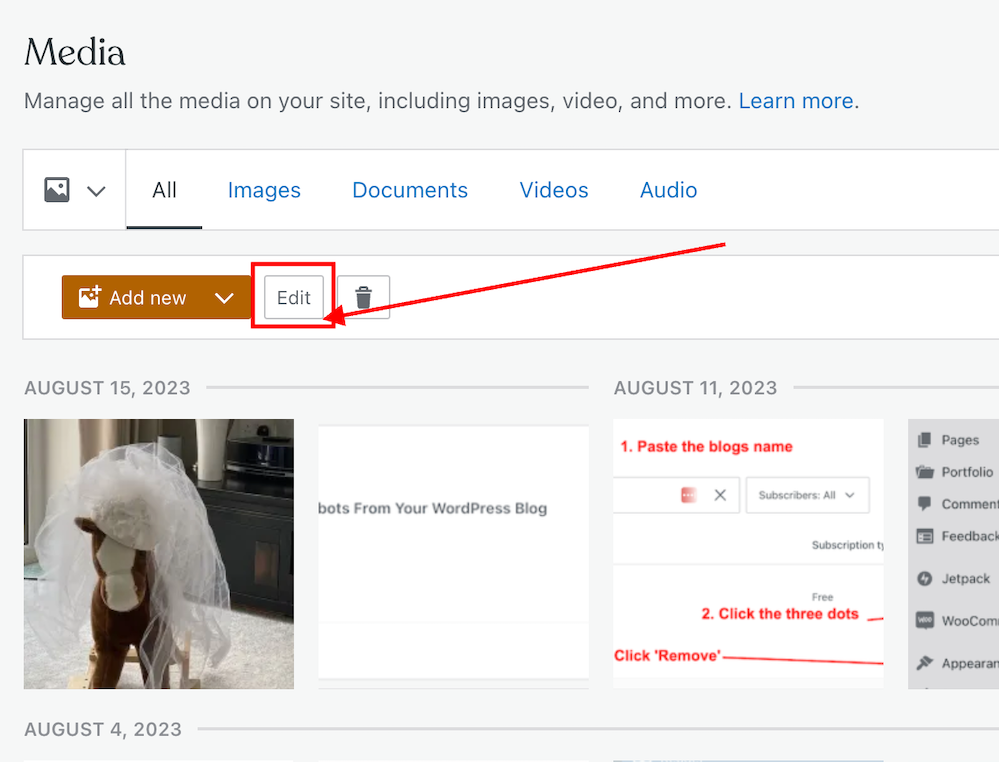
Once the image has been added, click it and click the edit button to open it.
Click the edit button of the photo or image you want to add to a comment.
On the righthand side of the screen, you’ll see a window where you can add details about your image. It’s important to complete these details (see the image below).
Click the ‘Copy‘ button in the URL box.
Copy the URL address of the image or photo.
Paste the URL address into your comment.
Do not, at this stage, submit your comment as you need to edit one part of the text within the link.
Carefully delete the ‘s‘ from the ‘https‘ at the beginning of the link address, so it reads ‘http‘. (If you do not delete the ‘s‘ the image will not show in the comment).
Ensure your link ends with ‘.png’ or ‘.jpg’. If it doesn’t, delete any text after ‘.png’ or ‘.jpg’.
You can now submit your comment.
The image will now show on the comment. However, remember that if you are leaving an image in a comment on another blogger’s blog, they may have to approve it (and may even remove the link to the image) before it shows up.
I’ve only found this to work on WordPress.Com blogs. On self-hosted blogs, only the link to the image is visible rather than the image appearing. However, those clicking on the link will see the image.
Note – Not all images and photos will show if the security settings on your web browser are set high. However, this does not affect the photos or pictures you leave in the comments of your own blog posts. I recommend that you not change the security settings on your web browser.
Let’s wrap it up.
Yes, it is possible to insert images and photos into comments on WordPress.
After inserting the URL address of the image, ensure you remove the ‘s‘ from the beginning of the URL so that ‘https’ becomes ‘http.’
Only leave images and photos in comments if invited to do so or if you have asked for permission to do so first.
If the security settings on your web browser are set high, images and photos may not show. However, this does not affect the photos or pictures you leave in the comments of your own blog posts.
Want to give inserting an image or photo into a comment a go?
Leave me a comment with the link to your image. Perhaps it can be a photo of your latest book cover or of a family pet. I’ll leave it up to you, but only family-friendly images and photos, please.
If you have any further questions about inserting images or photos into the comments, leave them in the comments section.
Layout, content, settings, and format might differ on self-hosted blogs.
Follow Hugh on social media. Click the buttons below.
Is your blog plagued by spam, spammers and spambots? Do they annoy you? Do you know they’re even there and the damage they could be doing?
Allowing spammers and spambots to follow your blog makes it easier for them to attempt to flood your blog with spam comments. In turn, this opens the floodgates to your readers becoming the victims of scams or having their computer, tablet or phone infected with malware.
Is your blog infected with spammers and spambots?
There are many different types of spammers in the blog world. From those who leave uninvited links, those who flood your posts with pleas to check out their blog and follow them, and comments from spambots; they can all be a nuisance.
Some spammers are easy to spot. The clues are in their name.
The name of some spammers gives them a way straight away.
Some spammers try a little harder to trick you.
Always check the web address of where a comment has come from.
The above comment may sound genuine, but just look at the web address where it’s come from.
I’ve witnessed some bloggers approve and respond to the comments from these spambots. The comments look genuine, but they’re not. Here’s an example of a spam comment from one of the dog breeders.
Comment from a dog breeders spambot
Approving and allowing comments from spammers and spambots onto your blog posts will damage the ranking of your blog. It may also end up resulting in genuine readers clicking on links in comments or visiting the sites of these scammers resulting in them becoming victims of scams or having their computer infected with malware.
These spammers often leave messages on posts that look authentic and nice, but they never mention anything about the contents of the posts (other than saying they like them) and often trick bloggers into believing they are genuine.
Spammers who follow your blog will also click the ‘like’ button on all your posts in the hope that other readers will see their gravatar icon, and visit their site. Once there, the reader puts themselves in danger of being scammed or having their device infected.
How Do You Spot Comments From Scammers and Spambot?
WordPress has recently improved the subscribers’ page of a blog. Not only has this helped spotting spammers and spambots, but it’s easy to remove them as subscribers to your blog.
Here’s a screenshot of a comment from a spambot. I’ve highlighted the spammers name for instructions on how to unsubscribe them from following your blog further down in this post.
Make sure you remove spammers from following your blog.
The Akismet Anti-Spam software that WordPress provides is excellent at dealing with spam, but it doesn’t catch it all.
Comments from spammers rarely have an image in their Gravatar, but spammers are now getting clever and inserting an image in their profile (like the one in the previous image).
Here’s how to spot, check and remove spammers and spambots as subscribers to your blog.
Make sure you are viewing your blog’s dashboard in ‘Default‘ view.
Copy the name of the spammers blog.
On your blog’s dashboard, go to ‘Users‘ – ‘Subscribers.’
Click Users – Subscribers
On the ‘Subscribers‘ page you’re taken to, paste the spammers blog’s name in the ‘search box.’
If the spammer is following your blog, their name will show in the results.
Click the three dots next to the blog you want to remove.
Click the ‘Remove‘ button to unsubscribe the blog from following you.
How to remove a spammer from following your blog.
The spammer has now been unsubscribed from following your blog.
Spammers who follow your blog are more likely to try and flood your blog posts with spam comments because they get notifications when you publish new posts. You can mark any such comments as spam, but I’d recommend you unsubscribe them from following your blog.
Of course, there is nothing stopping spammers from subscribing to your blog again, but every time they follow, unsubscribe them. As I have found out with those dog breeder spammers, they soon get fed up of having to keep subscribing to your blog.
Let’s Wrap It Up
Don’t allow spammers, scammers or spambots invade your blog or stress you out.
Spotting spammers, scammers and spambots is easy to do. Follow the guide in this post.
Never approve or respond to spam comments.
If you’re unsure a comment is from a spammer, check out their website address first.
Always unsubscribe spammers, scammers and spambots from your blog. Follow the guide in this post.
Although the Akismet Anti-Spam software that WordPress provides catches the majority of spam, it won’t catch all of it.
Approving and allowing comments from spammers and spambots onto your blog posts will damage the ranking of your blog. It may also end up resulting in genuine readers clicking on the links in their comments or visiting their website and becoming a victim of scams or having their computer infected with malware.
Look after your readers, not the spammers, scammers or spambots.
How do you deal with spam, spammers and spambots on your blog?Share details in the comments section.
Layout, content, settings, and format might differ on self-hosted blogs.
Follow Hugh on social media. Click the buttons below.
Have you noticed the three horizontal dots next to your blog posts when viewing the ‘Posts‘ page of your blog’s dashboard on WordPress? If not, you’re missing out on some useful tools that will help save you time when blogging and make your blog posts appeal to even more readers.
Have you discovered these 9 hidden blogging tools on WordPress?
For the purpose of this post, I’m viewing my blog’s dashboard in ‘Default‘ view.
These three horizontal dots are known by numerous names, my favourite being a ‘Meatball Menu.’
Not sure what I’m referring to? Here’s a screenshot pointing out the meatball menu on the dashboard of the posts page of my blog.
The Meatball Menu.
When you click on the meatball menu against a post, the three horizontal dots change to three vertical dots (known as a kebab Menu), and nine options appear.
Let’s investigate each option.
Edit
Click this button to edit or update a post. Useful when spotting mistakes. Don’t forget to press the Update button to save any changes you make.
View
This button does more than just show a preview of your post. It also offers the option of previewing the post as it appears on a desktop computer, tablet and phone. You should always preview your posts before publishing them.
See your post in desktop, tablet and phone form.
The Search & Social button (at the bottom of the menu) allows you to preview your post as it appears on Facebook, Twitter (now known as X), and a Google search.
I recommend you always preview your post first to ensure they are mobile-friendly, especially given that most people now read blog posts on tablets and phones.
Promote With Blaze
Blaze is a way to pay to have a post advertised by WordPress, putting it in front of thousands of new readers.
You can advertise a post or page on some of the millions of pages across WordPress.com and Tumblr from $5 per day. This option is not available to bloggers who have a free WordPress plan.
Stats
Click ‘Stats‘ to check a post’s latest daily, weekly, monthly, and yearly stats.
For some WordPress plans, you can view a post’s stats for emails opened and how many people who got the email clicked the link to view the post.
You can also view who clicked the ‘like‘ button on the post and how often ‘like‘ has been clicked.
What’s behind the ‘Stats’ option?
Under ‘Post Likes‘, hover your mouse over any of the profile icons to display the blog name of the blogger.
Click on an icon to view a list of that blogger’s blog posts, how many posts they have published, how many followers they have, a list of their most popular tags, and a follow button (WordPress.Com bloggers only). This is a great way to find new blogs to follow.
If you’re already following a blogger who has clicked ‘like‘, the ‘follow‘ button will be replaced with the word ‘following.’
Are you following somebody who clicked ‘like’ on your post?
To unfollow, click the ‘Following‘ button.
Comments
View all the comments that have been left on a post.
Along the top, you can view the following information for a post.
The number of comments it has received.
The number of comments that are pending (waiting for approval).
The number of comments that have been approved.
The number of comments you or WordPress have marked as spam.
The number of comments that have been sent to the trash folder.
Your replies to comments also show on this page.
You can also sort comments by newest first and oldest first.
With just one click, the ‘bulk edit‘ button allows you to perform a command (approve, un-approve, send to spam, send to trash). However, the ‘bulk edit‘ is only done per page, so if the post has many comments, you’ll need to bulk edit each page.
An easier way to view comments on a post.
You can also perform the following under the comments link –
View the post.
Approve a comment.
Mark and send a comment to the spam folder.
Send a comment to the trash bin.
Like a comment.
Edit a comment.
Reply to a comment.
To the right of each comment is a ‘User Info‘ button. Clicking on this button reveals the following information.
The name of the commenter’s WordPress blog.
The commenter’s email address.
A link to the commenter’s blog/website.
The IP address of the commenter.
You’ll also see a ‘Block User‘ button when clicking ‘User Info.’ If you press ‘Block User,’ any further comments from that user on any of your blog posts are sent directly to your WordPress trash folder.
Share
This neat button allows you to auto-share details of the post to the social media accounts WordPress have an auto-share facility with which you have connected to your blog.
Click on the ‘Share Post‘ button to share the post.
You can also manage all your social media auto-share connections by clicking on ‘Manage Connections.’
Copy Post
This is my favourite of all the options on the kebab menu.
Not only will clicking on this button duplicate your post, but the categories and tags of the post are also copied over.
This is especially beneficial if you run a daily/weekly/monthly blog challenge, series, or promotional posts on your blog.
It’s saved me lots of time by not copying, pasting, or redoing links, images, text, tags, and categories.
I also use the ‘copy post‘ function for posts with the same layout (such as my ‘Wordless Wednesday’ posts.
However, if you write excerpts for your blog posts (and I recommend you do), remember to change the excerpt before publishing the post. Otherwise, the excerpt may not make sense.
Copy Link
A link to the post is copied to the clipboard of the device you are using. You can paste the link into an email, message, website, blog post, comment, etc.
Trash
Clicking this button will send your post to the trash folder.
You can reinstate the post from the trash folder if you accidentally clicked it.
Let’s wrap things up.
There are nine hidden options available to WordPress.Com users on the page that displays their blog posts (and pages).
The options are hidden behind a menu known as a meatball menu.
The meatball menu opens up a kebab menu listing all available options.
Some of the options do exactly as they say on the can.
However, other options lead to lots more options and functions.
The comments option has a hidden ‘Block User‘ button – great for blocking comments from spammers or those you don’t want leaving comments anymore.
No need to copy and paste – The copy option copies an existing blog post and copies over the categories, tags and any images you have on that post, saving you lots of time.
It’s worth checking out all the options, especially as some are time-saving functions.
I hope you have found this post useful. If you have any questions, please leave them in the comments section.
Layout, content, settings, and format might differ on self-hosted blogs.
Follow Hugh on social media. Click the buttons below.
Who do you blame when something goes wrong with your blog?
Most of us will probably blame WordPress, yet have you ever thought that the problem could be that the theme of your blog is to blame because you’ve never changed it and it’s been retired?
Is your blog’s theme causing the problems you’re experiencing with your blog?
Many problems can arise on blogs when a theme has been retired.
How Do I Find Out If The Theme I’m Using Has Been Retired?
You’ll see the following image on the themes page of your blog.
Has your theme been retired?
Go to your blog’s dashboard and click Appearance – Themes to determine if your chosen theme has been retired.
Can I Still Use My Retired Theme?
Yes, you can. WordPress won’t remove it from your site. However, when a theme is retired, it no longer appears in the list of themes available on WordPress.
Your retired theme may remain available for the lifetime of your site or blog, but it will no longer be fully supported by WordPress. It won’t receive any updates with new features; hence WordPress won’t guarantee it will always function correctly with their ever-evolving software. If anything goes wrong, it may not be possible to fix it.
You can still contact WordPress support so the Happiness Engineers can take a look, but support will be limited, and they’ll probably recommend switching to a newer theme. In addition, they won’t provide any CSS support for the retired theme.
Why Do Themes Get Retired?
Web technology updates make the visibility and functionality of some themes outdated.
Web design is an area that is continually evolving, thanks to trends, tastes, and new technologies. WordPress has to keep up to date with these changes and is at the forefront of wanting blogs to look fresh and modern.
Retired themes can make blogs look outdated, stale, and uninviting to visitors, especially if you’ve never changed your theme since starting to blog.
Themes may also be retired if their design has become old-fashioned or uses certain no longer supported features.
What Should I Do If The Theme I Am Using Is Retired?
You can continue to use it, but it may no longer be possible for WordPress to fix any issues you encounter.
Some of the issues I have found with blogs that are still using retired themes are –
I can no longer leave comments.
Pingback to the blog no longer work.
Pingbacks from the blog no longer work.
The gravatar image is no longer displayed.
The ‘Notify me of new comments via email’ box is missing.
Pressing the ‘like’ button no longer works.
New blog posts do not appear on the WordPress Reader.
Blog posts are no longer mobile or tablet-friendly.
Comments do not display correctly.
Images, photos and paragraphs do not display correctly.
Sharing buttons no longer work correctly.
In all cases, when I’ve checked the blog’s theme when these problems have happened, it’s an old, retired theme.
Some bloggers find workarounds when problems occur, but all this does is put off the inevitable that one day they will have to change the theme.
My recommended advice is to consider switching to a new theme to ensure your blog has a modern look and feel to its design.
If you’re not bothered about parts of your blog being broken, you may wish to continue using it until you are forced to change the theme. However, that’s not something I recommend.
Not only can finding a new theme be fun, but it can also boost your blog’s ranking.
How Do I Find A New Theme?
On the dashboard of your blog, go to Appearance – Themes. You’ll see all the WordPress themes available. For free themes, click the ‘Free‘ button in the top-right of the page.
You can also use the search field on the themes page to find a replacement theme. Click on the filter options below the search bar or type directly into the search field to filter by specific features or subjects or by the number of columns the theme natively displays to select a new theme similar to your retired theme.
Block Themes Vs Classic Themes
Block (or Full-Site Editing) themes are the new boys on the block.
WordPress recommends switching to a Block theme, as these are the future and what will be supported in the long term.
I have heard of some bloggers encountering problems switching to Block themes. It’s a long learning curve to get used to them, but WordPress has plenty of advice and help for switching to one.
Some bloggers who have already made the switch have reported that not only do their blogs run faster after switching to a Block theme, but problems they were experiencing with their blogs also disappear.
I recommend watching WordPress tutorial videos and reading their guidance page before switching to a Block theme. For information, click the links below.
Contact the WordPress Happiness Engineers by clicking on the ‘question mark’ icon (next to the ‘bell’ notification icon) in the top right of your blog’s dashboard.
Ask for help from your followers and other bloggers by writing and publishing a post or contacting a blogger directly.
Important Information: Do not activate a new theme unless you are absolulty sure you like the theme you have chosen, as it’s impossible to go back to a retired theme once you’ve activated a new theme.
Classic themes were created to work with the old Classic editor, but with the large drop in Classic editor users, WordPress has been retiring them, especially when they no longer work with new functionality software or when updates to the WordPress platform have been released.
Unlike Block themes, Classic themes are heavily loaded with CSS code, meaning many things can go wrong. Block themes are only lightly loaded with CSS code, so are less likely to break.
Currently, WordPress provides 54 Classic themes that are free to use and compatible with the Block editor.
To find current Classic themes, search for them by adding ‘Classic‘ to the search bar on the Themes page, and select ‘Classic Theme‘ from the dropdown menu that appears.
If the theme you’re currently using has been retired, I recommend you switch to one of the Classic themes if you do not want to switch to a Block theme. Doing this will fix some or all of the problems your blog may be experiencing.
If you still experience problems after switching to a current Classic (or Block) theme, report the problems to WordPress. How will WordPress know about a problem unless you report it? Don’t rely on other users reporting the problems you’re having with your blog.
Does WordPress have any plans for new Classic themes?
I asked WordPress the above question. Their response was –
‘No, and we doubt there will be as the industry shifts to the more modern and convenient Full Site Editing (Block) themes that remove most of the need to learn coding to create and customize your theme.’
Is WordPress retiring all Classic themes? If so, when?
Their response –
‘It’s likely, as the focus is shifted to the more modern approach. We do not have specific timelines for each theme or the ones available on our list at this moment.’
So I guess it’s a case of ‘watch this space.’
However, given that the Classic Editor plugin is still available, my guess is that WordPress will retain some of the Classic themes until they stop supporting the Classic Editor plugin. But the choice of Classic themes will become more and more limited as time passes.
I didn’t ask WordPress if there are any plans to stop supporting the Classic Editor plugin, although I have heard rumours that they plan to stop supporting it by the end of 2024.
Let’s wrap it up.
Problems may affect your blog because your theme has been retired.
WordPress may be able to fix some issues, but they will advise you to switch to a new theme if the theme you’re using is retired.
You can continue to use a retired theme you’re using, but it may not work correctly.
Once you activate a new theme, you won’t be able to go back to the retired theme you’ve been using.
Upon publication of this post, WordPress offers Full Site Editing (Block) and Classic themes.
All Classic themes are free to use.
There are no plans to introduce new Classic themes.
The number of available Classic themes will continue to diminish.
I’ve seen some bloggers say they will wait until they are forced to switch themes. Given that switching themes can be a complicated and time-consuming project, all that will do is make them panic when the time comes to switch. Don’t be one of them.
If the theme you’re using has been retired, switch now.
WordPress welcomes feedback on the new Block themes and encourages everyone to contact them with suggestions for improving them.
If you enjoyed this post and want more like it, enter your email address and click ‘Subscribe’ to stay up-to-date with my latest content.
To follow Hugh on social media, click the links below.
‘Help! I’ve run out of media storage space on my blog and can no longer upload new photos, images or videos. What can I do?’
That was a question to me from Micheal, who blogs at Spo-Reflections.
Michael was happy to upgrade his WordPress plan to obtain more media space, but there are other things you could do if you find your blog running out of media space.
Have you run out of media space on your blog? Here are 5 things you can do to obtain more.
1. Upgrade your plan.
WordPress currently offers 6 plans.
The amount of media storage space you get varies. Click the following link to see the plans – ‘There Is A Plan For You.’ Pricing is correct at the time of publication of this post.
Each plan provides the following media storage space.
Name of plan
Storage Amount
Free
1GB
Personal
6GB
Premium
13GB
Business
200GB
Commerce
200GB
Enterprise
N/A
However, only upgrade your WordPress plan if you absolutely need to. Do not get into debt by upgrading unless you can afford it, as there are other things you can do to free up media storage space.
2. Resize the size of your images and photos.
One of the biggest reasons bloggers run out of media space is that they do not resize their images and photos before uploading them to their media library.
There are several ways you can reduce the size of images and photos. You can reduce them using photo editing software or via the tools of your device you use to blog.
I use an Apple iMac and can change the size of photos and images by clicking on Tools – Adjust size on the menubar of my desktop computer. I do this before uploading them to my WordPress media library.
I recommend reducing image and photo sizes to 900 x 675 pixels.
On a Windows computer, you can use Microsoft Paint. Open your image with that program, then click on Resize. You can find this option on the middle-right side of the “Image” section at the top of the Paint window.
The WordPress media library also has editing software, but please note that if you reduce the size of an image or photo using this tool, the original image is kept in your media library when you reduce the size of the picture – thus, you won’t have freed up any storage space.
Large images can also slow down your blog’s downloading speed, negatively impacting your blog’s search engine rankings and overall user experience. So, I recommend you always reduce the size of images and photos before uploading them to your blog.
3. Do not upload videos to your media library.
If you include videos in your blog posts, uploading them to your media library can take up vast amounts of space.
To overcome this problem and free up all the space they take up, upload your videos to YouTube. Then add the YouTube block to your blog post and include the link to the video in the block.
Adding videos to your blog via YouTube helps free up media space for your blog.
Do this for any existing videos you have in your media library. Upload them to YouTube and add them via the YouTube block before deleting the original from your media library. This will free up large amounts of storage in your media library.
4. Delete images from your media library.
We can accumulate vast amounts of images and photos in our media library, many of which will become redundant.
Deleting these images will free up storage space. However, when you delete any images or photos in your media library, they disappear from the blog posts they appear on.
Deleting old, redundant blog posts containing images, photos, and videos frees up storage space. However, delete any images, photos and videos in your media library before deleting the posts.
5. Reduce the number of images and photos you add to blog posts.
While I recommend adding at least one image or photo to a blog post (because blog posts containing images get up to 70% more traffic), reducing the number of images and pictures will help save media space.
Before adding more images or photos, ask yourself if adding them to your post is necessary.
Let’s wrap it up.
Resize your images and photos before uploading them to your blog’s media library.
Upload videos to YouTube and use the YouTube block to show them on your blog posts.
Delete old images and photos from your media library, but remember to remove them from any posts first.
Do not resize images using tools in the media library, as this does not save storage space.
Consider deleting old blog posts that are no longer relevant.
Reduce the number of images and photos on blog posts. Ask yourself if they’re necessary.
How do you free up storage space in your blog’s media library? If you have any questions about this post, leave them in the comments section.
To follow Hugh on social media, click the links below.
Blog posts containing images and photos get up to 70% more traffic than posts without visuals. So why wouldn’t you use them in your posts?
Visual content is an essential component of any successful blog. Adding images, videos, and infographics to your blog posts can make your content more engaging and memorable.
Are you making any mistakes when adding images or photos to blog posts?
If you plan to include images or photos in your blog posts, there are four essential things to remember. These steps will help ensure your content is engaging and visually appealing while avoiding copyright issues.
1. Use High-Quality Images And Photos.
Always use high-quality images that are relevant to your post. Blurry or low-resolution images can detract from your message and make your blog appear unprofessional.
Additionally, using images that are not directly related to your topic can confuse readers and reduce the effectiveness of your post.
2. Ensure Images And Photos Are Not Copyrighted
Ensure you have permission to use any images and photos you include in your posts. This means sourcing images from websites offering free, non-copyrighted images (such as Pixabay) or purchasing the rights to use images from a stock photo website.
Not all images are free to use. And some that are free may only be free for a limited time. Always check the small print.
Don’t think you’ll ever get fined for using copyrighted images or photos. There are copyright bots continually looking for copyrighted images that have been illegally used and downloaded all over the web.
I know of two bloggers who have been fined for using images/photos on their blog posts that were not free to use.
To avoid copyright issues, use your own images and photos and watermark them before adding them to your blog posts. I use a free app called Photobulk to do this. Seeing a watermark is a great deterrent in persuading some thieves not to copy and use them.
Of course, if you’re not concerned about your photos and images being used by anybody else, you don’t need to watermark them.
3. Ensure Images And Photos Are The Correct Sizes.
Optimize your images for web use by compressing them to reduce file size.
Large images can slow down your website’s loading speed, negatively impacting your blog’s search engine rankings and overall user experience.
If you have limited space in your media library, not reducing the size of your images and photos will soon take up all your media space. When that happens, you won’t be allowed to download additional images to your blog unless you free up space or move to a plan that gives you more storage space.
I recommend reducing image and photo sizes to 900 x 675 pixels.
There are several ways you can reduce the size of images and photos. You can reduce them using photo editing software or your device’s software.
The WordPress media library also has editing software, but please note that if you reduce the size of an image or photo using this tool, the original image is kept in your media library when you reduce the size of the image- thus, you won’t save any storage space.
The newly edited image with the reduced size is added as a new file in your media library. You can always revert back to the original image by clicking on the image in the media library, selecting Edit, and then choosing the “Restore Original” button. If you’ve inserted an edited image into other published posts, reverting an image may break this image on those posts.
I use an Apple iMac and can change the size of photos and images by clicking on Tools – Adjust Size on the menubar of my desktop computer. I do this before adding them to my WordPress media library.
On a Windows computer, you can use Microsoft Paint. Open your image with that program, then click on Resize. You can find this option on the middle-right side of the “Image” section at the top of the Paint window.
However, as I mentioned earlier, you can also reduce the size of images and photos on WordPress. But only do this if your WordPress plan has a large storage space allowance.
To do this, ensure you view your media library in Classic view.
Click the editimage button on the image you want to edit.
Click the edit button.
Add the new dimensions in the Scale Image box and click the Scale button.
Add the new dimensions of your image.
Click the save or update button to save the changes.
Your photos and images will be reduced in size, but remember that a copy of the original is also kept, so you won’t save any storage space.
If posting to your site using the Jetpack App, the app can optimise images.
In the Jetpack app for iPhone, you can set the Max Image Upload Size so the original file is resized automatically when you upload it. This option can be found by going to My Site and clicking the profile icon in the top right, then choosing App Settings.
In the Jetpack app for Android, click on your profile icon in the top right corner and choose App Settings. There, enable Optimise Images to resize and compress images on upload.
4. Add information to your images and photos.
Don’t forget to include alt text and captions for your images.
Alt text is a description of the image that allows visually-impaired readers to understand what the image is conveying. At the same time, captions can add context and help readers engage with your content. This is especially important when participating in blog challenges such as Wordless Wednesday and Silent Sunday.
Always add information about your images and photos.
Adding a description of the image or photo also helps with SEO searches.
Click the save or update button to save all the changes.
Following these four essential steps, you can create visually stunning and engaging blog content with images that stand out.
Let’s wrap it up.
Always use high-quality images and photos on your blog.
Never use images and photos that are copyrighted. You may be fined for doing so.
Use your own images and photos. That way, you won’t encounter any copyright issues.
Reduce the size of images and photos before loading them to your blog.
Alternatively, reduce the size of images and photos with WordPress’s tools in the media library, but only if you have a WordPress plan that offers a large amount of storage.
Always add information about images and photos before adding them to blog posts, as this allows visually-impaired readers to understand what the image conveys.
Adding a description of the image or photo also helps with SEO searches.
What do you use to resize images and photos for your blog posts? Do you always complete the details of images and photos in the Alt Text box? If you have any questions about adding images and photos to your blog, please leave them in the comments section.
To follow Hugh on social media, click the links below.