The other day, I came across a wonderfully written blog post after clicking a link on Mastodon. But the trouble was that I seemed to be the first visitor to that blog, even though the post had been published in May 2023. But it didn’t end there.
Don’t do this with your blog.
I always find it sad to discover a well-written blog post over a few months old that has captivated me but generated no comments or likes. It’s like it’s been cut adrift, floating around in the deepest, darkest part of the blogging world, where few venture.
Yet there are blog posts I lose interest in after only reading the first few lines that have hundreds of likes and lots of comments.
Not all of those likes will have been generated by people who read the post, and I call many of the comments dead-end comments that fail to ignite any proper discussion.
What are the clues to an unwelcoming blog?
I couldn’t help but feel sorry for the blogger whose post I’d found via Mastodon. I wondered how they feel when they see other badly written posts that have generated lots of likes and comments.
Of course, just because a post has no comments and nobody has clicked the like button doesn’t mean nobody has read it, but how must that blogger feel when they see that their post hasn’t generated any engagement? Do they feel sad or cheated, or do they not care because they wrote and published the post just for themselves?
Looking more closely at the rest of the blog where I found the post, I did find some clues as to why nobody seems to be visiting and engaging with it.
For a start, none of the 15 posts had been categorised. They were all uncategorised. One of the posts was password-protected, so you could not see the contents unless you knew the password. And there was no information about how to obtain the password.
None of the posts had tags attached, meaning they would not appear on any search results page.
Although there was a ‘Contact the Blogger’ page, the ‘About the Blogger’ page contained only a photo. Who is this person? Where in the world are they located? What do they blog about? What are their interests? Why do they want you to read and follow their blog? All you can do is guess the answers to these questions.
Their first post was published in January 2019, meaning, on average, they only publish 4 blog posts a year. Not a lot, you may think, but I’ve seen blogs that publish one post every three months do well.
Imagine my delight when I checked the other 14 posts and found one with a single comment. Somebody had discovered this blog before I had. Somebody had visited, looked around, liked what they had found, and left a lovely comment. But this blog was lifeless, like an uninhabited planet; there was no response to the comment. Whoever was here three years before I arrived had left empty-handed.
The overall look of the blog was clean and simple. No fancy menus or widgets to click, so it was more of a place where visitors could hang out and engage. Yet, the sheer fact that there seemed to be nobody there had probably put visitors off from following and engaging.
I tried contacting the blog’s owner, but my words bounced back as an echo in this deserted, uninviting place. Maybe they only check in to their blog every three months. We’ll wait and see, but I think I’ll prepare my spaceship and visit another new blog where I hope I find some inhabitants who want to engage with more than just themselves.
Follow Hugh on social media. Click the buttons below.
Are you running out of media storage space on your blog? These 5 methods help create more storage space so you can continue to upload images and photos to your blog.
If the WordPress theme you’re using has been retired, it’s probably the main reason why you’re experiencing problems with your blog. How to check if your blog’s theme has been retired and how and why you should change it.
I’ve been contacted by several bloggers asking the question in the title of this post.
In March 2023, the WordPress app that many of us are familiar with will lose many key features. For example, you’ll no longer be able to access the WordPress Reader or view your blog’s stats.
But fear not because all the features the WordPress app bring have been transferred to the new Jetpack app.
Which app should I use?
Which app should I use?
If you want access to all the WordPress features you’re used to, switch to the new Jetpack app.
If you only want to focus on the basics of writing and publishing and have no interest in your blog stats, notifications of comments, menus and the WordPress Reader (to name a few), stick with the WordPress app.
Can I use both apps?
It’s not recommended that you use both apps. Managing your blog across both apps is unsupported and may lead to issues such as data conflicts. So I’d recommend sticking to one.
What features does the Jetpack app have?
Posts
Pages
Media Library
Comments
Site Settings
Stats
WordPress Reader
Notifications
Activity Log
Jetpack Social
Jetpack Backup
Jetpack Scan
Menus
People
Themes
With the Jetpack app, you’ll benefit from powerful tools to manage and build your blog.
Is the Jetpack app free?
Yes. There are no additional costs for using the Jetpack app.
What features does the WordPress app have?
From March 2023, only the features listed below will be available on the WordPress app.
Posts
Pages
Media library
Comments
Site Settings
How do I make the switch to the Jetpack app?
First, ensure you have the latest version of the WordPress app installed and are logged in to it.
If you’ve had (or get) an email from WordPress asking you to choose which app to use, click the link in the email to download the Jetpack app. If you’ve not had the email, click here to download the Jetpack app.
Once the app has been downloaded, open it, and you’ll be automatically logged in with all your data and settings in place. All your posts, pages, media library and anything else you have on your blog will also be transferred.
Remember to delete the WordPress app.
Any questions about switching to the Jetpack app? Leave them in the comments section.
Follow Hugh on Social Media. Click the buttons below.
What makes you put your head in your hands or shake your head regarding blogging?
Recently, I’ve been shaking my head a lot when visiting the blogging world.
Some of my fellow bloggers worry me, and I’m concerned about their mental health.
I’m witnessing bloggers panicking, stressed, feeling guilty, or apologising because of how they blog.
Are you showing signs of stress because of blogging?
Here are some of the bloggers I am referring to. Are you one of them?
The Sprinters
Have you heard this quote?
Blogging is a marathon, not a sprint!
It’s a quote many bloggers acknowledge.
Sprinters rush around the blogging world every day as if they’re on a time challenge where they must read and leave comments on as many blog posts as possible within a certain amount of time.
The comments they leave are seldom engaging and are often empty. Instead of leaving a comment saying why they thought a post was great or why they liked a photo or reading a piece of fiction, they’ll leave a comment like, ‘Great story’ or ‘I enjoyed this.’
They don’t have time to leave engaging comments, so leave comments that’ll not make you want to engage with them other than maybe to say ‘Thanks.’
If they fail to leave comments on all the blogs they’re following, they believe they may upset someone. They need to prove they’ve visited your post, often by leaving an empty comment.
They often show signs of stress or pressure in the content they publish and the comments they leave.
They won’t read long-engaging posts because that wastes time and worsens their stress. They’re on a mission to read as many posts as possible in the time they have so they don’t upset anyone.
Why read a couple of interesting, engaging, long posts when you can read lots of short blog posts in the time it takes to read one fascinating post over 1,000 words that gets you and lots of other readers wanting to get into a discussion?
Tip for new bloggers –
Slow it down.
One post, and engaging with six blogs a week will get you further than trying to do it all.
When I saw the above tweet from James, I punched the air with my fist. He makes a valid point. And it doesn’t only apply to new bloggers.
Blogging should never be about sprinting under pressure around the blogging world to see how many blog posts you can read and comment on in 20 minutes!
Those posts will still be there next week.
There is no such thing as being behind in blogging. Read, respond and leave comments when you have the time to do so.
Hugh W. Roberts
Ask yourself why you started blogging. Was it for enjoyment and fun? Or did you come to the blogging world on a mission to try and break the world record every day for the number of blog posts you can read and comment on so you don’t feel guilty or upset anyone?
Is rushing around the blogging world, feeling stressed out while leaving the same non-engaging short comments, fun?
Slow down, and engage with bloggers rather than trying to prove the point that you have visited their posts.
If you don’t have the time to read and leave comments, make time by reading less blogs.
Hugh W. Roberts
This brings me to…
The obliging blogger
In the next paragraph, I’ll ask you a question. Leave your answer in the comments section before reading the rest of this post.
Question: If a blogger reads and leaves comments on all your blog posts, should you feel obliged to read and leave comments on all their posts?
You won’t be surprised that my answer to that question is ‘No.’
But if you answered ‘Yes’, share your reasons in the comments section.
Nobody should feel obliged to read and comment on another blogger’s posts because they read and leave comments on all their blog posts.
Your time is precious, and wasting it by forcing yourself to read and comment on content that does not interest you is a waste of your time.
“But won’t the blogger who reads and comments on all my posts stop reading and commenting on my blog posts if I don’t return the favour?’
Yes, they may, but does it matter? And if they do, ask yourself this question.
‘Why am I following that blogger?’
If it’s because you genuinely enjoy reading their content, then, by all means, continue to follow them, but don’t feel obliged to read and leave comments on all their posts.
If a blogger gets upset with you for not reading and leaving comments on all their posts, consider unfollowing them.
Allocate the time you spent reading their blogs to the blogs you enjoy reading, and leave valuable, engaging comments on those posts rather than short, empty, non-engaging comments.
Tip: Make the first comment count and show that you genuinely want to engage.
Don’t get too upset if the blogger you’re trying to engage with doesn’t want to engage with you when they respond to your comment with nothing but a ‘Thank you.’
That’s your cue to think twice before engaging with them again.
If you don’t want to engage with a blogger after reading a post, press the like button and move on. After all, that’s why it’s there.
There is nothing wrong with not leaving a comment after reading a blog post if you’ve nothing of value to add. Stop acting like it’s a crime not to leave one.
Hugh W. Roberts
Don’t be tricked into feeling guilty if you don’t always leave a comment. I read many blog posts where I do not click the ‘like’ button or leave comments. Why? Because I have nothing of value to add.
Likewise, never feel obliged to follow a blogger who has followed your blog. There’s no harm in visiting their blog to check out their content. If you like it, by all means, follow back, but don’t follow them simply because they followed you.
The desperate blogger
This blogger comes in two forms.
The first are bloggers you’ve never received comments from, and suddenly they’ll leave a comment and link on one of your posts that begs you (and your readers) to check out their blog, read their posts and leave comments.
I’ve received lots of these types of comments recently.
Their comment won’t mention anything about the contents of the posts they’ve left their comment on, just a few words of desperation and a link to their blog.
You’ll see them leaving the same comment on other blogs. I never approve these comments, so you’ll never see them in the comments section of any of my blog posts.
These types of comments are often left by new bloggers looking for new followers and readers.
If you’re new to blogging, there are much better ways to gain followers and new readers than to leave uninvited links on other blogs. These posts list some tips that will help you gain new followers and readers.
The other type of desperate blogger is someone who has previously left some engaging comments but unexpectedly starts dropping links to their posts that have nothing to do with the content of your post, asking you to read and comment.
I’ve said this many times before. Other blogs are not places for you to leave links unless the host has invited you to leave them. For example, in my Wordless Wednesday posts, I invite bloggers to leave links to their Wordless Wednesday posts.
If you have a post you’d like to share with a blogger in the comments section because it’s connected to their post, ask for permission to leave the link first.
Many bloggers class uninvited links as spam and move comments that include them to the spam folder or bin.
How do you deal with uninvited links left in the comments section of your blog?
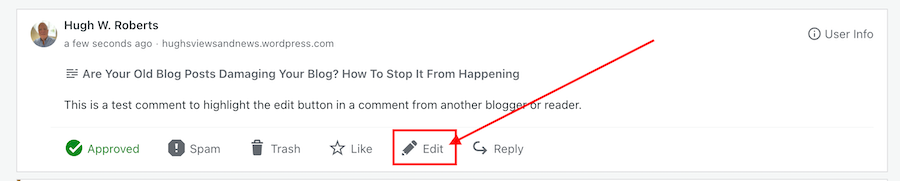
I edit them out before approving the comment by pressing the edit button.
Click edit to edit out uninvited links from bloggers
Remember to save the changes and then approve the comment. Most bloggers leaving uninvited links soon get the message.
Let’s wrap it up
Never feel pressured to read and comment on too many blog posts when you don’t have the time.
Read and leave engaging comments on a few blog posts a day/week rather than try and read and leave empty, non-engaging comments on all the blog posts of those you follow.
Never feel obliged to follow a blog simply because they followed you.
Don’t force yourself or waste time reading blog posts that do not interest you. Instead, invest your time reading and engaging with bloggers who publish content that interests you.
It doesn’t matter if you don’t read a blog post today. It’ll still be there to read in a week or when you have more time.
Don’t feel guilty if you do not get around to reading all the blog posts you want to read and comment on.
If you have nothing of value to add in a comment, rather than leaving short, empty, non-engaging comments, click the ‘like’ button and move on.
Other blogs are not the place to leave uninvited links promoting your blog.
Edit out uninvited links before approving comments.
Remove any thoughts of thinking you’re behind with blogging and have to catch up. Read and comment on posts when you have the time to do so.
Are there any examples of blogging that have you holding your head in your hands, shaking your head or concerned for other bloggers? Please share them in the comments section.
Follow Hugh on Social Media. Click on the buttons below.
Getting readers to engage with you by leaving comments on your blog posts is something many bloggers crave.
And when those comments clearly show that your post has been read, it’s one of the best feelings in the world.
However, once you get visitors reading your posts and leaving comments, you need to do all you can to ensure they keep coming back.
Writing good quality posts that make your readers want to engage with you and each other is one way to keep your readers returning, but you also need to ensure they can easily find your other similarly themed posts, which are often buried deep in your blog archives.
Need more readers and followers? These 5 blogging tools will help
Here are five blogging tools that work for me. Not only do they give my readers a way of finding more similarly-themed content, but these tools have also helped bring me many new readers and followers.
1. The Search Bar
The other day, I was writing a new blog post and wanted to include links to some posts I had read on other blogs.
However, try as I might, I couldn’t find one of the posts I wanted to link to. Even worse, there was no search bar on the blog concerned.
It wasn’t long before I gave up looking for that blog post. I didn’t have the time to find it.
You can make it easy for readers to find what they are looking for by including a search bar on your blog.
Does your blog have a search bar? If not, WordPress has a ‘search’ widget. Click here to find out how to install one.
Once you’ve installed a search bar, open up one of your blog posts and check you are happy with its position. Ensure it’s visible and easy for visitors to find. The search bar on my blog is the first widget on my widget bar to the right of all my blog posts.
Remember, too, that you can use the search bar when looking for your own posts. You can save yourself a lot of time by doing this instead of scrolling through all your blog posts on your blog’s dashboard.
2. The Menu Bar
Navigation is of prime importance on any blog. Make it difficult for visitors to navigate or find more content, and they’ll probably give up and never return.
That’s why it’s essential to have a menu bar on your blog.
A menu bar allows your readers to check out what is on your blog and helps direct them to other parts of your blog they’d like to explore.
Many bloggers can be frightened by including a menu bar on their blog or adding items. However, it’s an easy and straightforward process.
Click here for details on how to set up a custom menu bar on your WordPress blog.
However, don’t overload the menu bar on your blog, as it can look overwhelming. And ensure you keep it updated and check that everything works on it.
3. The ‘Contact Me Page
Just imagine another blogger, a magazine editor, or somebody from your local radio station wanting to contact you to invite you to write an article or appear on a show. How exciting would that be? But they can’t find a way of reaching you privately!
Not everyone wants to leave a comment when they want to invite you to write a guest post, be interviewed, or ask you to appear on a show. If you don’t have a ‘contact me’ page, and nobody can contact you privately, then they’ll probably move on and give that opportunity to somebody else.
On the menu bar of my blog, you’ll see a ‘Contact Hugh’ button. That’s how people can contact me privately.
I get lots of people contacting me every week. As a result, I’ve written guest articles, appeared on radio shows and recorded podcasts, all of which have allowed me to promote myself and my blog. In return, I’ve got hundreds of new readers and followers to my blog.
Make sure you’re contactable. Click here to find out how to set up a ‘contact me’ page.
4. The ‘About Me’ Page
Ever since my early days of blogging, I’ve been told that many new blog visitors will want to learn a little about the blogger behind the blog before deciding whether to follow.
When I visit a new blog, I first look for an ‘about me’ page to learn more about the blogger.
If the blogger doesn’t have an ‘about me’ page or it’s difficult to find, I’m more likely to move on than check out the rest of their blog.
If you do have an ‘about me’ page, ensure you allow new visitors to introduce themselves by allowing them to leave a comment on it. And don’t forget, a friendly reply is more likely to keep that visitor returning to read your posts.
Click here for details on setting up an ‘About Me’ page and what to include.
5. The Gravatar
The image that appears next to all comments is known as a Gravatar. A gravatar is created for you as soon as you leave your first review or comment on the internet.
How many times have you clicked on the gravatar image of somebody who has left an excellent comment on a post and not been able to find their blog details? Frustrating, isn’t it, especially when you think it may be a blog you’d like to follow.
Unfortunately, one of the biggest mistakes many bloggers make, as soon as their gravatar is created, is they forget about it. Many don’t realise they can add images and leave links to their blog and social media accounts on their gravatar.
If a reader then clicks on your gravatar, they’ll see the links to your blog and social media accounts and be able to visit them. That means more visitors to your blog and social media accounts which could result in more followers.
Click here to find out how to add links to your blog and social media accounts to your gravatar.
Let’s wrap it up
Many blogging tools can help readers notice your blog and keep them returning.
Make sure you have a Search Bar on your blog to help visitors find other content.
Ensure your blog includes a menu bar, but don’t overload it with too many items.
Ensure the links on your blog’s menu bar all work. Check for broken links at least once a month and fix any that have become broken.
Ensure your blog has a page where readers and visitors can contact you privately. Not everyone will want to leave a comment inviting you to write a guest post or to appear on a radio show or podcast.
Many new visitors want to know a little about the person behind the blog before deciding whether to follow. Tell visitors a little about yourself on an ‘about me’ page.
Ensure your Gravatar has links to your blog and social media accounts.
This is an updated version of a post originally published on Hugh’s Views And News in September 2018
What powerful blogging tools do you use on your blog, and why do you use them? Share them with us by leaving a comment.
Did you know that a blog can be killed other than by just deleting it?
While not all of the items on the following list will kill your blog instantly, some are what some call slow burners, where the killing of your blog will take much longer.
Are you thinking of killing your blog?
Are you responsible for doing any of these to your blog?
Don’t have an ‘about me’ page on your blog.
The ‘about me’ page takes visitors more than a minute to find.
The ‘about me’ page starts with these words – ‘this is an example of an about me page…’
The number of followers is more important to you than what you write and publish.
Publishing too many poor-quality posts due to rushing them.
Believe you have to publish content several times daily; otherwise, nobody will visit your blog.
Have links on your blog that you have no idea are broken or can not be bothered to fix.
You do not respond to comments.
You do not respond to questions or queries.
Don’t allow anyone to leave comments on your blog.
Ignore your readers.
Do not treat visitors to your blog as guests.
Don’t give yourself a name by which you can be addressed in the comments section.
Do not read other blogs.
Do not leave comments on other blogs.
Believe that blogging is going to make you rich.
Believe your blog will make money within the first year.
Leave links with no relevance (usually to your own posts) on the posts of other bloggers when not invited to do so.
Don’t believe you need to promote your blog.
Refuse to use social media to boost your blog posts.
Refuse to keep up to date with blogging technology and changes.
Think readers will find you rather than you find your readers.
Do not use enough ‘white space’ between the paragraphs in your blog posts.
The paragraphs on your posts are too long and blocky (more than 5 sentences long).
Have no way readers can contact you on your blog other than by leaving a comment. (No ‘contact me’ page).
Do not thank people for sharing your posts on their blogs.
Do not use images and/or photos in any posts.
Use images, photos and words (including lyrics) on your blog which are copyrighted and not free to use.
Do not ask permission to use photos and/or images owned by other bloggers before using them.
Ignore all copyright advice.
Respond to constructive, negative comments in an unprofessional and unfriendly manner.
Allow other bloggers to spam your blog with links that have nothing to do with the post’s content.
Keep begging other bloggers to reblog your posts, visit, or follow your blog.
Leave worthless comments on other blogs.
Leave worthless comments on other blogs which clearly show you’ve not read the post.
Do not take time to edit posts before publishing them.
Do not preview your posts before publishing them.
Inundate followers with too many posts in a short space of time instead of scheduling them out.
Respond to comments left by trolls in the comments section of your blog, where all can read them.
Allow trolls to leave comments on your blog.
Allow trolls to attack other bloggers who have left comments.
Personally attack other bloggers in the comments section on your own or different blogs.
Steal the ideas of other bloggers and publish them on your blog as if the content is original and has been written by you.
Fail to maintain and house-keep your blog regularly.
Keep reblogging or rescheduling your own posts which are less than a few months old.
Do not have a ‘landing’ page that will keep visitors returning.
Ignore advice and feedback from other bloggers.
Believe that blogging will only take up a few minutes of your time every week.
Wake up and dread opening up your blog because of all the comments you will need to reply to.
Keep telling your readers that you are giving blogging up, and keep coming back.
Allow blogging to stress you out.
Allow blogging to make you feel guilty.
Your blog and/or blog posts are poorly laid out.
Choose a font and background combination that makes it hard for visitors to read your posts.
Fail to categorise all your blog posts (including reblogs).
Fail to add ‘tags’ to your blog posts.
Don’t understand ‘pingbacks’ and how to use them.
Have no ‘search’ bar on your blog.
Have a menu that is too top-heavy, making it overwhelming to readers.
Fail to add your blog details to your gravatar.
Fail to connect your social media accounts to your blog.
Have pop-up boxes on your blog that can not be removed unless somebody subscribes to your mailing list.
Have pop-up boxes on your blog which keeps popping up every time someone visits or until they have subscribed to your mailing list.
Keep suffering from blog envy when you read a post you’d wish you’d written.
Regularly publish posts that tell your readers to buy your book(s) or other products and services you offer rather than allow them to decide if they want to buy them.
You believe that blogging is all about the number of blog posts you can publish daily rather than what you are writing about.
You think you have the power to read and comment on every new blog post on all the blogs you follow.
Fail to update your readers that you are about to take a blogging break and how long it will last.
Lose motivation and a desire to continue blogging when your blog stats take a nosedive.
Believe that everyone will enjoy reading every post you write and publish.
Believe that all your followers will read and comment on all your posts.
Get upset when your blog loses followers.
Argue with bloggers and readers for failing to read and comment on all your blog posts.
Follow other blogs in the hope that they will follow back before unfollowing them again.
Believe all your readers will agree with everything you say in your blog posts.
Think nobody will dare to disagree with what you have to say by leaving a constructive comment telling you why they disagree.
Criticise other bloggers behind their backs (in the comments section of your own blog or on other blogs) for wanting to help other bloggers.
Maintain too many blogs, thus spreading yourself too thinly.
Fail to take some time away from blogging (knowing that you need to) because you believe the blogging world can not survive without you.
What about you? What would you add to the list? How would you kill your blog other than by deleting it?
This is an updated version of a post I wrote and published in 2017.
You can find the answers to solving many of the above issues by clicking on ‘blogging tips’ in the menu at the top of my blog, but feel free to leave any questions in the comments section. I’m always happy to help.
Have you ever had any of your blog posts stolen? What I mean by that is literally copied word for word to another blog.
It’s happened to me a few times, and it’s also happened recently to James, who blogs at Perfect Manifesto. Read his post here.
Reading James’s post prompted me to update and republish this post from 2019.
Are you protecting your blog posts and photos from being stolen and used without your permission?
Some of my blog posts have been copied and published on other blogs. The thieves gave full credit for the work to themselves. When it first happened to me, I was utterly shocked and angry.
Unfortunately, with the internet being such a vast, open space used by billions of people worldwide, the chance of having your blog posts or work stolen is high.
Don’t think your blog is too small to have its contents stolen. As you’ll see in the comment image below, James felt his blog was too small for anyone to want to steal his blog posts, but he was wrong.
Never assume that nobody will steal your blog posts, images or photos
Whether it’s photos, fiction, reviews, poetry, recipes or gardening tips, everything faces the chance of being copied and somebody else taking full credit for your hard work.
What should you do if you discover one of your blog posts or photos have been stolen?
Contact the blogger concerned and ask them to remove what they have stolen.
If that fails, contact the blogging platform hosting the blog and file a copyright claim against the blogger. Whenever I have filed a claim. I’ve been lucky that the offending blogs and their contents were deleted.
Click here to find out what to do if a WordPress.Com user has infringed your Copyright.
What Can I Do To Protect My Blog Posts And Photos Being Stolen?
What I am about to advise you to do may not stop somebody else from copying your work, but it acts as a warning to anyone thinking of copying or duplicating your work without your permission that they could face the possibility of prosecution, a fine, both, or having their blog deleted by their host.
1. Display a copyright and disclaimer notice
I recommend that anybody with their own blog or web page clearly display a ‘Copyright and/or Disclaimer’ notice.
Some websites offer ‘Copyright and Disclaimer’ notices free of charge and give instructions on how to copy and paste one of these notices to your blog or webpage.
WordPress offers excellent advice and instructions on displaying a ‘Copyright and/or Disclaimer’ notice. Click here to view it.
2. Widgets and menus
If you use a theme on your blog which displays widgets, I recommend you display your Copyright and/or disclaimer notice as one of your widgets. I use the Toujours theme on my blog, and the widgets I use are displayed on the sidebar to the right of my blog posts.
My ‘Copyright’ notice is the last widget at the bottom of my sidebar, while my disclaimer notice (Disclaimer & GDPR) can be found on the menu at the top of my blog. Take a look at them.
You are welcome to use them as your blog’s copyright and disclaimer notices. All you need to do is copy and paste them to your own blog and, where necessary, change some of the wording to reflect your own name and the name of your blog.
If you’re unsure what ‘widgets’ are or how to add them to your WordPress blog, click here for full details.
You’ll see I’ve placed a copyright notice at the base of this post.
When a bot or spambot copies one of your posts, it won’t remove the copyright mark. Therefore, anyone reading the post may become suspicious and realise the post has been stolen. It also acts as a warning not to follow the blog that has stolen the post.
4. Protect your photos and images
Many bloggers also include photos and pictures in their posts.
While you may display a Copyright and/or disclaimer notice on your blog, I recommend you also watermark your photos and images.
Most computers come with software that helps edit photos you have loaded onto your hard drive, but there are other ways to watermark them.
I use an app called ‘Photobulk’ to watermark all my photos. It’s easy to use and costs around $9.99, but it can often be found on offer or free to download from the developer’s website. Click here to visit the website. (The link is not an affiliated link, so I do not receive any payment from it.)
There are free watermarking apps for Apple products, too many to mention here, so check the Apple App Store for more details.
What about Android users?
Click here for a free photo watermarking app for android. As an Apple user, I’ve never used the app, but the reviews for this particular app are excellent.
Don’t forget you can also add copyright notices as a photo caption. Your copyright details will then show under the photo, but it is best to watermark the photos, making stealing them more difficult.
If you have a reblog button on your blog, readers will assume you’re happy for them to reblog your posts. So, remove the reblog button if you don’t want any of your posts reblogged.
6. Remember to update
Finally, always ensure you download the latest updates for any apps or software you use; otherwise, they may not work correctly. This includes antivirus software for your computer and the latest updates for the blogging platform you use.
Of course, if you’re not worried about your blog posts, work, photos or images being copied or used without your permission, you can ignore all the above advice. However, I’d be surprised if any bloggers are not concerned about their posts, work and photos being stolen.
Remember what I said earlier? James thought his blog was a low target for thieves to steal his blog posts, but it happened.
If you have any questions about displaying copyright and/or disclaimer notices on your blog, please leave a comment.
Let’s wrap it up
Don’t assume your blog is too small to have anything stolen from it. It can happen to anyone.
Display a copyright and disclaimer notice on your blog.
Copyright every blog post by adding a copyright mark at the end of every post.
Watermark photos and images with the name of your blog before inserting them into posts.
If you don’t want other bloggers reblogging your posts, remove the reblog button from your blog.
Remember to update apps, antivirus software and any updates your blogging host releases.
Have you ever had your blog posts and/or photos/images copied and used without your permission? What do you do to help stop your blog posts, photos and images from being used illegally?
Throwback Thursday is the day to bring your old blog posts back to life.
Are you making the most of your old blog posts?
We all have old blog posts in our archives, many of which are buried bits of treasure that can reward us again. Throwback Thursday is the perfect day to rekindle those old blog posts.
Only use blog posts that are still relevant, although always ensure you first make any necessary changes to the posts you want to highlight.
How to participate in Throwback Thursday
Select a favourite blog post that is at least a few months old.
Share it via a pingback or link in a new Throwback Thursday blog post.
After all, not only will some of your readers not have seen the post the first time it was published, but new followers may also not have seen it.
However, as I mentioned, rather than publish the whole post again, the idea behind Throwback Thursday is to include a link to the post you want to highlight in your Throwback Thursday post.
What you should do with your Throwback Thursday blog posts.
Only publish the post on a Thursday. That may seem like common sense, but I’ve seen bloggers publish them on other days of the week. Some readers may find it odd to publish Throwback Thursday posts on any other day than a Thursday. After all, the clue is in the title.
However, don’t worry if you miss publishing your Throwback Thursday blog post. You can always delay publication until the following Thursday. There are lots of Thursdays to choose from.
Flashback Friday.
If you’re a day late in publishing your Throwback Thursday post, you can always change it to a Flashback Friday post. Flashback Friday has the same concept as Throwback Thursday, where you are encouraged to highlight older blog posts.
Share your Throwback Thursday posts on social media using the hashtag #ThrowbackThursday so that other participants can find your post.
Tag your post ‘ThrowBack Thursday’ on your blog so other participants can find it.
You can also include the words ‘Throwback Thursday’ or the hashtag in the title of your blog post, but always ensure you add the title of the blog post you’re highlighting. You don’t want to end up with many blog posts simply titled ‘Throwback Thursday.’
When creating the pingback to the post you want to highlight, ensure you turn on the ‘open in new tab‘ button so that readers don’t lose the page of your blog they’re on.
Not sure how to create a pingback? Click here for full details.
Is there anything else I should consider when publishing Throwback Thursday blog posts?
Yes, I recommend closing comments on the post and asking readers to leave any new comments on the original blog post you’re highlighting. That way, they can see and read comments already left on the post you’re promoting. They can join any ongoing discussion. It makes more sense to have comments on the same post rather than scattered across several blog posts.
When selecting which posts to promote, choose the ones you believe your readers will benefit from and think they’ll enjoy reading again.
And that is Throwback Thursday.
Do you participate in Throwback Thursday? Do you have any questions about Throwback Thursday? Please leave them in the comments section.
Join Hugh on Social Media. Click the button below.
If you’re a blogger who has used or still uses the reblog button to share other bloggers’ posts, I urge you to read this post.
Likewise, if you use photos or images in your own posts that are not your own or do not come from a genuine website that offers free images and photos, this post is a must-read.
Early 2021, during the lockdown, I had a nasty shock.
For me, the lockdown was terrific – I live in a farmhouse in the Scottish Highlands with gorgeous gardens, have a horse and a pack of rescue dogs, and for once, I could legitimately stay at home and not travel for work. This also allowed me to sit and write without feeling like I was short-changing some other part of my life.
What I had not expected, however, was to receive an email from a law firm accusing me of copyright infringement on a photograph I’d displayed on my blog back in my earliest blogging days, somewhere around 2013.
To add insult to injury, it wasn’t even a blog post I’d put together myself, but a collection of inspirational photos on a friend’s blog, which I’d reblogged!
I shared her post using the WordPress ‘Reblog’ button, and, as you may know, the post appears on your blog with a link to the original for anyone wanting to see more.
I had NO idea (this was quite early in my blogging career); this meant that ALL the photographs in that post were downloaded and stored in my own media library. The fact they were downloaded, even without my knowledge, became a potential legal problem.
If this happens to you, DO NOT ignore it.
The ‘Cease and Desist’ email came from an Italian law firm. Their client, the photographer, is based in the UK, as am I. It detailed the blog post and the specific photograph and demanded £1045.00 compensation for using the picture without obtaining a licence. This was justified as:
£195 financial loss (£39 per year for the licence)
£150 damages for flagrancy (putting the photographer at increased risk of having the photo stolen/used without obtaining a licence)
£100 damages for negative financial consequences
£150 for the absence of a picture credit
£50 damages for moral prejudice
£100 damages for consequential losses
£100 damages for devaluing the image
£200 lawyers’ fees
Scary, huh?
This was what I did:
The first step was to check that the law firm existed, looking up their website and digging a little on Google. Sadly, for me, it was legit.
Then I looked at the photographer’s site to find the photo. Yes, it was there, along with the price for an annual licence, as detailed in the legal letter.
So, having established that I had indeed violated copyright, although unwittingly, I checked my own post. As a reblog, I could only see the first picture, which wasn’t the one in dispute. I replied to the lawyer, asking for a screenshot of the image displayed on my site. To my shock, an image of the entire post came back, with all the photos in evidence displayed on my blog. I still don’t know how this is possible, but I couldn’t argue because they had the screenshot.
I removed the post from my site and also delved into my media library, which is when I discovered to my shock, that all the pictures from the post were stored there. I deleted them all, just in case.
I contacted the original blogger and advised her to delete it, which she did. The last thing I wanted was for them to go after her, too.
The next step was to contact the lawyer again and point out I was not the original poster, explaining it was a reblog of someone else’s post.
They replied that while they would consider this, I was still held responsible because the image had been displayed on my site. They dropped the proposed settlement to £800 and gave me 10 days to pay up.
I contacted another lawyer for advice. Her answer was: ‘If you did not download it and post it on your site, then you did not copy it. I would argue that re-posting or embedding is not copying because the image is hosted elsewhere and therefore cannot be copyright infringement.’ Note that last bit? Unfortunately, the way WordPress works, the photo had been downloaded and hosted on my own site, even though I hadn’t known it, so this didn’t help me.
I went back to the Italian lawyer and again stressed that I was not the person who had chosen to use the image. I felt they were being unfair coming after me and not the original poster (which is why I’d given her the heads-up first and ensured she’d removed all traces from her site before typing this message).
By now, this had gone on for 6 weeks, with me leaving it almost to the stipulated 10-day deadline when I replied to the lawyer. I never once refused to pay them, but I did not offer to do so or haggle about the sum. I spent more time researching potential help from legal groups, but…
Nearly a year on, and I’ve not heard from them again! This sounds fairly simple, but it was a time-consuming and stressful experience.
I understand from years ago, mainly when posting paper letters, that sometimes the answer to such events is to continue corresponding. Never offer anything, but keep querying small details and spread them out as long as possible. If nothing else, you may get a reduction (as I did) in the sum they demand.
I was lucky; I know others who have had to pay up. In this case, they apparently wrote me off as too much bother to pursue.
If you should be unfortunate enough to have this happen to you, the most important things are:
Don’t ignore it – it has the potential to be very expensive.
Don’t pay up straight away – always investigate your options.
Deborah Jay writes fantasy and urban fantasy featuring complex, quirky characters and multi-layered plots – just what she likes to read.
Fortunate enough to live not far from Loch Ness in the majestic, mystery-filled Scottish Highlands with her partner and a pack of rescue dogs, she can often be found lurking in secluded glens and forests, researching locations for her books.
Her first published novel, epic fantasy THE PRINCE’S MAN, won a UK Arts Council award and debuted as an Amazon Hot 100 New Release.
Reblogging saves many bloggers time. It’s quick to do and can result in more visits and comments to the reblogged post.
It’s also a safe option, but only when used correctly. Here are several points to consider and note if you intend to reblog another blogger’s post or have ever reblogged another blogger’s post.
If you reblog or have reblogged the blog posts of other bloggers, any images, videos or photos in those posts will have been downloaded into your WordPress media library. You could, therefore, have downloaded illegal images or photos and images that are copyrighted.
Check the small print – Some photos, images, and pictures may have a limited time that they’re free to use. After that, you could face a fine if they remain on your blog or in your media library.
Consider other options for sharing blog posts where images and photos are not downloaded to your blog. The ‘Press This’ sharing button is a good option, as no images and photos are downloaded to your media library.
Another option instead of reblogging is to write and publish a post that includes pingback links to blog posts you want to share. Blogger Sally Cronin does this with her ‘Blogger Weekly’ feature.
If you run a blogging challenge where you reblog posts from participants, consider adding links to those posts in your blog post or in a new blog post rather than reblogging them. Blogger Terri Webster Schrandt does this in her Sunday Stills photography challenge.
If you’re unsure that any content in a blog post you want to share is not free to download or use, don’t reblog the post.
Don’t think that what happened to Deborah won’t happen to you. It can!
If you believe you may have reblogged posts that have images or photos that are copyrighted or not free to download and use, delete the posts immediately.
After deleting posts, remember to remove any images and photos that appeared on the reblog from your WordPress media library, as deleting the post does not delete them.
Remember that copyright laws can also apply to lyrics, artwork, drawings and text.
WordPress offers users hundreds of free images and photos.
If you’re not convinced by Deborah’s experience of copyright infringement, then read Debby Kaye’s post here about a copyright experience she had where she was fined for reblogging a post that contained an image that was copyright protected.
If you have any questions about Deborah’s experience or about reblogging, leave them in the comments section. Deborah and I will try and answer them, although we cannot offer any legal advice.
Follow Hugh on Social Media. Click the buttons below.






 Hugh's Views & News