
WordPress users often face problems, but they may not always be caused by their blogging platform. Device issues, internet browsers, poor blog housekeeping and retired themes can all contribute to problems.
My post outlines what to do if you’re experiencing issues with using WordPress.
Do you encounter problems using WordPress? Are your posts not aligning correctly, or are you unable to leave comments on certain blogs? What’s causing these problems? Is it WordPress, or are you or your device causing them?
Don’t panic when WordPress causes you problems. The problem could be you!
Like any online website, the WordPress platform experiences problems. Bugs occur. They can often cause havoc for users. Sometimes, things don’t go to plan when new updates are released.
But what causes these problems, and how can they be fixed?
Case 1 – Your posts are not displaying correctly.
A few years ago, a reader informed me that my blog posts were not displaying correctly.
I checked my blog and couldn’t see any problems. I used another device and couldn’t see any issues.
I contacted the WordPress Happiness Engineers. They assured me that from what they saw, there were no problems with how my blog posts were displaying. They even sent me screenshots and some short video clips showing me what they were seeing at their end.
But I was still not happy.
I decided to write and publish a post about the problem.
I asked my followers to check some of my blog posts and let me know if there were any problems with how they were displaying. Over 100 people came to my call for help. Only one person said there was a problem with how my posts were displayed, and this was the person who reported the problem to me.
It turned out that the problem wasn’t my blog or WordPress. The problem was the device belonging to the reader who reported the issue.
I asked them to make sure their device had the latest updates. They never informed me that my blog was displaying incorrectly again.
Case 2 – I can’t leave comments on certain blogs.
I recently saw a post from a blogger who said he had problems leaving comments on certain blogs.
He named the blogs so they knew who they were and apologised, saying that his comments were being cut off as he wrote them.
He asked if anybody else was having the same problem when leaving comments.
By the time the responses came in (and all were saying ‘No’), he’d gone to another device. He tried leaving comments on the same blogs. They all worked, and he came back and apologised.
The problem was caused by the device he was using. He updated the device’s software and also tried using another internet browser, and his comments worked.
Case 3 – When was the last time you cleaned your house?
Some of my WordPress data and stats were not displaying. ‘Have you tried clearing your browser history, cookies and cache on your computer?” somebody asked?
I did the clear-out, and the data all showed up.
Like your home, your blog device needs some housekeeping to keep it working correctly.
Case 4 – Have you tried the most popular advice when things go wrong?
A user contacted me saying they could not leave comments or ‘likes’ on any blog posts. She was using the Jetpack app on her mobile phone.
I told her to try signing out of the Jetpack app, delete it, reinstall it and sign in again.
Problem solved.
Case 5 – Has the blog theme you’re using been retired?
Another WordPress user was experiencing many problems with her blog. Her posts were not aligning correctly, and some readers contacted her to say they couldn’t leave comments. The sharing buttons at the end of her posts were also not working. There were also other issues like certain tools no longer working.
She contacted WordPress, which informed her that her blog theme was retired and was no longer supported. The advice was to change her theme. She didn’t want to change the theme; she liked it. She tried working around the problems. That worked for a while. Then, the issues worsened, and she eventually gave up on her blog.
The WordPress platform wasn’t the problem. The device she was using wasn’t the problem. She was the problem for refusing to change to a theme that WordPress supported.
If your theme has been retired, you will find this notice on the theme’s info page:
Has your WordPress theme been retired?
When a theme is retired, it no longer appears in the list of themes at Appearances – Themes or at Appearance – Theme Showcase if using the Classic Editor.
But, if the theme is already active on your site, you can continue to use it. Some retired themes will usually stay available for the lifetime of your site or blog without any issues. However, if you continue using a retired theme, you should note the following:
A retired theme no longer receives WordPress updates or new features. This includes security updates that protect your blog from spammers and hackers.
A retired theme should continue functioning on your site. However, WordPress does not guarantee that it will always work well with its ever-evolving software.
You may lose access to certain features like sharing and reblog buttons, blocks, writing tools and clicking the ‘like’ button.
If you still use a retired theme, you will likely encounter problems at some point. Visitors to your blog may also experience problems viewing it correctly or engaging with you.
How do I change my WordPress theme?
Some bloggers are terrified of changing the theme of their WordPress blog. It can seem like a daunting task.
Once upon a time, changing your WordPress blog theme was a nightmare. I recall the first time I changed the theme of my blog. It took a whole weekend to finish.
But changing the theme of your WordPress blog is now easy and quick. WordPress provides full details on how to do it on the ‘Change your theme‘ page.
Have you checked the WordPress forum?
A user experiencing problems with their WordPress blog does not necessarily mean that other users are experiencing the same problems. Sometimes, problems can be exclusive to one blog (as in some of the above cases).
The WordPress forum page is great for determining if problems affect other users. Here, you can report issues and check what other issues users are experiencing.
Another way to find out if other users are experiencing the same problems with their WordPress blog is to ask them (as I did in Case Number One). Sometimes, issues can be theme-related. Once reported and provided the theme has not been retired, WordPress quickly fixes theme-related problems.
Let’s Wrap It Up!
Like any website, the WordPress platform will suffer from bugs and problems.
While some problems are widespread, many problems can be caused by a user’s device when blogging, especially if the device is old and does not have the latest updates installed.
If you can access another device, try using it to determine whether the problem is only related to one device or a certain web browser.
Some problems are related to themes. If a theme has been retired, consider changing to one WordPress support.
Changing your blog theme is now easier and quicker.
You can check if other bloggers are experiencing the same problems you’re having with your blog by asking them, posting on the WordPress forum, or doing both.
Consider that any issues lie outside of WordPress first before blaming them solely.
Ensure all devices you use to blog have the latest updates.
Report issues and problems to WordPress. They may not know about issues unless you report them.
Are you experiencing any problems using WordPress? Have you checked if the issues are sitewide or only affecting you? How do you deal with issues using the WordPress platform?
Layout, content, settings, and format might differ on self-hosted blogs.
WordPress has managed to do it once more! It’s relocated a setting I frequently use, seemingly without informing anyone about it.
Turning comments off is simple to do. But WordPress has moved the settings!
During a recent post-drafting session, I attempted to disable comments on a post. I encountered difficulty locating the ‘Discussion‘ setting, which is the usual place for enabling or disabling comments on individual posts.
Why turn comments off?
I consistently close comments whenever I share another blogger’s post or a guest post I’ve written on another blog. This strategy ensures that new comments appear on the original post, consolidating the discussion in one place rather than being split between two posts. Kinda makes sense, doesn’t it?
Some bloggers also choose to close comments on older posts as a proactive measure. This practice became popular when WordPress faced a significant spam issue. Specific posts received hundreds of spam comments daily, making it challenging for bloggers to sift through the spam in their WordPress folders to find authentic comments that can sometimes end up there.
The installation of the updated Askimet anti-spam software in 2023 has led to a significant improvement in the spam situation. Thanks to Askimet’s enhanced functionality, the previously prevalent issue of hundreds of visible spam comments daily has been effectively curtailed to just a few a week. Consequently, there is no longer a necessity to close comments on these posts.
Where has the ‘Discussion’ setting gone?
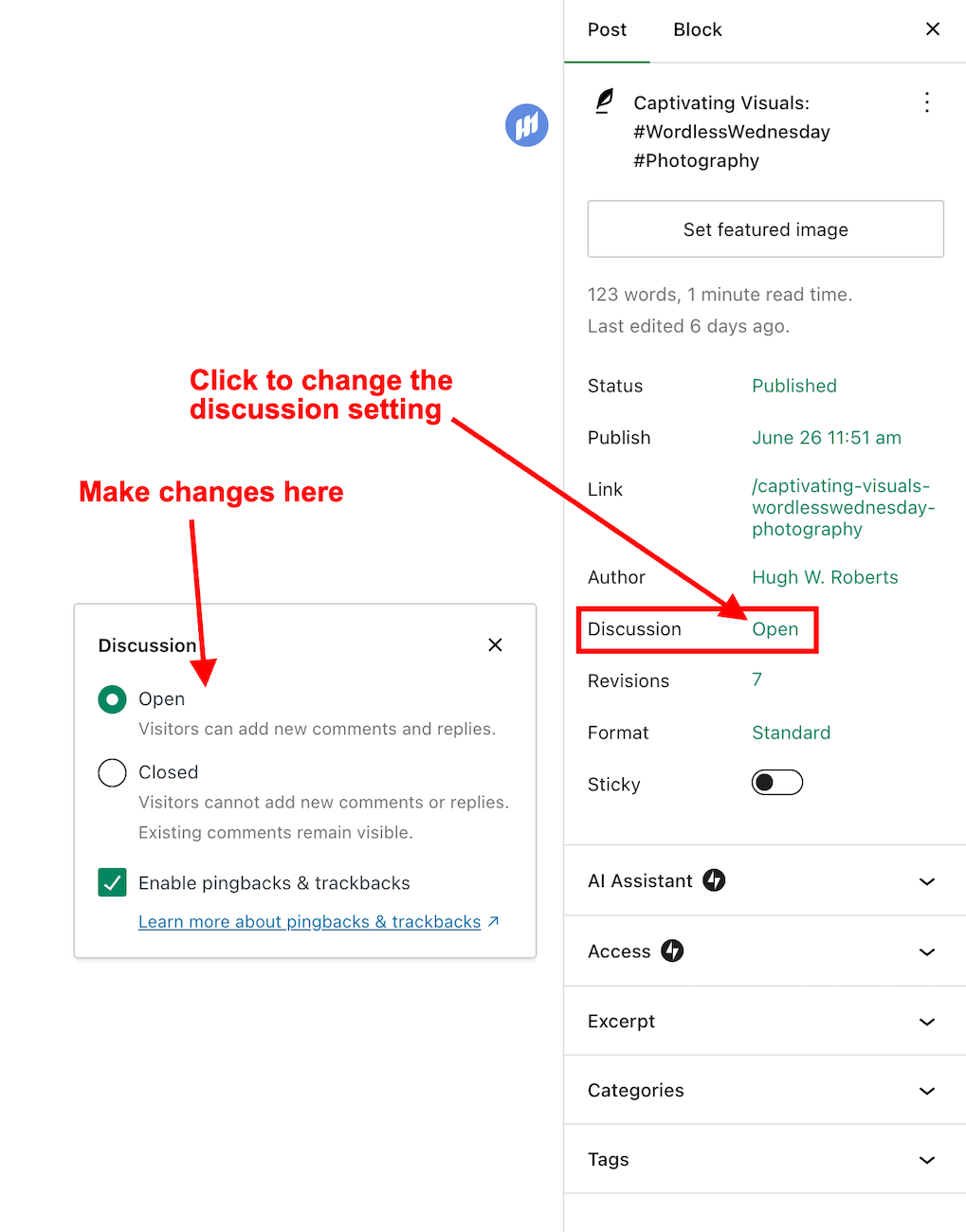
The ‘Discussion’ setting used to be located at the bottom of the settings box of a post.
The ‘Discussion’ setting used to sit under ‘Tags.’
Now, the discussion setting has been conveniently relocated to a more prominent position at the top of the post settings panel rather than at the bottom. This new placement, coupled with the clear indication of whether comments on a post are open or closed, significantly enhances the ease and user-friendliness of managing comments and pingbacks.
Changing the discussion setting is straightforward. Click on ‘open‘ or ‘closed‘ to make the change.
The ‘Discussion’ setting is now further up the ‘draft post’ section of a post.
This simple, user-friendly system also allows you to control comments, pingbacks, and trackbacks.
This is where to turn on or switch off pingbacks on your WordPress posts.
Pingbacks and trackbacks are methods for alerting other blogs that you have linked to them. However, they only work when the blog you’re linking to has enabled pingbacks and trackbacks and you do not link to a blog’s home page. My post, ‘The Power Of Pingbacks: How To Create One‘, has more details.
Do you disable comments on posts? If so, which posts? Do you have any questions about the ‘Discussion’ setting on WordPress? Please leave them in the comments box.
Layout, content, settings, and format might differ on self-hosted blogs.
Click the buttons below to follow Hugh on Social Media
Categorising and tagging blog posts are some of the most potent ways for bloggers to get their posts noticed. However, some bloggers don’t bother with either, meaning they’re losing the potential for new readers and followers. Are you one of them?
But what are categories and tags, and how do they work?
Do you categorise and add tags to all your blog posts?
What are blogging categories?
Blogging categories act like groups where blog posts that have a connection with each other are stored.
For example, if you’re a travel blogger, you could have The United Kingdom categoryand list the sub-categories Scotland, Wales, England, and Northern Ireland.
Categories are important because they make finding specific blog posts more straightforward for visitors to your blog (especially first-time visitors).
Every blog post should have at least one category.
Unfortunately, if you don’t categorise blog posts, they will be uncategorised, which is no help to anyone.
Imagine going into a shop to find a particular book about dinosaurs and finding that none of the books has been categorised. You’d leave and go to another shop that helps customers by categorising its books to find what you’re looking for much easier.
I never return to blogs that do not categorise posts.
How to add a category to your WordPress blog post
This tutorial uses an Apple iMac desktop computer and the WordPress ‘Default’ dashboard.
While drafting a blog post, you’ll see a toolbar in the settings area on the right-hand side of the page. This is where you can add categories.
Every blog post should have at least one category.
If a blog post doesn’t fit into one of your existing categories, click ‘Add New Category‘ and create a new one.
Remember to do some housekeeping regularly for the categories on your blog. For example, delete categories that are no longer being used or update categories by giving them a new name if something works better.
How to edit the categories on your blog.
On your blog’s dashboard, click on Posts to open a submenu, and click on Categories.
Click Posts and Categories.
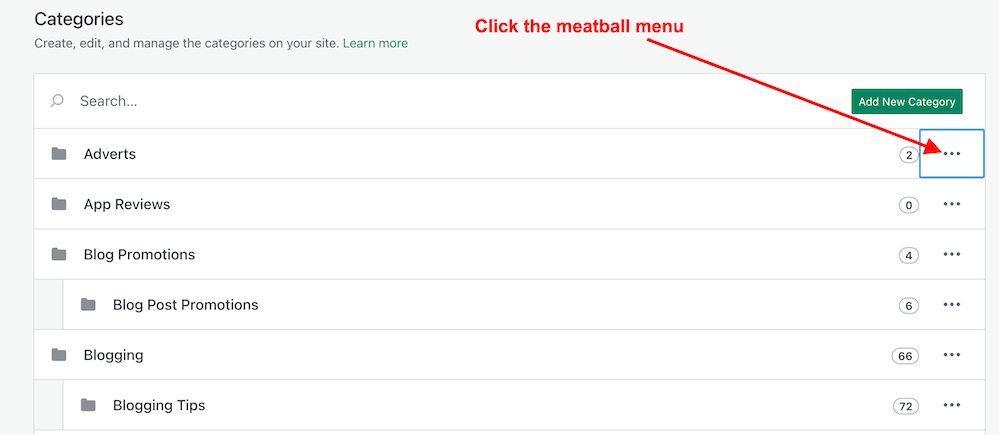
To edit a category, click the three verticle dots (meatball menu) next to the category you want to edit.
Click the meatball menu to edit a category.
The meatball menu displays four options: edit, delete, view posts, and set as a default.
Edit – Edit the name or description of the category.
Delete – Delete the category.
View posts – View a list of all your posts under the category.
Set as default – Useful when most posts fall under a particular category.
Remember to click the ‘Update‘ button to save any changes you make.
The number next to each category tells you how many posts are under that category. I recommend deleting any categories that are not being used.
Any sub-categories will show under each category.
Tip: Setting your default category to ‘Uncatorigised‘ allows you to search for any blog posts you may have forgotten to categorise.
What are tags?
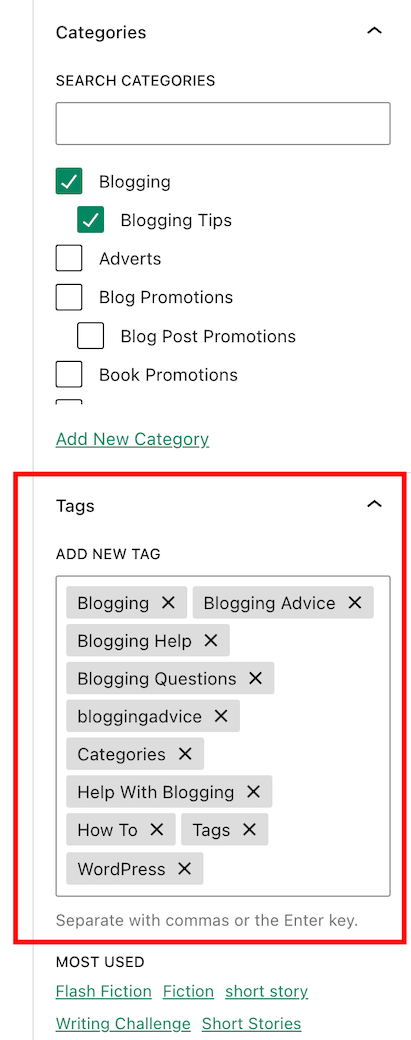
Tags are popular keywords that can be added to a blog post. For example, some of the tag words I’ve added to this post are –
blogging
bloggingtips
categories
tags
WordPress
HowTo
Each tag should be separated with a comma or by pushing ‘Enter’ on your keyboard.
Tags containing more than one word (such as ‘Blogging tips’) act as one tag word, but you must add them without any space between the words, i.e., ‘ blogging tips’ becomes ‘bloggingtips.’
Generally, tags do not need to connect with each other, but when used correctly, they can generate a lot of extra traffic to a blog post.
Like categories, tags can be added to blog posts in the settings area toolbar on the right side of a draft post.
Always add keywords (Tags) to your blog posts.
When adding tags to your post, consider the keywords somebody would add to the WordPress search bar when looking for specific blog posts. Or think of words you would use to search for your post.
Check out the tags I’ve added for this blog post. They appear at the end of every post.
Important information – Did you know this…?
The cardinal tagging rule on WordPress.com is that you should never add more than 15 tags and categories (combined) to your post; otherwise, it won’t appear in the WordPress Reader.This cap prevents spam posts from appearing on the reader list, as spammers and spambots tend to use many categories and tags to lure readers in
15 tags and categories can seem like a lot, but you don’t need to use all of them.
Never tag your blog post with words that have nothing to do with the post’s subject. Otherwise, visitors will come to your blog under false pretences and probably won’t return.
Generally, I add no more than three categories and between six and ten tags to my blog posts.
As with categories, it’s also essential to do some housekeeping for the tags you use on your blog.
How to delete and update tags
On the dashboard of your blog, click on Posts – Tags.
A page showing your tags and how many blog posts containing each tag appears.
To edit, view and delete posts containing a tag word, hover your mouse over each tag word and click edit, quick edit, view or delete.
You can also view the posts containing the tag word by clicking the number in the ‘Count’ column. I recommend deleting any tag words that are no longer being used.
Let’s wrap it up!
All blog posts should be categorised and tagged.
Categorising and tagging your blog posts makes them user-friendly, meaning people will likely return to your blog.
Not categorising your blog posts means they’ll be challenging to find.
When tagging posts, think of keywords others will use when searching for your blog post.
Don’t use tag words that have nothing to do with the subject of your blog post.
WordPress users – never add more than 15 tags and categories (combined) to your posts; otherwise, they won’t appear on the WordPress Reader.
Remember to perform regular housekeeping of categories and tags on your blog.
Adding the proper tags to your blog posts will increase the number of readers who find them. More readers mean higher stats, more comments, and new followers.
Do you categorise and add tags to all your blog posts? If not, why not? Which tags-words work best for you? Is there anything you’d like to add or ask regarding categories and tags in blog posts? Join the discussion by leaving a comment.
Did you enjoy reading this post? Then you may also like…
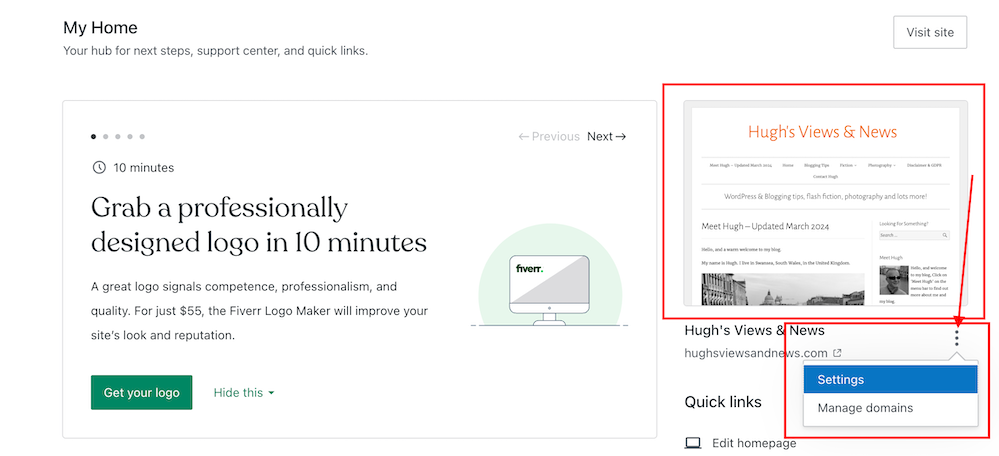
Have you noticed the new feature WordPress has added to your blog’s dashboard? It’s located on the ‘My Home‘ page in the top right corner.
But what does this new feature do?
This new ‘settings’ feature is easy to use. But what does it do?
For this post, I’m using an Apple iMac desktop computer and the ‘Default‘ view setting of my blog’s dashboard.
You’ll find this new feature on the ‘My Home’ page of your blog’s dashboard
Let’s get started
Click on the meatball menu (three horizontal dots) to open a new menu.
Click the kebab menu to open a new menu
The menu contains two options – Settings and Manage Domains.
Let’s take a look at the two options
Settings – this option takes you to the General Settings page of your blog.
You can make many changes to your blog on this page, including your blog’s icon (photo or image), name, and tagline.
Edit your blog’s icon, title and tagline
Click the ‘Save Settings‘ button if you make any changes.
On the same page, you can also create a logo for your blog via Fiverr logo maker (note that there is a charge for this) and set/change your blog’s primary language and timezone. Remember to save any changes you make.
Another option includes setting privacy settings for your blog.
Privacy – This is where you can set your blog to public viewing (anyone can view it) or private viewing (only visible to you and logged-in members you have approved to view it). There is also a ‘Coming Soon‘ option, so your blog is hidden from view until it’s ready for viewing.
Set privacy settings for your blog
Two other options are also available.
If ticked, the ‘Discourage search engines from indexing this site‘ option will prevent search engines from indexing your blog, but note that it is up to search engines to honour your request.
The ‘Prevent third-party sharing‘ option should be ticked if you want to restrict your blog’s content from AI training and third-party use. It will exclude your blog’s public content from WordPress’s network of third-party content and research partners. It also adds known AI bots to the ‘disallow’ list in your blog’s robots.txt file to stop them from crawling your site, though it is up to AI platforms to honour this request.
Click the ‘Save Settings‘ button if you make any changes.
Other settings include –
Accept a gift subscription – turn this setting on to accept gift subscriptions from visitors to your blog.
Footer credit: Here, you can choose or edit a footer credit that appears at the bottom of your blog’s pages and posts.
Site tools – this section allows you to do the following.
Register a new domain or change your blog’s URL address.
Transfer your blog to another blogging provider.
You can reset your blog and start afresh while keeping the same domain/blog name. (If you choose this option, all your posts, pages, and media will be deleted).
Delete your blog and give up your blog’s domain/address.
2. Manage Domains — This option takes you to the part of your blog where you can manage your blog’s domains.
It’s worth checking this page to see what domains you have and to see offers for other domains you may be interested in purchasing for your blog.
While you may not visit your blog’s settings page regularly, it’s worth knowing that there is now an even quicker way to find these settings.
Have you noticed the new style comment box on WordPress?
In line with the Block editor, WordPress has rolled out a new cool comment box on most WordPress blogs. While I’m writing this post, I still see a few blogs with the old-style comments box, but I’m confident all WordPress blogs will soon display the block-style comment box.
The new style comments box appears on blog posts, but not when you add your comment via the comments box on the WordPress Reader.
This new comments box can do more than just leave comments
For the purpose of this post, I’m using an iMac desktop computer.
Here is a breakdown of what users can do when leaving comments on blogs with the new block-style comment box.
What does it look like?
This is what the new style comment box looks like.
WordPress Block Style Comments Box
It looks very simple, doesn’t it? And it is very easy to use. Your Gravatar image appears in the bottom left corner.
The comments box looks like this as soon you click in the box.
Click inside the box to start typing your comment.
Notice the difference? A toolbar has opened along the top, and an ‘+‘ icon has appeared inside the comments box. Let’s examine what they do. I’ve numbered some icons in the following image.
Features of the toolbar
Block being used.
Aline text
Bold
Italic
Pingback link
1 – This is the type of block being used when commenting. It will always be the Paragraph block by default, but you can switch to the List or Quote block by clicking on it. If you change it to the List or Quote block, a new toolbar will appear.
2 – Use this icon to align text to the left, right or centre.
3 – Use this icon to make the text bold.
4 – Use this icon to make the text italic.
5 – Use this icon to create a pingback.
Most readers only use text when leaving comments and they will never feel the need to align it or make it bold. However, many bloggers want more.
You can now insert other blocks into the comments box by clicking the ‘+‘ icon. For example, you can now easily insert an image in your comment by clicking the ‘+‘ icon and choosing the Image block.
Copy and paste the URL address of the image you want to add.
How cool is that? (not the photo of me, but the fact that I can add an image to the comments). This is especially good for participating in photography challenges without creating a blog post or when explaining something where including an image or screenshot helps.
I want to mention that you can create pingbacks in your comments. Pingbacks are powerful and can help boost visitors to your blog. We could already add pingbacks when using the Classic view on our blog’s dashboard but we can now finally do it using the Default view.
Before submitting your comment, remember to click the small settings cog next to your Gravatar photo to open a new menu. Why?
Click the settings cog next to your Gravatar picture for a new menu.
Not only will the menu that opens confirm if you are logged into WordPress, but you can also sign up to receive web and mobile notifications for posts on the blog you are leaving your comment on, get email notifications of new posts, and receive email notifications of any new comments left on the post (including a response to your comment from the blog host).
Press the ‘Comment‘ box to submit your comment.
Is this true?
I’ve heard that some bloggers are threatening to stop leaving comments or are thinking of leaving WordPress because of the introduction of the new block-style comment box.
Given that the bare minimum somebody has to do to leave a comment is to type their comment into the box, I find it hard to believe that people are threatening to stop leaving comments or leaving WordPress because of the introduction of this new comments box. If you are, please reconsider your decision.
The new block-style comments box is not hard to use; it’s just a little different!
Update
Users can now disable blocks in comments. Go to Settings – Discussions, and in the ‘Comments‘ section of the page, turn off ‘Enable blocks in comments.’ Remember to save the change.
WordPress’s new comments box style is a refreshing update that enhances the user experience. Its modern and intuitive design makes interacting with comments more enjoyable. If you have any questions about it, feel free to leave them in the comments section. I look forward to hearing your thoughts!
Layout, content, settings, and format might differ on self-hosted blogs.
Click the buttons below to follow Hugh on Social Media
WordPress constantly changes; some things keep changing and return to where they were before. That’s why I’ve updated and am republishing this post from July 2023.
This is where to find the ‘Open in new tab’ box on WordPress.
If, like me, when you create a pingback, you prefer links to open in a new window rather than in the same window you’re viewing (thus losing the page), it’s vital that you tick the ‘open in new tab‘ box when adding links or pingbacks to a blog post.
The ‘open in new tab‘ box used to be visible when creating a pingback but has reverted to being hidden again. I don’t know why, but I wanted to show you where to find it.
I came across some comments recently where somebody asked how to create a pingback to the post they were leaving their comment on. The blog host didn’t know. It got me thinking that I should do an updated post on what pingbacks are and how to create them.
Pingbacks are a powerful blogging tool. Don’t miss out on not using them.
What are pingbacks?
A pingback is a type of notification that allows you to inform another blogger that you have linked to a post or article on their blog or website. This notification is typically automated and serves as a way to establish connections between different blogs or websites. Sometimes, pingbacks are also referred to as trackbacks.
If the other blogger has a pingback-enabled website or blog, then they can see a notification that you have linked to their article. They can then choose to allow your link to appear in the comments section of their blog post.
This may drive traffic to your blog when readers click on the pingback notification link.
Click the pingback link that pops up in the toolbar.
In the URL box, enter the URL address of the blog post you’re linking to, or if it’s one of your own posts, search for the post.
Choose the post you’re linking to.
Finally, and most importantly, tick the box next to the ‘open in new tab‘ box.
Tick the ‘Open in new tab’ box.
Ticking the ‘open in new tab’ option guarantees that when users click the pingback link, the linked post will open in a new tab or page. This feature effectively retains users on the current page, allowing them to easily return to your post to leave a comment or engage with the content.
Not selecting the “open in new tab” option could result in missed opportunities for comments and likes.
Your pingback has been created and will be highlighted in the post.
Tip – You can also highlight the pingback by making the text bold. To do this, highlight the text and click ‘B‘ (bold button in the toolbar).
Before publishing your post, preview it first and make sure the pingback works. Does it go to the right location? If not, delete the URL and insert the correct one.
Once you are happy that your pingback is working, publish the post.
Pingbacks should be exclusively directed toward blog posts and websites relevant to the subject of the post you are sharing or where you have been specifically invited to link.
Never create a pingback to a post that has no connection with the subject of your post.
Should I ask first before creating a pingback to another blogger’s post?
It’s always nice to ask first, but you’re good to go if the blogger has enabled pingbacks. And if you know the blogger well, there is no need to ask. But it’s best to ask if it’s your first time linking to one of their posts.
However, there’s no guarantee that your pingback requests will get the thumbs up. I receive pingback approval requests every day, and I won’t approve any that seem spammy or are completely unrelated to the post they’re trying to link to.
Are there any advantages of having pingbacks on your blog posts?
Yes. Here are a few advantages.
Creates traffic to your blog.
SEO-friendly.
Search engine optimizations (SEOs) such as Google and Bing rank blog posts that include pingbacks higher.
Bloggers may link back to one of your blog posts.
Great for promoting older blog posts you have published that some of your followers may not have read.
Caution—It is crucial to refrain from creating a pingback to a blog or website’s home page. This practice is discouraged because it fails to notify the blogger whose post you are referencing.
Do pingbacks attract spam?
Some experts recommend not allowing any pingbacks or trackbacks to a blog because they attract spam. However, by moderating all pingback notifications, you can prevent any spam pingbacks from appearing in the comments section of your blog posts.
Good news from WordPress about spam comments
After an update in 2023, the WordPress anti-spam software has dramatically strengthened its ability to intercept spam. Consequently, there has been a significant decrease in the volume of visible spam comments reaching blogs. Previously, hundreds of spam comments inundated my blog on a daily basis. However, following the update, I only encounter one or two weekly.
Where possible, try and include at least one pingback in every blog post you publish.
You can use a mixture of pingbacks to your posts and those of other bloggers.
Are there any problems with allowing pingbacks on your blog?
None that I am aware of.
An invitation to create a pingback
If you’ve never created a pingback before, try creating one for this post. I’ll be happy to let you know if it works and include it in the comments section.
If you encounter any problems creating a pingback, don’t hesitate to ask me for some help.
Summary: The Power of Pingbacks and How to Create Them
This guide explains pingbacks, how to create them, and the best practices to follow.
This guide covers everything from creating a pingback to the benefits, staying safe from spam comments, and recent anti-spam updates from WordPress.
This post also encourages readers to use pingbacks and shares my positive experience. It’s helpful for new and experienced bloggers, giving them the knowledge and confidence to use pingbacks effectively.
In the busy blogging world, pingbacks are important for connecting and getting more site visitors.
Pingbacks, sometimes also known as trackbacks, are useful tools for bloggers that let other bloggers know when you link to their posts.
It’s polite to ask first before creating a pingback to another blog unless you know the blogger well or have been invited to link to a post.
Always tick the ‘open in a new tab’ box so that readers do not lose the page they are reading.
Pingbacks do not attract spam.
WordPress anti-spam software now eliminates the majority of visible spam, saving you time in checking for comments that may have been marked as spam by mistake.
Layout, content, settings, and format might differ on self-hosted blogs.
I actively utilise pingbacks as part of my content strategy. My experience with using them has been positive, as they help me foster connections with other blogs and websites and enhance engagement. If you have any questions about pingbacks, please leave them in the comments section below, and I’ll be happy to address them.
You wouldn’t leave your doors unlocked if you were the last one to leave the house, would you?
Would you give a stranger the password to your online banking account?
Would you share or give a stranger the password to your blog?
Protecting your blog is just as important as protecting your home and online bank accounts, yet many bloggers share personal details about themselves on their blogs and on social media, which can be a treasure trove for scammers. Be careful what information you share.
Before sharing any information, ask yourself, ‘Would I share this information with a complete stranger?’
Adding this feature will give your blog an extra layer of security.
Although we’re all encouraged to use a strong password to protect our blogs, did you know that many blogging platforms, including WordPress, offer users an extra layer of security when it comes to protecting their blogs?
Two-factor authentication adds an extra layer of security by requiring you to enter a code or use another device in addition to your password. For example, you can use an app like Microsoft Authenticator or Google Authenticator to generate access codes for your blog.
WordPress offers users two-factor authentication security. Follow the guide below to set it up for your WordPress blog. For this example, I’m using an Apple iMac desktop computer.
How to set up two-step authentication for your WordPress blog.
In the top right of your blog, click on your profile picture/avatar.
Click on ‘Security‘ in the menu on the page’s left side.
Click on the ‘Security’ tab.
Select the ‘Two-step Authentication‘ option.
Select Two-Step Authentication
Select which method you would like to receive the two-step passcode generated by WordPress, and click the ‘Get Started‘ button.
Click the ‘Get Started’ button.
Follow the onscreen instructions depending on your selected method to receive the WordPress two-step authentication passcode.
Once enabled, logging into WordPress.com will require you to enter a unique passcode generated by an app on your mobile device or sent via text after adding your username and password.
You will receive an email from WordPress confirming that two-step authentication has been enabled.
You’ll get an email from WordPress confirming that two-step authentication has been set up for your blog.
That’s it! Access to your blog is now protected by an extra layer of security.
I’d recommend adding or checking that the recovery email address and recovery SMS number for your WordPress blog/account are also correct when switching on two-step authentication.
Are you making the most of Two-Step Authentication to safeguard your blog? Need guidance on setting it up? Share your best practices for securing your blog in the comments below.
Whether you’re a seasoned developer or a novice blogger, there might come a time when you need assistance or have questions about your WordPress site.
Have you ever had to contact WordPress? What’s your preferred method and experience of contacting them?
What’s your preferred method to contact WordPress?
During the ten years I’ve been blogging, I’ve contacted WordPress many times for support with my blog. I’ve always received good support from them.
From reporting bugs to getting answers to my questions and getting deals on renewing my WordPress plan, they’ve always been helpful and friendly.
But does the level of support vary depending on which WordPress plan you have?
Fortunately, WordPress offers various channels for users to seek help and find solutions to their queries. In this blog post, we’ll explore how you can contact WordPress for support.
WordPress Support Forums
The forums cover various topics, from general troubleshooting to specific plugins or theme-related queries.
This is my preferred way of contacting WordPress as their staff (Happiness Engineers) get involved in your query, as do other blogging community members.
Users worldwide share their knowledge and assist each other in the forums. You can post your questions, describe your issues, and receive helpful responses from experienced WordPress users, moderators, and WordPress staff.
I’ve helped bloggers out with their queries and questions on the forums.
Next time you have a question or a problem with your blog, give the Forums a go. I’ve had great success with them. And who knows? It may be me who responds to your question or query.
For more personalised assistance, you can contact WordPress support via email. The official WordPress support email address can only be accessed by completing a form – Contact Us.
When reaching out through email, be sure to provide detailed information about your issue, including the name of your blog, which WordPress plan you are on, which WordPress theme you use, which device you are using, and details of the device’s operating system.
The more details you provide, the easier it is for the support team to understand and address your problem.
Social Media Channels
WordPress is active on various social media platforms, including X and Facebook.
You can follow official WordPress accounts and use these platforms to ask questions or seek assistance. Community members and WordPress developers often actively monitor these channels and may respond to your queries.
I’ve spoken with WordPress staff on X and have found them professional, helpful and friendly. After talking to them on X, I even got a discount code for renewing my WordPress plan.
This can be a quick way to get real-time assistance.
If you’re lucky enough to have a WordPress plan that offers Live Chat, it’s an instant way of getting help from a staff member at WordPress, although I have found that Live Chat isn’t always available.
Although I’ve always had much success with Live Chat, it can sometimes be time-consuming.
As well as having details of your blogging problem or question, give details of which device and operating system you are using. Screenshots of errors or bugs are also helpful and help resolve issues quickly.
To find out if your WordPress plan has Live Chat, click the question mark icon in the top right of your screen and click the ‘Still need help‘ button, and you’ll see a list of options available to you.
Live chat is great for getting an instant response from WordPress.
Users with a free or starter WordPress plan or those on a monthly subscription cannot access Live Chat.
Hire a WordPress Developer
Hiring a WordPress developer might be the best solution for complex issues or customisation requirements. However, this could be an expensive option.
If you do go down the route of this option, I’d recommend you ask around first to find out if anybody can recommend a computer savvy who knows their way around the WordPress platform. Asking the blogging community is always a good option.
If you want to hire a member of the WordPress staff to sort out problems with your blog, contact them via email at support@wordpress.org.
WordPress isn’t always at fault, but sometimes they are.
You only have to look at the WordPress Forums to see that some problems are caused by users rather than WordPress. They’re usually not following the correct procedures or do not understand how something works.
I recently saw a user blame WordPress because they could not add images to their posts. It turned out that they’d never reduced the size of the images they were downloading into their media library; hence, they’d run out of media space.
Some bloggers also give out incorrect information to other bloggers. I had to step in when one blogger said everyone had to be logged into WordPress to leave comments on any WordPress blog. That is not true, and I corrected them explaining that all bloggers can choose via their blog settings whether or not readers had to be logged into WordPress to be able to leave a comment.
So, WordPress are not always at fault.
Of course, the WordPress platform will have bugs like any online site and platform, but WordPress will only know about them if you report them. Don’t sit back and hope that somebody else will do the job.
Sometimes, problems can be related to just one blog.
I recently had a problem with my blog, which only seemed to be affecting me. I stopped getting email notifications of new comments being left on my blog posts.
From the moment I reported the problem, the WordPress staff I spoke with on the Forums were not only accommodating and kept me updated, but they finally got to the bottom of what was causing the problem and fixed it.
My blogging friend Colleen Chesebro also reported problems around some Full Site Editoring themes. WordPress has since withdrawn some of the themes without any notice to users. They’d launched these themes too soon without proper testing, so sometimes, WordPress can be at fault.
However, I hear that current changes to the FSE Themes make them easier to use and install. I think the very least WordPress could have done was give notice first to those using the FSE themes they were going to withdraw.
Finally, whenever contacting WordPress, please be friendly. Treat them how you expect them to treat you. Being angry, impatient or nasty does nobody any good.
Conclusion:
WordPress has built a robust and supportive community that caters to users of all skill levels. Whether you prefer community-driven forums, official documentation, or personalised support via email, various channels are available to help you navigate any WordPress-related challenges.
By exploring these options, you can ensure a smooth and enjoyable experience as you build and manage your WordPress blog.
What’s your experience with reporting problems to WordPress? What methods do you use to report problems? Are you currently experiencing any issues with WordPress? If so, what are they and have you reported them to WordPress? Share your experiences in the comments section.
Click the buttons below to follow Hugh on Social Media