How often do you click on the reblog sharing button?
Are you somebody who reblogs every day or, like me, no longer uses the reblog button?
Are you still reblogging?
When I first started blogging in 2014, I was amazed by how many bloggers used the reblog button. Fast forward to today, and I see little use for it.
It’s one of the reasons why I removed the reblog button from my blog. Not only have I seen a sharp decline in the reblogging of my posts, but I’ve seen the same in the reblogging of the posts of other bloggers.
Looking Back
I remember the first time one of my blog posts got reblogged. It was one of the highlights of my blogging journey. Funnily, it marked the beginning of my believing I’d become a successful blogger.
For years, my blog posts got reblogged almost weekly. It helped put me and my blog in front of new readers and did wonders for the number of followers my blog gained.
When Followers Are Not Followers
Of course, not all followers are followers.
I soon learned that people followed my blog but never returned to it.
I knew that some unfollowed my blog as soon as I followed them back.
I couldn’t figure out why anyone would unfollow my blog as soon as I followed them, but a couple of years into my blogging journey, I discovered that some bloggers are more interested in numbers than content. They don’t hang around in the blogging world for long.
What’s The Most Significant Risk In Reblogging?
When I first heard of bloggers receiving fines for reblogging material that included copyrighted material, my love of reblogging began to dwindle. Seriously? Are bloggers fined for reblogging? Yes, it’s true, and that may be one of many reasons why many bloggers no longer use the reblog button.
When author and blogger Deborah Jay wrote a guest post for me, she shared her story of how a simple reblog ended up with her being threatened with legal action and a fine. Click here to read the post.
But it’s not only Deborah who has faced legal action and a fine for reblogging another blogger’s blog post. Several bloggers have been fined for reblogging blog posts that included copyrighted photos or images.
Don’t think it can’t happen to you. It can happen to anyone who shares copyrighted material on their blog.
Removed The Reblog Button From Your Blog? Your Posts Can Still Be Reblogged!
Did you know that just because I have removed the reblog button from my blog posts doesn’t mean nobody can no longer reblog them?
One of the few flaws of WordPress that annoys me is that readers can still reblog any of my posts from the WordPress Reader. That doesn’t make sense to me when I’ve removed the reblog button from my blog.
Fortunately, it hasn’t happened to any of my blog posts since I removed the reblog button.
However, I am still delighted when somebody shares my blog posts via a ‘pingback‘ the ‘Press This‘ marketing (not sharing) button or on social media.
Feel free to share this post via one of those methods.
How Do I Remove The Reblog Button From My Blog?
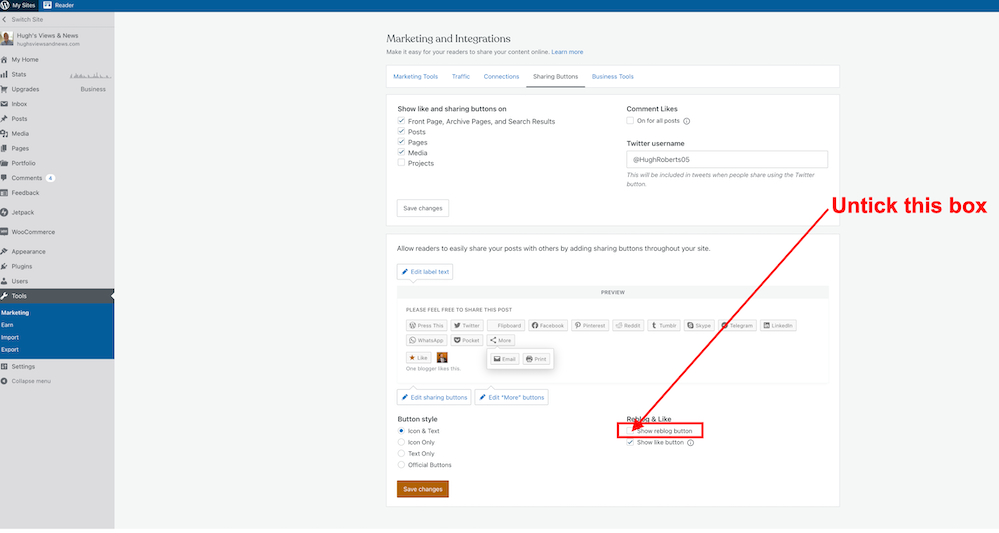
If you decide you would rather not offer the option to reblog your posts, you can disable the button by navigating to My Sites → Tools → Marketing. Then click on the Sharing Buttons tab.Disable ‘Show reblog button’ under Reblog & Like, and the Reblog button will no longer appear on your blog posts.
How to disable the reblog button on WordPress
Did You Know This?
Blogs that are full of reblogged posts are known as ‘Reblogging Farms.’ Is your blog a reblogging farm?
Do you still use the reblog button? If so, what do you reblog?
Follow Hugh On Social Media. Click on the buttons below.
If you’re a blogger who has used or still uses the reblog button to share other bloggers’ posts, I urge you to read this post.
Likewise, if you use photos or images in your own posts that are not your own or do not come from a genuine website that offers free images and photos, this post is a must-read.
Early 2021, during the lockdown, I had a nasty shock.
For me, the lockdown was terrific – I live in a farmhouse in the Scottish Highlands with gorgeous gardens, have a horse and a pack of rescue dogs, and for once, I could legitimately stay at home and not travel for work. This also allowed me to sit and write without feeling like I was short-changing some other part of my life.
What I had not expected, however, was to receive an email from a law firm accusing me of copyright infringement on a photograph I’d displayed on my blog back in my earliest blogging days, somewhere around 2013.
To add insult to injury, it wasn’t even a blog post I’d put together myself, but a collection of inspirational photos on a friend’s blog, which I’d reblogged!
I shared her post using the WordPress ‘Reblog’ button, and, as you may know, the post appears on your blog with a link to the original for anyone wanting to see more.
I had NO idea (this was quite early in my blogging career); this meant that ALL the photographs in that post were downloaded and stored in my own media library. The fact they were downloaded, even without my knowledge, became a potential legal problem.
If this happens to you, DO NOT ignore it.
The ‘Cease and Desist’ email came from an Italian law firm. Their client, the photographer, is based in the UK, as am I. It detailed the blog post and the specific photograph and demanded £1045.00 compensation for using the picture without obtaining a licence. This was justified as:
£195 financial loss (£39 per year for the licence)
£150 damages for flagrancy (putting the photographer at increased risk of having the photo stolen/used without obtaining a licence)
£100 damages for negative financial consequences
£150 for the absence of a picture credit
£50 damages for moral prejudice
£100 damages for consequential losses
£100 damages for devaluing the image
£200 lawyers’ fees
Scary, huh?
This was what I did:
The first step was to check that the law firm existed, looking up their website and digging a little on Google. Sadly, for me, it was legit.
Then I looked at the photographer’s site to find the photo. Yes, it was there, along with the price for an annual licence, as detailed in the legal letter.
So, having established that I had indeed violated copyright, although unwittingly, I checked my own post. As a reblog, I could only see the first picture, which wasn’t the one in dispute. I replied to the lawyer, asking for a screenshot of the image displayed on my site. To my shock, an image of the entire post came back, with all the photos in evidence displayed on my blog. I still don’t know how this is possible, but I couldn’t argue because they had the screenshot.
I removed the post from my site and also delved into my media library, which is when I discovered to my shock, that all the pictures from the post were stored there. I deleted them all, just in case.
I contacted the original blogger and advised her to delete it, which she did. The last thing I wanted was for them to go after her, too.
The next step was to contact the lawyer again and point out I was not the original poster, explaining it was a reblog of someone else’s post.
They replied that while they would consider this, I was still held responsible because the image had been displayed on my site. They dropped the proposed settlement to £800 and gave me 10 days to pay up.
I contacted another lawyer for advice. Her answer was: ‘If you did not download it and post it on your site, then you did not copy it. I would argue that re-posting or embedding is not copying because the image is hosted elsewhere and therefore cannot be copyright infringement.’ Note that last bit? Unfortunately, the way WordPress works, the photo had been downloaded and hosted on my own site, even though I hadn’t known it, so this didn’t help me.
I went back to the Italian lawyer and again stressed that I was not the person who had chosen to use the image. I felt they were being unfair coming after me and not the original poster (which is why I’d given her the heads-up first and ensured she’d removed all traces from her site before typing this message).
By now, this had gone on for 6 weeks, with me leaving it almost to the stipulated 10-day deadline when I replied to the lawyer. I never once refused to pay them, but I did not offer to do so or haggle about the sum. I spent more time researching potential help from legal groups, but…
Nearly a year on, and I’ve not heard from them again! This sounds fairly simple, but it was a time-consuming and stressful experience.
I understand from years ago, mainly when posting paper letters, that sometimes the answer to such events is to continue corresponding. Never offer anything, but keep querying small details and spread them out as long as possible. If nothing else, you may get a reduction (as I did) in the sum they demand.
I was lucky; I know others who have had to pay up. In this case, they apparently wrote me off as too much bother to pursue.
If you should be unfortunate enough to have this happen to you, the most important things are:
Don’t ignore it – it has the potential to be very expensive.
Don’t pay up straight away – always investigate your options.
Deborah Jay writes fantasy and urban fantasy featuring complex, quirky characters and multi-layered plots – just what she likes to read.
Fortunate enough to live not far from Loch Ness in the majestic, mystery-filled Scottish Highlands with her partner and a pack of rescue dogs, she can often be found lurking in secluded glens and forests, researching locations for her books.
Her first published novel, epic fantasy THE PRINCE’S MAN, won a UK Arts Council award and debuted as an Amazon Hot 100 New Release.
Reblogging saves many bloggers time. It’s quick to do and can result in more visits and comments to the reblogged post.
It’s also a safe option, but only when used correctly. Here are several points to consider and note if you intend to reblog another blogger’s post or have ever reblogged another blogger’s post.
If you reblog or have reblogged the blog posts of other bloggers, any images, videos or photos in those posts will have been downloaded into your WordPress media library. You could, therefore, have downloaded illegal images or photos and images that are copyrighted.
Check the small print – Some photos, images, and pictures may have a limited time that they’re free to use. After that, you could face a fine if they remain on your blog or in your media library.
Consider other options for sharing blog posts where images and photos are not downloaded to your blog. The ‘Press This’ sharing button is a good option, as no images and photos are downloaded to your media library.
Another option instead of reblogging is to write and publish a post that includes pingback links to blog posts you want to share. Blogger Sally Cronin does this with her ‘Blogger Weekly’ feature.
If you run a blogging challenge where you reblog posts from participants, consider adding links to those posts in your blog post or in a new blog post rather than reblogging them. Blogger Terri Webster Schrandt does this in her Sunday Stills photography challenge.
If you’re unsure that any content in a blog post you want to share is not free to download or use, don’t reblog the post.
Don’t think that what happened to Deborah won’t happen to you. It can!
If you believe you may have reblogged posts that have images or photos that are copyrighted or not free to download and use, delete the posts immediately.
After deleting posts, remember to remove any images and photos that appeared on the reblog from your WordPress media library, as deleting the post does not delete them.
Remember that copyright laws can also apply to lyrics, artwork, drawings and text.
WordPress offers users hundreds of free images and photos.
If you’re not convinced by Deborah’s experience of copyright infringement, then read Debby Kaye’s post here about a copyright experience she had where she was fined for reblogging a post that contained an image that was copyright protected.
If you have any questions about Deborah’s experience or about reblogging, leave them in the comments section. Deborah and I will try and answer them, although we cannot offer any legal advice.
Follow Hugh on Social Media. Click the buttons below.




 Hugh's Views & News