4 Tips For Housekeeping Your Blog And Improving Its SEO Rating

Performing housekeeping on your blog has many benefits. After all, who doesn’t want their blog to look like a friendly, easy-to-use and inviting place old and new visitors will want to keep coming back to?

If you’re a blogger looking to expand their readership, performing housekeeping on your blog is something you should seriously consider.

But what blog housekeeping jobs should you consider doing?
Banner for the blog post '4 Tips For Housekeeping Your Blog And Improving Its SEO Rating
This is why blog housekeeping is essential.

During a 4-day heatwave last month, I couldn’t venture outside, so I took the opportunity to do some blog housekeeping. Here’s what I did.

1. Delete old, out-of-date blog posts.

I always feel that old, out-of-date blog posts that can not be updated or rewritten do nothing but drag down my blog.

They hang around like some uninvited members of the family you hardly ever see or have contact with. You know they are there but feel afraid to ask them to leave.

I had over 400 blog posts on my blog, some of which were doing nothing apart from attracting spam comments. They were dead ducks. They were not attracting any new views, visitors or comments.

I ended up deleting over 80 posts. Not only did I feel good getting rid of what I considered clutter, but it made my blog look much better with no more outdated information.

Some bloggers claim that deleting old posts is not a good idea because they can look back and see how much they have improved since those early posts. I disagree! When you’re somebody who never goes back to read old posts, mainly because you don’t have the time to do so, deleting these old blog posts is like cutting away the string tied to the brick holding your blog down.

2. Fixing broken links.

A downside of deleting old blog posts is that any pingback and links you have to them will become broken.

I used Broken Link Check to run a report showing me broken links on my blog. It’s free to use.

Since SEOs like Google rank blogs that have broken links lower, cleaning up and fixing broken links is a job every blogger should consider.

That first broken link report could be long and overwhelming, but once you start running a broken link report every month, you’ll soon conquer that job.

Fixing broken links was the best bit of blog housekeeping I did because it improves your blog’s overall ranking, meaning more traffic and visitors to your blog.

3. Categories and tags

When I checked how many categories and tags I had on my blog, I was shocked by the number.

What amazed me was that many categories and tags were no longer active. Like some of my old blog posts, they were deadwood.

Checking which categories and tags are no longer active is easy.

Follow this guide.

  • On your blog’s dashboard, click on Posts and then Categories. (Click on Tags to manage Tags).
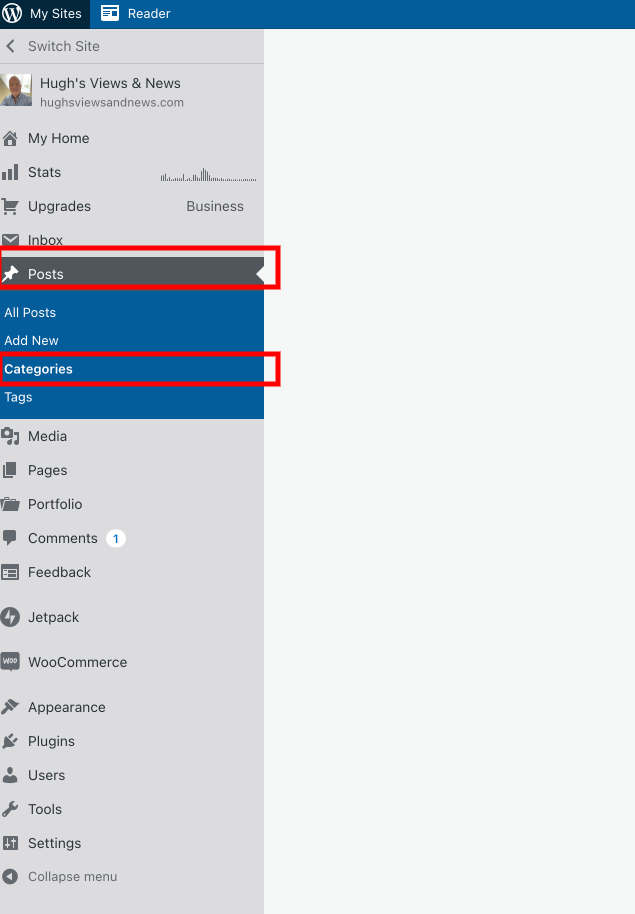
Image highlighting where to manage categories and tags on your WordPress blog
How to manage categories and tags on your WordPress blog

A list of all your categories will show how many posts you have under each category.

  • To delete a category, click on the meatball menu next to the number and click on ‘delete.’
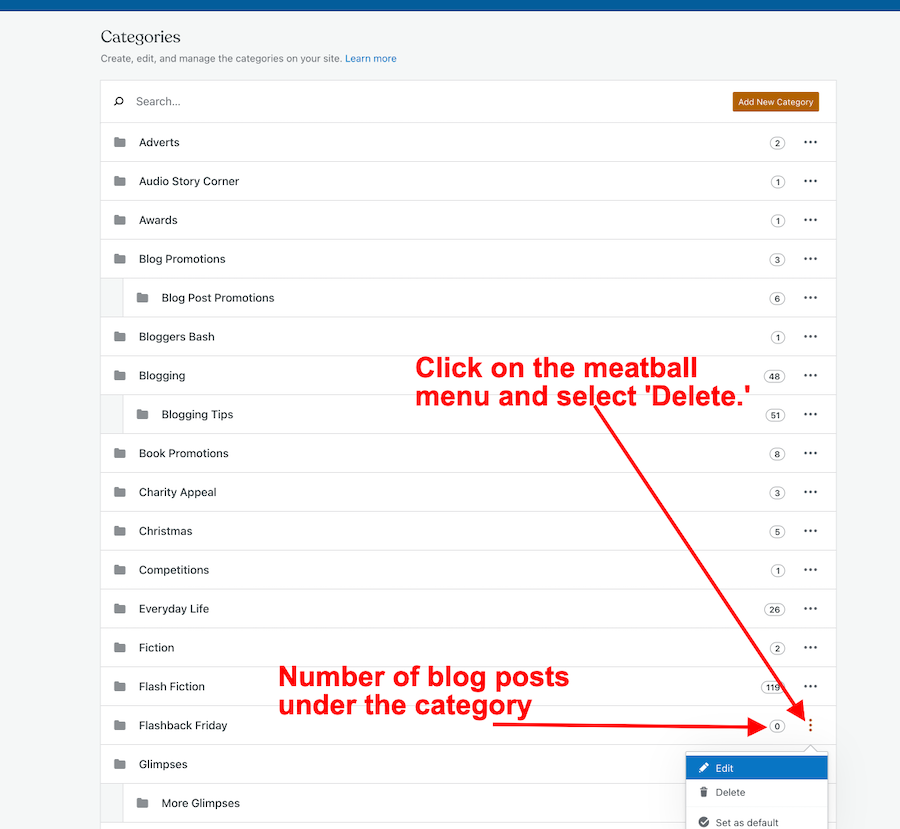
Image showing how to delete categories on a WordPress blog
How to delete categories on your WordPress blog

Follow the same process for managing the Tags on your blog.

4. Menu Bar

I also took the opportunity to tidy up the menubar on my blog. Although it was not what I considered ‘top heavy’, I moved some items to sub-categories.

Here’s an example. I moved some fictional stuff to sub-categories under ‘Fiction.’ When you hover over ‘Fiction‘ on the menu, you’ll see the sub-categories pop up.

Blogs with top-heavy menus can look overwhelming and messy to visitors.

For more information about menus on your blog, see ‘Menus‘ by WordPress.

Once you start housekeeping your blog, it will make you feel much more positive about blogging.

Try and get into the habit of housekeeping your blog at least once every six months, although I’d recommend running a broken links report at least once a month.

Let’s wrap it up

  • Performing housekeeping on your blog is something every blogger should perform at least once every six months.
  • A well-kept blog is one that old and new visitors will want to keep returning to.
  • Fixing broken links on your blog will improve your blog’s SEO rating.
  • Run a broken link report for your blog once a month. Fix any broken links.
  • Delete categories and tags that are no longer being used on your blog. Too many categories and tags can confuse readers.
  • Delete old out-of-date blog posts, especially if all they are doing is attracting lots of spam.
  • Try and keep the menu of your blog to a minimum. Top-heavy menus can look messy and overwhelming.

How often do you perform blog housekeeping? What do those jobs involve? Do you have any simple tips for housekeeping your blog? Share them in the comments.

Remember that a well-kept blog is a positive and friendly place for your visitors and readers.

Follow Hugh on social media. Click on the links below.

Copyright © 2022 hughsviewsandnews.com – All rights reserved.
79 Ways To Kill Your Blog

Have you ever killed your blog?

Did you know that a blog can be killed other than by just deleting it?

While not all of the items on the following list will kill your blog instantly, some are what some call slow burners, where the killing of your blog will take much longer.

Banner for the blog post '79 Ways To Kill Your Blog'
Are you thinking of killing your blog?

Are you responsible for doing any of these to your blog?

  1. Don’t have an ‘about me’ page on your blog.
  2. The ‘about me’ page takes visitors more than a minute to find.
  3. The ‘about me’ page starts with these words – ‘this is an example of an about me page…’
  4. The number of followers is more important to you than what you write and publish.
  5. Publishing too many poor-quality posts due to rushing them.
  6. Believe you have to publish content several times daily; otherwise, nobody will visit your blog.
  7. Have links on your blog that you have no idea are broken or can not be bothered to fix.
  8. You do not respond to comments.
  9. You do not respond to questions or queries.
  10. Don’t allow anyone to leave comments on your blog.
  11. Ignore your readers.
  12. Do not treat visitors to your blog as guests.
  13. Don’t give yourself a name by which you can be addressed in the comments section.
  14. Do not read other blogs.
  15. Do not leave comments on other blogs.
  16. Believe that blogging is going to make you rich.
  17. Believe your blog will make money within the first year.
  18. Leave links with no relevance (usually to your own posts) on the posts of other bloggers when not invited to do so.
  19. Don’t believe you need to promote your blog.
  20. Refuse to use social media to boost your blog posts.
  21. Refuse to keep up to date with blogging technology and changes.
  22. Think readers will find you rather than you find your readers.
  23. Do not use enough ‘white space’ between the paragraphs in your blog posts.
  24. The paragraphs on your posts are too long and blocky (more than 5 sentences long).
  25. Have no way readers can contact you on your blog other than by leaving a comment. (No ‘contact me’ page).
  26. Do not thank people for sharing your posts on their blogs.
  27. Do not use images and/or photos in any posts.
  28. Use images, photos and words (including lyrics) on your blog which are copyrighted and not free to use.
  29. Do not ask permission to use photos and/or images owned by other bloggers before using them.
  30. Ignore all copyright advice.
  31. Respond to constructive, negative comments in an unprofessional and unfriendly manner.
  32. Allow other bloggers to spam your blog with links that have nothing to do with the post’s content.
  33. Keep begging other bloggers to reblog your posts, visit, or follow your blog.
  34. Leave worthless comments on other blogs.
  35. Leave worthless comments on other blogs which clearly show you’ve not read the post.
  36. Do not take time to edit posts before publishing them.
  37. Do not preview your posts before publishing them.
  38. Inundate followers with too many posts in a short space of time instead of scheduling them out.
  39. Respond to comments left by trolls in the comments section of your blog, where all can read them.
  40. Allow trolls to leave comments on your blog.
  41. Allow trolls to attack other bloggers who have left comments.
  42. Personally attack other bloggers in the comments section on your own or different blogs.
  43. Steal the ideas of other bloggers and publish them on your blog as if the content is original and has been written by you.
  44. Fail to maintain and house-keep your blog regularly.
  45. Keep reblogging or rescheduling your own posts which are less than a few months old.
  46. Do not have a ‘landing’ page that will keep visitors returning.
  47. Ignore advice and feedback from other bloggers.
  48. Believe that blogging will only take up a few minutes of your time every week.
  49. Wake up and dread opening up your blog because of all the comments you will need to reply to.
  50. Keep telling your readers that you are giving blogging up, and keep coming back.
  51. Allow blogging to stress you out.
  52. Allow blogging to make you feel guilty.
  53. Your blog and/or blog posts are poorly laid out.
  54. Choose a font and background combination that makes it hard for visitors to read your posts.
  55. Fail to categorise all your blog posts (including reblogs).
  56. Fail to add ‘tags’ to your blog posts.
  57. Don’t understand ‘pingbacks’ and how to use them.
  58. Have no ‘search’ bar on your blog.
  59. Have a menu that is too top-heavy, making it overwhelming to readers.
  60. Fail to add your blog details to your gravatar.
  61. Fail to connect your social media accounts to your blog.
  62. Have pop-up boxes on your blog that can not be removed unless somebody subscribes to your mailing list.
  63. Have pop-up boxes on your blog which keeps popping up every time someone visits or until they have subscribed to your mailing list.
  64. Keep suffering from blog envy when you read a post you’d wish you’d written.
  65. Regularly publish posts that tell your readers to buy your book(s) or other products and services you offer rather than allow them to decide if they want to buy them.
  66. You believe that blogging is all about the number of blog posts you can publish daily rather than what you are writing about.
  67. You think you have the power to read and comment on every new blog post on all the blogs you follow.
  68. Fail to update your readers that you are about to take a blogging break and how long it will last.
  69. Lose motivation and a desire to continue blogging when your blog stats take a nosedive.
  70. Believe that everyone will enjoy reading every post you write and publish.
  71. Believe that all your followers will read and comment on all your posts.
  72. Get upset when your blog loses followers.
  73. Argue with bloggers and readers for failing to read and comment on all your blog posts.
  74. Follow other blogs in the hope that they will follow back before unfollowing them again.
  75. Believe all your readers will agree with everything you say in your blog posts.
  76. Think nobody will dare to disagree with what you have to say by leaving a constructive comment telling you why they disagree.
  77. Criticise other bloggers behind their backs (in the comments section of your own blog or on other blogs) for wanting to help other bloggers.
  78. Maintain too many blogs, thus spreading yourself too thinly.
  79. Fail to take some time away from blogging (knowing that you need to) because you believe the blogging world can not survive without you.

What about you? What would you add to the list? How would you kill your blog other than by deleting it?

This is an updated version of a post I wrote and published in 2017.

You can find the answers to solving many of the above issues by clicking on ‘blogging tips’ in the menu at the top of my blog, but feel free to leave any questions in the comments section. I’m always happy to help.

Whatever you do, keep blogging fun!

Copyright © 2022 hughsviewsandnews.com – All rights reserved.
How To Help Prevent Somebody From Stealing Your Blog Posts And Photos

Have you ever had any of your blog posts stolen? What I mean by that is literally copied word for word to another blog.

It’s happened to me a few times, and it’s also happened recently to James, who blogs at Perfect Manifesto. Read his post here.

Reading James’s post prompted me to update and republish this post from 2019.

Banner for the blog post 'How To Help Prevent Somebody Stealing Your Blog Posts And Photos'
Are you protecting your blog posts and photos from being stolen and used without your permission?

Some of my blog posts have been copied and published on other blogs. The thieves gave full credit for the work to themselves. When it first happened to me, I was utterly shocked and angry.

Unfortunately, with the internet being such a vast, open space used by billions of people worldwide, the chance of having your blog posts or work stolen is high.

Don’t think your blog is too small to have its contents stolen. As you’ll see in the comment image below, James felt his blog was too small for anyone to want to steal his blog posts, but he was wrong.

Screenshot showing comments about stolen blog posts
Never assume that nobody will steal your blog posts, images or photos

Whether it’s photos, fiction, reviews, poetry, recipes or gardening tips, everything faces the chance of being copied and somebody else taking full credit for your hard work.

What should you do if you discover one of your blog posts or photos have been stolen?

Contact the blogger concerned and ask them to remove what they have stolen.

If that fails, contact the blogging platform hosting the blog and file a copyright claim against the blogger. Whenever I have filed a claim. I’ve been lucky that the offending blogs and their contents were deleted.

Click here to find out what to do if a WordPress.Com user has infringed your Copyright.

What Can I Do To Protect My Blog Posts And Photos Being Stolen?

What I am about to advise you to do may not stop somebody else from copying your work, but it acts as a warning to anyone thinking of copying or duplicating your work without your permission that they could face the possibility of prosecution, a fine, both, or having their blog deleted by their host.

1. Display a copyright and disclaimer notice

I recommend that anybody with their own blog or web page clearly display a ‘Copyright and/or Disclaimer’ notice.

Some websites offer ‘Copyright and Disclaimer’ notices free of charge and give instructions on how to copy and paste one of these notices to your blog or webpage.

WordPress offers excellent advice and instructions on displaying a ‘Copyright and/or Disclaimer’ notice. Click here to view it.

2. Widgets and menus

If you use a theme on your blog which displays widgets, I recommend you display your Copyright and/or disclaimer notice as one of your widgets. I use the Toujours theme on my blog, and the widgets I use are displayed on the sidebar to the right of my blog posts.

My ‘Copyright’ notice is the last widget at the bottom of my sidebar, while my disclaimer notice (Disclaimer & GDPR) can be found on the menu at the top of my blog. Take a look at them.

You are welcome to use them as your blog’s copyright and disclaimer notices. All you need to do is copy and paste them to your own blog and, where necessary, change some of the wording to reflect your own name and the name of your blog.

If you’re unsure what ‘widgets’ are or how to add them to your WordPress blog, click here for full details.

3. Copyright every blog post

I always add a copyright mark at the end of all my blog posts. All my posts finish with Copyright © (Year) hughsviewsandnews.com – All rights reserved. Doing this also helps as a deterrent against copying my posts. Remember to change the year when a new year begins.

You’ll see I’ve placed a copyright notice at the base of this post.

When a bot or spambot copies one of your posts, it won’t remove the copyright mark. Therefore, anyone reading the post may become suspicious and realise the post has been stolen. It also acts as a warning not to follow the blog that has stolen the post.

4. Protect your photos and images

Many bloggers also include photos and pictures in their posts.

While you may display a Copyright and/or disclaimer notice on your blog, I recommend you also watermark your photos and images.

Most computers come with software that helps edit photos you have loaded onto your hard drive, but there are other ways to watermark them.

I use an app called ‘Photobulk’ to watermark all my photos. It’s easy to use and costs around $9.99, but it can often be found on offer or free to download from the developer’s website. Click here to visit the website. (The link is not an affiliated link, so I do not receive any payment from it.)

I simply drag any photos I want to watermark to Photobulk, type in the text for the watermark I use (in my case, I use © hughsviewsandnews.com), and press ‘start.’ My photos are then watermarked with my details.

There are free watermarking apps for Apple products, too many to mention here, so check the Apple App Store for more details.

What about Android users?

Click here for a free photo watermarking app for android. As an Apple user, I’ve never used the app, but the reviews for this particular app are excellent.

Don’t forget you can also add copyright notices as a photo caption. Your copyright details will then show under the photo, but it is best to watermark the photos, making stealing them more difficult.

5. Remove the reblog button from your blog

If you don’t want your blog posts stolen or shared by other bloggers, consider removing the reblog button from your blog. My post, Is Reblogging Dead? Why I Have Removed The Reblog Button From My Blog, details why you should remove the reblog button and how to remove it.

If you have a reblog button on your blog, readers will assume you’re happy for them to reblog your posts. So, remove the reblog button if you don’t want any of your posts reblogged.

6. Remember to update

Finally, always ensure you download the latest updates for any apps or software you use; otherwise, they may not work correctly. This includes antivirus software for your computer and the latest updates for the blogging platform you use.

Of course, if you’re not worried about your blog posts, work, photos or images being copied or used without your permission, you can ignore all the above advice. However, I’d be surprised if any bloggers are not concerned about their posts, work and photos being stolen.

Remember what I said earlier? James thought his blog was a low target for thieves to steal his blog posts, but it happened.

If you have any questions about displaying copyright and/or disclaimer notices on your blog, please leave a comment.

Let’s wrap it up

  • Don’t assume your blog is too small to have anything stolen from it. It can happen to anyone.
  • Display a copyright and disclaimer notice on your blog.
  • Copyright every blog post by adding a copyright mark at the end of every post.
  • Watermark photos and images with the name of your blog before inserting them into posts.
  • If you don’t want other bloggers reblogging your posts, remove the reblog button from your blog.
  • Remember to update apps, antivirus software and any updates your blogging host releases.

Have you ever had your blog posts and/or photos/images copied and used without your permission? What do you do to help stop your blog posts, photos and images from being used illegally?

Copyright © 2022 hughsviewsandnews.com – All rights reserved.

Is Reblogging Dead? Why I Have Removed The Reblog Button From My Blog

How often do you click on the reblog sharing button?

Are you somebody who reblogs every day or, like me, no longer uses the reblog button?

Banner for the blog post 'Is Reblogging Dead? Why I Have Removed The Reblog Button From My Blog
Are you still reblogging?

When I first started blogging in 2014, I was amazed by how many bloggers used the reblog button. Fast forward to today, and I see little use for it.

It’s one of the reasons why I removed the reblog button from my blog. Not only have I seen a sharp decline in the reblogging of my posts, but I’ve seen the same in the reblogging of the posts of other bloggers.

Looking Back

I remember the first time one of my blog posts got reblogged. It was one of the highlights of my blogging journey. Funnily, it marked the beginning of my believing I’d become a successful blogger.

For years, my blog posts got reblogged almost weekly. It helped put me and my blog in front of new readers and did wonders for the number of followers my blog gained.

When Followers Are Not Followers

Of course, not all followers are followers.

I soon learned that people followed my blog but never returned to it.

I knew that some unfollowed my blog as soon as I followed them back.

I couldn’t figure out why anyone would unfollow my blog as soon as I followed them, but a couple of years into my blogging journey, I discovered that some bloggers are more interested in numbers than content. They don’t hang around in the blogging world for long.

What’s The Most Significant Risk In Reblogging?

When I first heard of bloggers receiving fines for reblogging material that included copyrighted material, my love of reblogging began to dwindle. Seriously? Are bloggers fined for reblogging? Yes, it’s true, and that may be one of many reasons why many bloggers no longer use the reblog button.

When author and blogger Deborah Jay wrote a guest post for me, she shared her story of how a simple reblog ended up with her being threatened with legal action and a fine. Click here to read the post.

But it’s not only Deborah who has faced legal action and a fine for reblogging another blogger’s blog post. Several bloggers have been fined for reblogging blog posts that included copyrighted photos or images.

Don’t think it can’t happen to you. It can happen to anyone who shares copyrighted material on their blog.

Removed The Reblog Button From Your Blog? Your Posts Can Still Be Reblogged!

Did you know that just because I have removed the reblog button from my blog posts doesn’t mean nobody can no longer reblog them?

One of the few flaws of WordPress that annoys me is that readers can still reblog any of my posts from the WordPress Reader. That doesn’t make sense to me when I’ve removed the reblog button from my blog.

Fortunately, it hasn’t happened to any of my blog posts since I removed the reblog button.

However, I am still delighted when somebody shares my blog posts via a ‘pingback‘ the ‘Press This‘ marketing (not sharing) button or on social media.

Feel free to share this post via one of those methods.

How Do I Remove The Reblog Button From My Blog?

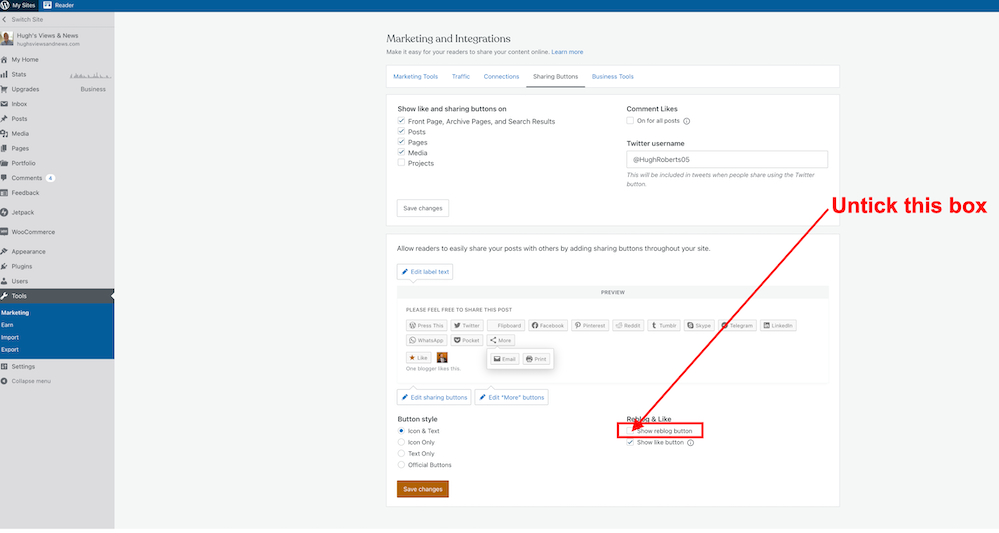
If you decide you would rather not offer the option to reblog your posts, you can disable the button by navigating to My Sites → Tools → Marketing. Then click on the Sharing Buttons tab. Disable ‘Show reblog button’ under Reblog & Like, and the Reblog button will no longer appear on your blog posts.

Image showing how to disable the reblog button on WordPress
How to disable the reblog button on WordPress

Did You Know This?

Blogs that are full of reblogged posts are known as ‘Reblogging Farms.’ Is your blog a reblogging farm?

Do you still use the reblog button? If so, what do you reblog?

Follow Hugh On Social Media. Click on the buttons below.

Copyright © 2022 hughsviewsandnews.com – All rights reserved.
How To Participate In Throwback Thursday And Help Your Old Blog Posts Get Noticed

What is Throwback Thursday?

How do you participate in Throwback Thursday?

Throwback Thursday is the day to bring your old blog posts back to life.

Image for the blog post 'How To Participate In Throwback Thursday And Help Your Old Blog Posts Get Noticed Again'
Are you making the most of your old blog posts?

We all have old blog posts in our archives, many of which are buried bits of treasure that can reward us again. Throwback Thursday is the perfect day to rekindle those old blog posts.

Only use blog posts that are still relevant, although always ensure you first make any necessary changes to the posts you want to highlight.

How to participate in Throwback Thursday

Select a favourite blog post that is at least a few months old.

Share it via a pingback or link in a new Throwback Thursday blog post.

After all, not only will some of your readers not have seen the post the first time it was published, but new followers may also not have seen it.

However, as I mentioned, rather than publish the whole post again, the idea behind Throwback Thursday is to include a link to the post you want to highlight in your Throwback Thursday post.

What you should do with your Throwback Thursday blog posts.

Only publish the post on a Thursday. That may seem like common sense, but I’ve seen bloggers publish them on other days of the week. Some readers may find it odd to publish Throwback Thursday posts on any other day than a Thursday. After all, the clue is in the title.

However, don’t worry if you miss publishing your Throwback Thursday blog post. You can always delay publication until the following Thursday. There are lots of Thursdays to choose from.

Flashback Friday.

If you’re a day late in publishing your Throwback Thursday post, you can always change it to a Flashback Friday post. Flashback Friday has the same concept as Throwback Thursday, where you are encouraged to highlight older blog posts.

Share your Throwback Thursday posts on social media using the hashtag #ThrowbackThursday so that other participants can find your post.

Tag your post ‘ThrowBack Thursday’ on your blog so other participants can find it.

You can also include the words ‘Throwback Thursday’ or the hashtag in the title of your blog post, but always ensure you add the title of the blog post you’re highlighting. You don’t want to end up with many blog posts simply titled ‘Throwback Thursday.’

When creating the pingback to the post you want to highlight, ensure you turn on the ‘open in new tab‘ button so that readers don’t lose the page of your blog they’re on.

Not sure how to create a pingback? Click here for full details.

Is there anything else I should consider when publishing Throwback Thursday blog posts?

Yes, I recommend closing comments on the post and asking readers to leave any new comments on the original blog post you’re highlighting. That way, they can see and read comments already left on the post you’re promoting. They can join any ongoing discussion. It makes more sense to have comments on the same post rather than scattered across several blog posts.

When selecting which posts to promote, choose the ones you believe your readers will benefit from and think they’ll enjoy reading again.

And that is Throwback Thursday.

Do you participate in Throwback Thursday? Do you have any questions about Throwback Thursday? Please leave them in the comments section.

Join Hugh on Social Media. Click the button below.

Copyright © 2022 hughsviewsandnews.com – All rights reserved.
Flash Fiction Friday – How To Farm A Blog

February 28, 2022, prompt: In 99 words (no more, no less), write about the farm life. Where is the farm and who are the farmers? What are they farming and why? How is the farm life? Go where the prompt leads! Click here for details.


How To Farm Your Blog – by Hugh W. Roberts

“Have you tried farming out your blog posts instead of cluster-publishing them?” asked the blogging genie.

“Farming them out?”

“Yes, another word for scheduling. Instead of publishing too many blog posts and overwhelming your readers, farm them out by scheduling them over a more extended period. Your readers won’t feel swamped.”

“I like that idea.”

“And don’t forget to farm out the posts you want to reblog. Instead of reblogging them the same day the original post is published, allow them to grow and farm them out a week later. After all, farming and blogging are all about growth.”

***

Written for the 99-word flash fiction challenge hosted by Charli Mills at the Carrot Ranch.

***

Notes

The definition of a cluster-blogger is somebody who publishes many blog posts within a short timeframe and then does not publish the next batch of blog posts for many days/weeks or months. It can result in making readers feel overwhelmed.

Scheduling blog posts in advance and leaving at least six hours between the publication of blog posts decreases the sense of overwhelmingness, resulting in a more manageable and enjoyable reading experience. 

Click here for information on how to schedule blog posts. 


Enjoyed this piece of flash fiction? Then you’ll love Glimpses

Glimpses

28 short stories and pieces of flash fiction take the reader on a rollercoaster of twists and turns.

Available on Amazon

Paperback – £4.99

Kindle – £0.99

***

Follow Hugh on his social media platforms by clicking the buttons below.

Copyright © 2022 hughsviewsandnews.com – All rights reserved.

Why I Was Threatened With Legal Action After Reblogging On WordPress – A True Story And Guest Post by Deborah Jay @DeborahJay2

If you’re a blogger who has used or still uses the reblog button to share other bloggers’ posts, I urge you to read this post.

Likewise, if you use photos or images in your own posts that are not your own or do not come from a genuine website that offers free images and photos, this post is a must-read.


Early 2021, during the lockdown, I had a nasty shock.

For me, the lockdown was terrific – I live in a farmhouse in the Scottish Highlands with gorgeous gardens, have a horse and a pack of rescue dogs, and for once, I could legitimately stay at home and not travel for work. This also allowed me to sit and write without feeling like I was short-changing some other part of my life.

What I had not expected, however, was to receive an email from a law firm accusing me of copyright infringement on a photograph I’d displayed on my blog back in my earliest blogging days, somewhere around 2013.

To add insult to injury, it wasn’t even a blog post I’d put together myself, but a collection of inspirational photos on a friend’s blog, which I’d reblogged! 

I shared her post using the WordPress ‘Reblog’ button, and, as you may know, the post appears on your blog with a link to the original for anyone wanting to see more.

I had NO idea (this was quite early in my blogging career); this meant that ALL the photographs in that post were downloaded and stored in my own media library. The fact they were downloaded, even without my knowledge, became a potential legal problem.

If this happens to you, DO NOT ignore it.

The ‘Cease and Desist’ email came from an Italian law firm. Their client, the photographer, is based in the UK, as am I. It detailed the blog post and the specific photograph and demanded £1045.00 compensation for using the picture without obtaining a licence. This was justified as:

  • £195 financial loss (£39 per year for the licence)
  • £150 damages for flagrancy (putting the photographer at increased risk of having the photo stolen/used without obtaining a licence)
  • £100 damages for negative financial consequences
  • £150 for the absence of a picture credit
  • £50 damages for moral prejudice
  • £100 damages for consequential losses
  • £100 damages for devaluing the image
  • £200 lawyers’ fees

Scary, huh?

This was what I did:

  • The first step was to check that the law firm existed, looking up their website and digging a little on Google. Sadly, for me, it was legit.
  • Then I looked at the photographer’s site to find the photo. Yes, it was there, along with the price for an annual licence, as detailed in the legal letter.
  • So, having established that I had indeed violated copyright, although unwittingly, I checked my own post. As a reblog, I could only see the first picture, which wasn’t the one in dispute. I replied to the lawyer, asking for a screenshot of the image displayed on my site. To my shock, an image of the entire post came back, with all the photos in evidence displayed on my blog. I still don’t know how this is possible, but I couldn’t argue because they had the screenshot. 
  • I removed the post from my site and also delved into my media library, which is when I discovered to my shock, that all the pictures from the post were stored there. I deleted them all, just in case.
  • I contacted the original blogger and advised her to delete it, which she did. The last thing I wanted was for them to go after her, too.
  • The next step was to contact the lawyer again and point out I was not the original poster, explaining it was a reblog of someone else’s post. 
  • They replied that while they would consider this, I was still held responsible because the image had been displayed on my site. They dropped the proposed settlement to £800 and gave me 10 days to pay up.
  • I contacted another lawyer for advice. Her answer was: ‘If you did not download it and post it on your site, then you did not copy it. I would argue that re-posting or embedding is not copying because the image is hosted elsewhere and therefore cannot be copyright infringement.’ Note that last bit? Unfortunately, the way WordPress works, the photo had been downloaded and hosted on my own site, even though I hadn’t known it, so this didn’t help me.
  • I went back to the Italian lawyer and again stressed that I was not the person who had chosen to use the image. I felt they were being unfair coming after me and not the original poster (which is why I’d given her the heads-up first and ensured she’d removed all traces from her site before typing this message). 
  • By now, this had gone on for 6 weeks, with me leaving it almost to the stipulated 10-day deadline when I replied to the lawyer. I never once refused to pay them, but I did not offer to do so or haggle about the sum. I spent more time researching potential help from legal groups, but…
  • Nearly a year on, and I’ve not heard from them again! This sounds fairly simple, but it was a time-consuming and stressful experience.

I understand from years ago, mainly when posting paper letters, that sometimes the answer to such events is to continue corresponding. Never offer anything, but keep querying small details and spread them out as long as possible. If nothing else, you may get a reduction (as I did) in the sum they demand.

I was lucky; I know others who have had to pay up. In this case, they apparently wrote me off as too much bother to pursue. 

If you should be unfortunate enough to have this happen to you, the most important things are: 

  1. Don’t ignore it – it has the potential to be very expensive.
  2. Don’t pay up straight away – always investigate your options.

Deborah Jay writes fantasy and urban fantasy featuring complex, quirky characters and multi-layered plots – just what she likes to read.

Fortunate enough to live not far from Loch Ness in the majestic, mystery-filled Scottish Highlands with her partner and a pack of rescue dogs, she can often be found lurking in secluded glens and forests, researching locations for her books.

Her first published novel, epic fantasy THE PRINCE’S MAN, won a UK Arts Council award and debuted as an Amazon Hot 100 New Release.

Photo of author, writer and blogger Deborah Jay

Connect With Deborah

Blog: Deborah Jay

Facebook

Twitter

Pinterest

Goodreads

Amazon

Newsletter & Free Short Story

Books

THE PRINCE’S MAN

DESPRITE MEASURES

SPRITE NIGHT

THE WORLD AND THE STARS

Image of the books by Deborah Jay
Books by Deborah Jay

Important Reminders About Reblogging from Hugh

Reblogging saves many bloggers time. It’s quick to do and can result in more visits and comments to the reblogged post.

It’s also a safe option, but only when used correctly. Here are several points to consider and note if you intend to reblog another blogger’s post or have ever reblogged another blogger’s post.

  • If you reblog or have reblogged the blog posts of other bloggers, any images, videos or photos in those posts will have been downloaded into your WordPress media library. You could, therefore, have downloaded illegal images or photos and images that are copyrighted.
  • Check the small print – Some photos, images, and pictures may have a limited time that they’re free to use. After that, you could face a fine if they remain on your blog or in your media library.
  • Consider other options for sharing blog posts where images and photos are not downloaded to your blog. The ‘Press This’ sharing button is a good option, as no images and photos are downloaded to your media library.
  • Another option instead of reblogging is to write and publish a post that includes pingback links to blog posts you want to share. Blogger Sally Cronin does this with her ‘Blogger Weekly’ feature.
  • If you run a blogging challenge where you reblog posts from participants, consider adding links to those posts in your blog post or in a new blog post rather than reblogging them. Blogger Terri Webster Schrandt does this in her Sunday Stills photography challenge.
  • If you’re unsure that any content in a blog post you want to share is not free to download or use, don’t reblog the post.
  • Don’t think that what happened to Deborah won’t happen to you. It can!
  • If you believe you may have reblogged posts that have images or photos that are copyrighted or not free to download and use, delete the posts immediately.
  • After deleting posts, remember to remove any images and photos that appeared on the reblog from your WordPress media library, as deleting the post does not delete them.
  • Remember that copyright laws can also apply to lyrics, artwork, drawings and text.

WordPress offers users hundreds of free images and photos.

If you’re not convinced by Deborah’s experience of copyright infringement, then read Debby Kaye’s post here about a copyright experience she had where she was fined for reblogging a post that contained an image that was copyright protected.

If you have any questions about Deborah’s experience or about reblogging, leave them in the comments section. Deborah and I will try and answer them, although we cannot offer any legal advice.

Follow Hugh on Social Media. Click the buttons below.

Not sure it’s free? Then don’t reblog, copy or download it.

I thank Deborah for sharing her true story about the perils of reblogging with us and for allowing me to publish it on my blog.

Do you have any experience of being fined for copyright infringement?

Copyright © 2022 hughsviewsandnews.com – All rights reserved.

How Do You Measure The Success Of Your Blog Posts?

How do you measure the success of a blog post?

Banner for the blog post 'How Do You Measure The Success Of Your Blog Posts?'
Which of your blog posts are the most successful?

As we drift into the last few weeks of the year, I find the world of blogging gradually becomes a quieter place. Like thousands of others, I’ll be taking a seasonal blogging break as we head deeper into December. 

However, one of the most popular posts I see appearing every December and early January is the traditional ‘My Top 10 Blog Posts Of The Year’ post. It won’t be long before these annual posts drop into your email inbox and WordPress Reader. 

But how do bloggers measure the success of those top 10 posts? What is it that helps make those posts appear in their ‘top 10’ lists?  

The more hits, the more successful? 

Most bloggers who will publish their ‘Top 10 Blog Posts of 2021’ blog post will base their list on the number of hits each blog post achieved. But that always has me questioning if that is the right way to compile a top 10 list. 

A blog post may have thousands of hits, but how many actually read the content? Does not reading a post make it successful? Should the number of hits count towards success when we’ve no idea how many times the post was read?

Does landing on a blog post by mistake make a post more successful when some of those who land there don’t stay and read the content?

Search engines are essential for finding something in particular on the web. However, how often have I clicked a link, then moved on quickly after realising the page I landed on isn’t what I was looking for? I’ll be honest and say that I’ve lost count!  

It’s made me question whether that click I made should count towards making the post more successful when I haven’t read the content. 

Volume V’s Sales

Let’s have a look at it another way. Take these two identical shops: 

Shop ‘A’ gets hundreds of customers a day because of its location or large advertising budget. However, it gets few sales a day. 

Shop ‘B” gets a much smaller number of customers because of its location or smaller advertising budget but gets a high sales volume. 

Which of the shops is the most successful? A or B?

When should comments count towards success?

If I compiled my ‘Top 10 Posts of 2021’ post based on the number of comments every post got, my top 10 list would look very different from the list I compiled for the number of hits or ‘likes’ a post got.

For example, one of my posts that received the most hits did not get any new comments or ‘likes’ left in the last 12 months. Yet the post that was number 21 on my most hits list got three new comments and six further ‘likes.’ Which one should be considered to have been the most successful in the last 12 months?

Then there are some bloggers (like me) who may not count specific comments. Comments that add value or prove the post was read count. Whereas lazy comments such as ‘Great Post’ or comments that only include a line of emojis may not count. 

When measuring success, should we include all comments or only those that add value or prove the post was read? 

When is a ‘like’ not a ‘like’?

I’ve never been a fan of the ‘like’ button on blogs since I discovered that some bloggers and readers misuse it. However, I see many bloggers basing the success of posts on the number of clicks on the ‘like’ button. 

Should clicking ‘like’ without reading a post count towards making a post successful? How many times have you had the same person press the ‘like’ button on lots of your blog posts within seconds of each other?

How many times has somebody clicked the ‘like’ button within seconds of you publishing a post?

Surely Sandra read my 900-word post if she clicked ‘like’ within ten seconds of me publishing it, didn’t she? Otherwise, why would she have clicked the ‘like’ button?

How do we know if somebody who clicks ‘like’ actually read the post?

Unfortunately, unless somebody clicks ‘like’ a reasonable time after publication, and leaves a genuine comment that proves they’ve read the post, we don’t know.  

Misuse of the ‘like’ button seems widespread in the blogging world, with some readers even pressing it to ease the guilt of not having time to read and comment on a post. Some click ‘like’ as a sign of support but may not read the post. Should those ‘likes’ count towards the success of a post?

Some see the ‘like’ button as nothing more than a free promotional tool for their blog, without even reading a post. Leave a ‘like’ and, fingers crossed, it will bring in some new visitors. 

The only success we should be discussing for these types of ‘likes’ is that the person clicking the ‘like’ button feels the post and blog are successful. All they’re doing is jumping on the success bandwagon of somebody else’s hard work.

If you’re wondering why I still have the ‘like’ button at the bottom of all my posts, allow me to enlighten you. I discovered (and WordPress told me) that it is connected to the ‘reblog’ button. Remove it, and the ‘reblog’ button also disappears from your blog posts.

That’s something I was not willing to allow. 

And removing the ‘like’ button from your blog doesn’t mean it will be removed from posts when they appear on the WordPress Reader. If you’ve removed the ‘like’ button from your blog, are you aware that people can still click on a ‘like’ button when reading your posts on the WP Reader?

How do I measure the success of a blog post?

Simple. If I were motivated or inspired to write and publish a post, then it would be a success. Therefore, you won’t find a ‘Top 10 Blog Posts Of 2021’ post on my blog.  

Winding-up

At the end of the day, I guess it’s entirely up to the blogger concerned about how they measure the success of their blog posts. What I do question, though, is whether bloggers should be publishing results that are not necessarily accurate.

Allow me to run a final thought past you 

Suppose a blog post gets only a few hundred hits but receives over 50 genuine comments and likes. Does it make it more successful than a post with thousands of hits yet very few comments and likes?

What do you think? How would you measure the success of a blog post?

Copyright © 2021 hughsviewsandnews.com – All rights reserved.