You wouldn’t leave your doors unlocked if you were the last one to leave the house, would you?
Would you give a stranger the password to your online banking account?
Would you share or give a stranger the password to your blog?
Protecting your blog is just as important as protecting your home and online bank accounts, yet many bloggers share personal details about themselves on their blogs and on social media, which can be a treasure trove for scammers. Be careful what information you share.
Before sharing any information, ask yourself, ‘Would I share this information with a complete stranger?’
Adding this feature will give your blog an extra layer of security.
Although we’re all encouraged to use a strong password to protect our blogs, did you know that many blogging platforms, including WordPress, offer users an extra layer of security when it comes to protecting their blogs?
Two-factor authentication adds an extra layer of security by requiring you to enter a code or use another device in addition to your password. For example, you can use an app like Microsoft Authenticator or Google Authenticator to generate access codes for your blog.
WordPress offers users two-factor authentication security. Follow the guide below to set it up for your WordPress blog. For this example, I’m using an Apple iMac desktop computer.
How to set up two-step authentication for your WordPress blog.
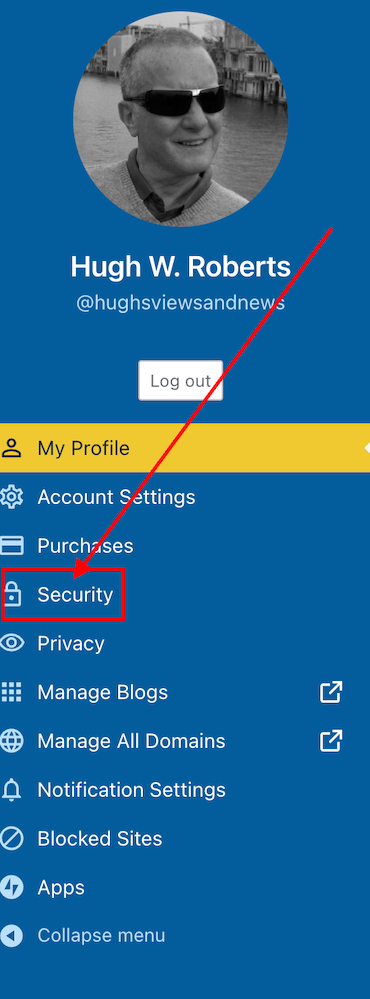
In the top right of your blog, click on your profile picture/avatar.
Click on ‘Security‘ in the menu on the page’s left side.
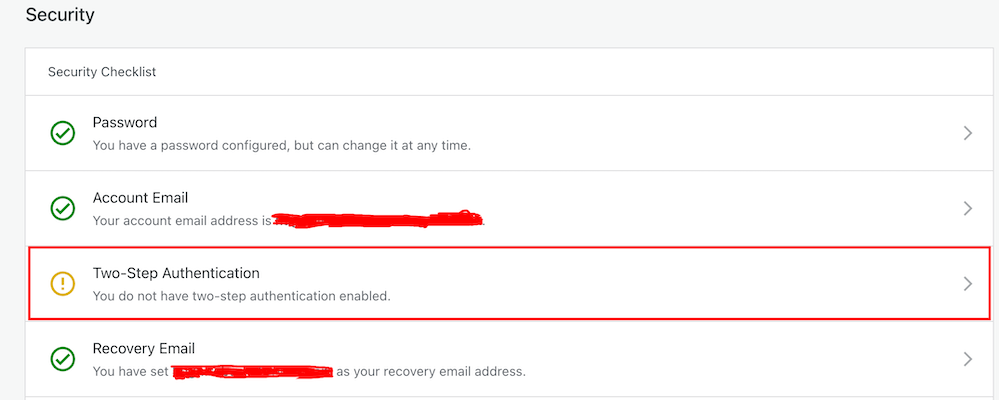
Click on the ‘Security’ tab.
Select the ‘Two-step Authentication‘ option.
Select Two-Step Authentication
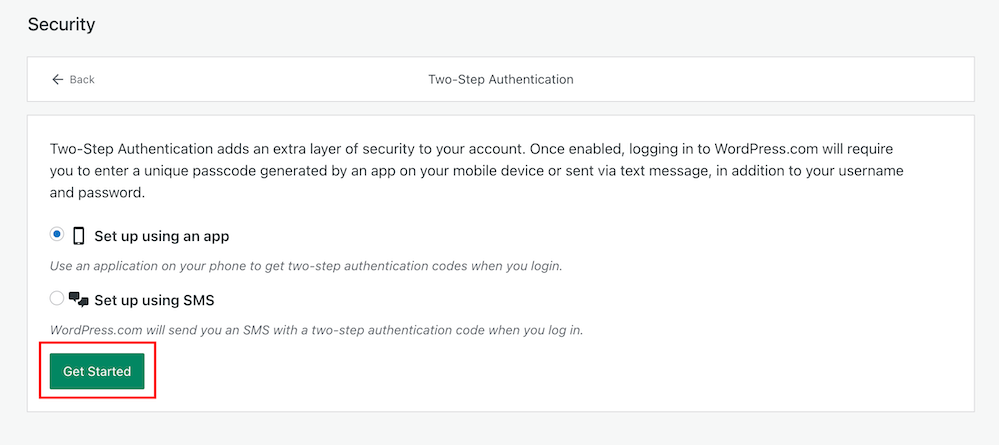
Select which method you would like to receive the two-step passcode generated by WordPress, and click the ‘Get Started‘ button.
Click the ‘Get Started’ button.
Follow the onscreen instructions depending on your selected method to receive the WordPress two-step authentication passcode.
Once enabled, logging into WordPress.com will require you to enter a unique passcode generated by an app on your mobile device or sent via text after adding your username and password.
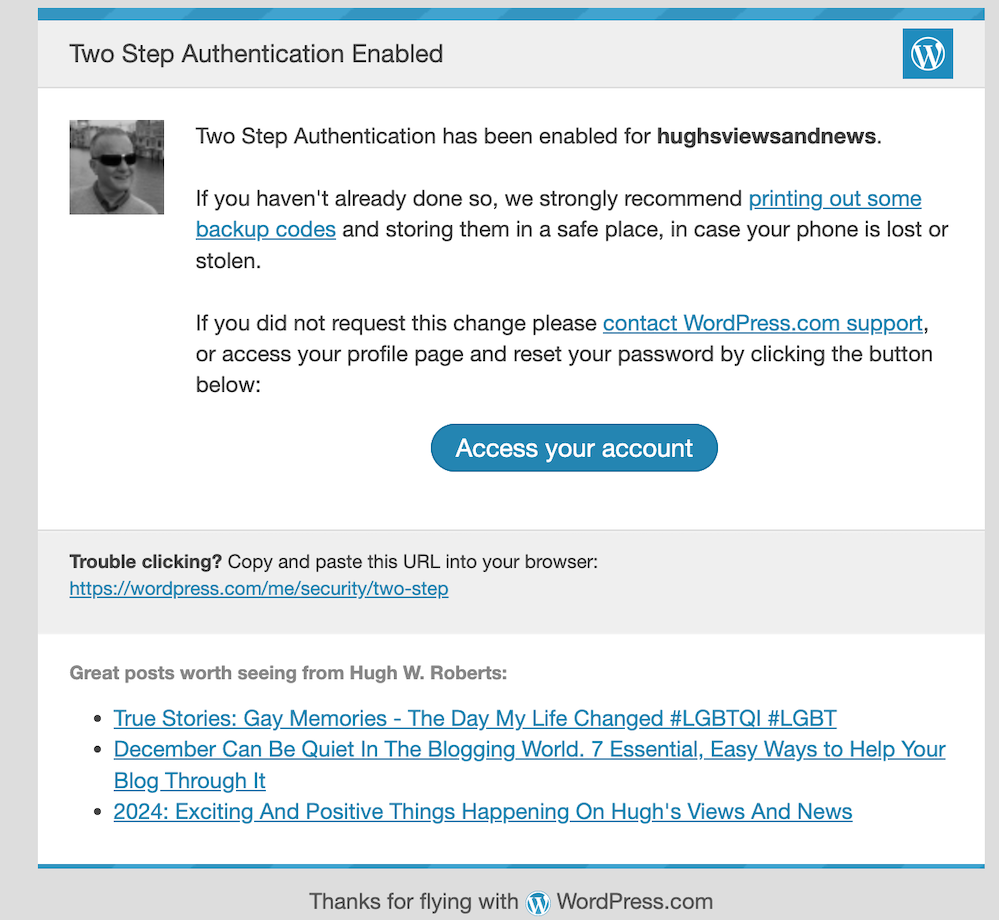
You will receive an email from WordPress confirming that two-step authentication has been enabled.
You’ll get an email from WordPress confirming that two-step authentication has been set up for your blog.
That’s it! Access to your blog is now protected by an extra layer of security.
I’d recommend adding or checking that the recovery email address and recovery SMS number for your WordPress blog/account are also correct when switching on two-step authentication.
Are you making the most of Two-Step Authentication to safeguard your blog? Need guidance on setting it up? Share your best practices for securing your blog in the comments below.
Did you catch these 6 blog posts that got everyone talking, discussing, and wondering? Maybe you were part of the conversation, but if not, jump in and share your thoughts!
Do you like this tree as much as I do? Share some photos with me of some of your favourite festive trees.
Performing these 7 jobs on your blog now will bring you and your blog excellent results in the New Year. Plus, are you planning to take a blogging break during December?
What, in your opinion, are the best festive colour combinations? Let me know in the comments section. Share a picture of your favourite festive colour combination.
Poetry is the hardest form of writing for me. Yet, this short Christmas poem is one of the first things I published on my blog. Why have I never written and published more poetry? What do you find the most difficult thing to write?
Did you catch these 11 blog posts that got everyone talking, discussing, and wondering? Maybe you were part of the conversation, but if not, jump in and share your thoughts!
What’s your opinion about the object in this photo? Is it a work of art or something that needs to be trashed? Let me know in the comments section. Share a picture of something you consider a work of art that others would trash.
If you use reusable blocks on WordPress, you may be wondering where WordPress has moved them. My post has all the details. Plus, I give my verdict on two new WordPress features you may like to try out.
There is always somebody, isn’t there? Somebody who knows I’m taking a photo. Can you spot them in this crowd? (Hint – You may need to zoom in to find them).
What’s your experience of dealing with WordPress? Are you experiencing problems with WordPress? Have you reported the problems to them? If not, why not? The 6 best ways to contact WordPress.
Whether you’re a seasoned developer or a novice blogger, there might come a time when you need assistance or have questions about your WordPress site.
Have you ever had to contact WordPress? What’s your preferred method and experience of contacting them?
What’s your preferred method to contact WordPress?
During the ten years I’ve been blogging, I’ve contacted WordPress many times for support with my blog. I’ve always received good support from them.
From reporting bugs to getting answers to my questions and getting deals on renewing my WordPress plan, they’ve always been helpful and friendly.
But does the level of support vary depending on which WordPress plan you have?
Fortunately, WordPress offers various channels for users to seek help and find solutions to their queries. In this blog post, we’ll explore how you can contact WordPress for support.
WordPress Support Forums
The forums cover various topics, from general troubleshooting to specific plugins or theme-related queries.
This is my preferred way of contacting WordPress as their staff (Happiness Engineers) get involved in your query, as do other blogging community members.
Users worldwide share their knowledge and assist each other in the forums. You can post your questions, describe your issues, and receive helpful responses from experienced WordPress users, moderators, and WordPress staff.
I’ve helped bloggers out with their queries and questions on the forums.
Next time you have a question or a problem with your blog, give the Forums a go. I’ve had great success with them. And who knows? It may be me who responds to your question or query.
For more personalised assistance, you can contact WordPress support via email. The official WordPress support email address can only be accessed by completing a form – Contact Us.
When reaching out through email, be sure to provide detailed information about your issue, including the name of your blog, which WordPress plan you are on, which WordPress theme you use, which device you are using, and details of the device’s operating system.
The more details you provide, the easier it is for the support team to understand and address your problem.
Social Media Channels
WordPress is active on various social media platforms, including X and Facebook.
You can follow official WordPress accounts and use these platforms to ask questions or seek assistance. Community members and WordPress developers often actively monitor these channels and may respond to your queries.
I’ve spoken with WordPress staff on X and have found them professional, helpful and friendly. After talking to them on X, I even got a discount code for renewing my WordPress plan.
This can be a quick way to get real-time assistance.
If you’re lucky enough to have a WordPress plan that offers Live Chat, it’s an instant way of getting help from a staff member at WordPress, although I have found that Live Chat isn’t always available.
Although I’ve always had much success with Live Chat, it can sometimes be time-consuming.
As well as having details of your blogging problem or question, give details of which device and operating system you are using. Screenshots of errors or bugs are also helpful and help resolve issues quickly.
To find out if your WordPress plan has Live Chat, click the question mark icon in the top right of your screen and click the ‘Still need help‘ button, and you’ll see a list of options available to you.
Live chat is great for getting an instant response from WordPress.
Users with a free or starter WordPress plan or those on a monthly subscription cannot access Live Chat.
Hire a WordPress Developer
Hiring a WordPress developer might be the best solution for complex issues or customisation requirements. However, this could be an expensive option.
If you do go down the route of this option, I’d recommend you ask around first to find out if anybody can recommend a computer savvy who knows their way around the WordPress platform. Asking the blogging community is always a good option.
If you want to hire a member of the WordPress staff to sort out problems with your blog, contact them via email at support@wordpress.org.
WordPress isn’t always at fault, but sometimes they are.
You only have to look at the WordPress Forums to see that some problems are caused by users rather than WordPress. They’re usually not following the correct procedures or do not understand how something works.
I recently saw a user blame WordPress because they could not add images to their posts. It turned out that they’d never reduced the size of the images they were downloading into their media library; hence, they’d run out of media space.
Some bloggers also give out incorrect information to other bloggers. I had to step in when one blogger said everyone had to be logged into WordPress to leave comments on any WordPress blog. That is not true, and I corrected them explaining that all bloggers can choose via their blog settings whether or not readers had to be logged into WordPress to be able to leave a comment.
So, WordPress are not always at fault.
Of course, the WordPress platform will have bugs like any online site and platform, but WordPress will only know about them if you report them. Don’t sit back and hope that somebody else will do the job.
Sometimes, problems can be related to just one blog.
I recently had a problem with my blog, which only seemed to be affecting me. I stopped getting email notifications of new comments being left on my blog posts.
From the moment I reported the problem, the WordPress staff I spoke with on the Forums were not only accommodating and kept me updated, but they finally got to the bottom of what was causing the problem and fixed it.
My blogging friend Colleen Chesebro also reported problems around some Full Site Editoring themes. WordPress has since withdrawn some of the themes without any notice to users. They’d launched these themes too soon without proper testing, so sometimes, WordPress can be at fault.
However, I hear that current changes to the FSE Themes make them easier to use and install. I think the very least WordPress could have done was give notice first to those using the FSE themes they were going to withdraw.
Finally, whenever contacting WordPress, please be friendly. Treat them how you expect them to treat you. Being angry, impatient or nasty does nobody any good.
Conclusion:
WordPress has built a robust and supportive community that caters to users of all skill levels. Whether you prefer community-driven forums, official documentation, or personalised support via email, various channels are available to help you navigate any WordPress-related challenges.
By exploring these options, you can ensure a smooth and enjoyable experience as you build and manage your WordPress blog.
What’s your experience with reporting problems to WordPress? What methods do you use to report problems? Are you currently experiencing any issues with WordPress? If so, what are they and have you reported them to WordPress? Share your experiences in the comments section.
Click the buttons below to follow Hugh on Social Media
If you don’t report problems to WordPress, how will they know about issues with their platform?
I am thrilled to inform you that the issue I reported regarding the ‘Email me new comments‘ checkbox when leaving a comment has been successfully resolved by WordPress.
Click the ‘Email me new comment’ button to get an email notification of when somebody has replied to a comment you left them.
So here’s what happened: When you checked the ‘Email me new comments‘ box, things went a bit haywire. You not only started getting email notifications for comments on that specific post, but you also got bombarded with notifications for comments on other posts on that blog, even if you hadn’t left a comment or picked the ‘Email me new comments‘ option. Your inbox was basically drowning in a sea of WordPress emails. Crazy, right?
Now, when you select the ‘Email me new comments‘ option, rest assured that you will only receive email notifications for comments posted on the exact same post where you have left a comment.
Why do I tick the ‘Email me new comments’ box?
Not only do I get informed via email when I get a reply to a comment I’ve left, but reading other blog posts’ comments always helps me with ideas for new posts. Sometimes, comments can be as interesting as the post they’ve been left on.
I can also definitely lend a helping hand when bloggers reach out for assistance in their comments. Moreover, I take great pleasure in rectifying any misinformation that comes my way. Just the other day, I came across a comment where a blogger erroneously mentioned that having a WordPress account is a prerequisite for leaving comments. Allow me to assure you that this information is not accurate. Indeed, anyone can participate in the discussion without the need for a WordPress account.
One problem remains
The problem I reported concerning no longer getting email notifications when somebody leaves a comment on any of my posts has still not been fixed. However, WordPress has assured me that they’re still working on fixing it.
I’d be interested in knowing if anybody else is experiencing problems with not getting email notifications when comments are left on their posts. Please let me know in the comments section.
Are you experiencing any problems with leaving or receiving comments on blog posts? What are they, and have you reported them to WordPress?
Click the buttons below to follow Hugh on Social Media
You may already be acquainted with these exciting new features I’ve recently uncovered on WordPress. However, I wanted to discuss them in case some of you are still unaware of their existence or unsure about how they function. Let’s delve into these remarkable additions and explore their potential!
New features you may like to try out on WordPress.
Send Test email.
I absolutely love this new feature! It’s incredibly handy because not only do I get to double-check my email notifications for my new blog posts before hitting the publish button, but it also serves as a safety net to ensure that my blog post is flawless and error-free. This is a game-changer for me!
Note – this feature may not be available to WordPress free plan users.
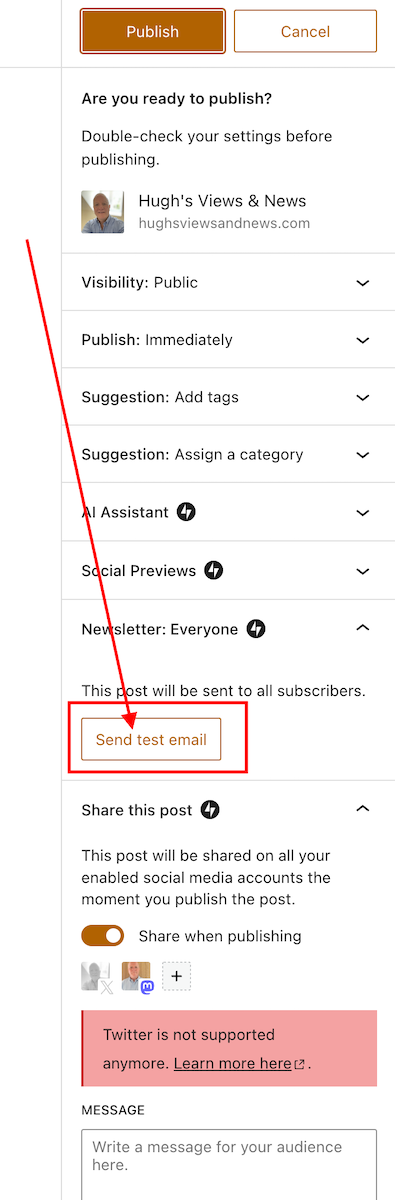
Before scheduling or publishing a new blog post, click the ‘Send test email‘ button, and WordPress will send you an email showing the excerpt and a link to the post.
Where can I find the ‘Send test email’ button?
Under the ‘Publish‘ settings of the draft of your post. Ensure you open the ‘Newsletter: Everyone‘ section to see it.
Here’s a screenshot.
Send test emails for all your WordPress new post notifications.
Not only can you check that the excerpt of your blog post is correct, but you can also click the link within the email to open the post and verify that everything is as it should be.
So, no more –
Missing images
Uncentred captions
Upsidedown images
Misplaced images
Images and text overlapping
Missing blog post titles
Missing headings
Missing words
Spelling mistakes
Forgetting to close comments
Broken videos or YouTube links
Broken links/pingbacks
Of course, spelling and grammar mistakes may still appear, but at least you now have another way of checking and editing a post before it’s published.
A new way to showcase previous blog posts.
Most bloggers like to showcase previous blog posts so those who missed them the first time can catch up.
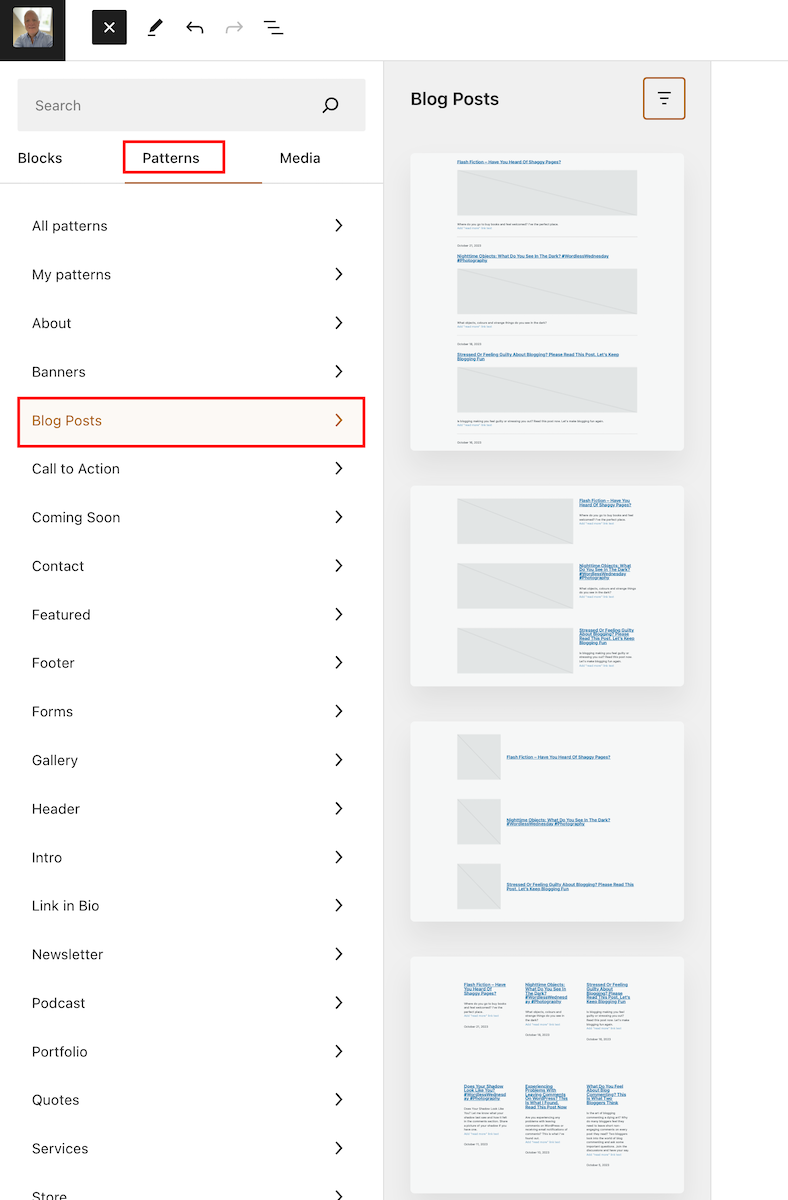
There are various ways to promote older blog posts on newly published posts. This is a new blog post template that WordPress has added to ‘Patterns‘ to help promote previous posts. In fact, WordPress has added lots of new ‘Blog Post’ templates. Here’s one I selected.
Tired of putting things off until tomorrow? Join me on my journey of transformation as I finally take the plunge on an important change for my blog. Discover how overcoming the ‘What if?’ moments have opened up a world of possibilities and excitement. Ready to see what’s next?
Discover the magic of storytelling at its best! I invite you to delve into a world created by diverse voices from around the globe. Curious to discover what happens when a television connects with the past and the future? Read on to uncover the stories and inspiration behind this engaging new collection!
How long have you blogged for? A brief and honest look at the world of blogging over the last 12 years.
Where can I find Blog Post templates?
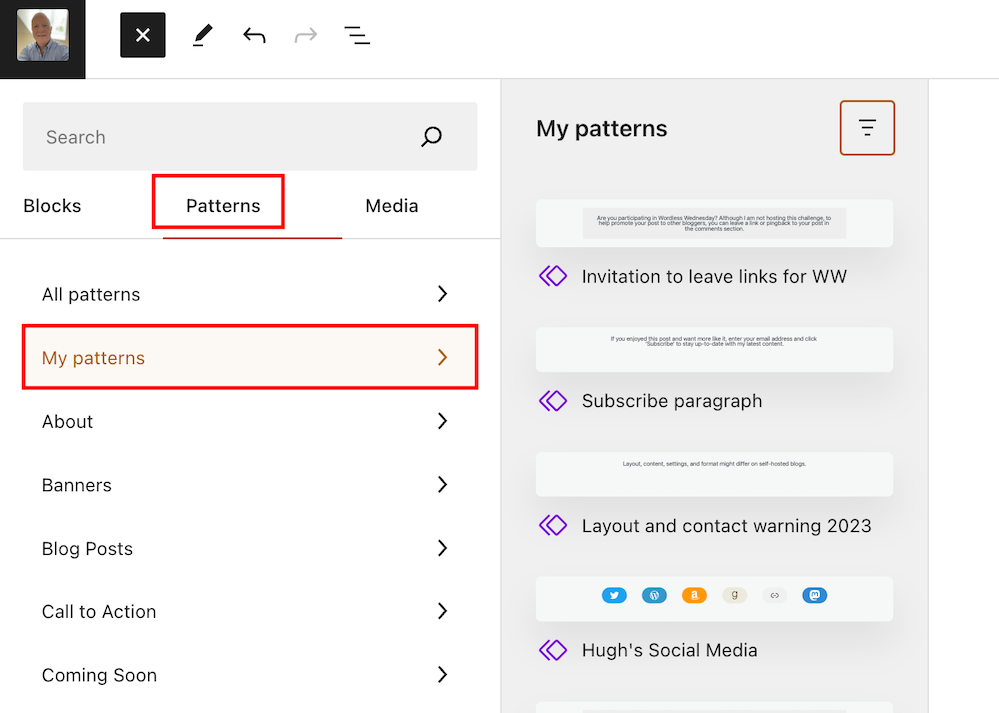
On a draft post, click the ‘+‘ symbol to add a new block and select ‘Patterns.’
On the menu that opens, click on ‘Blog Posts‘ and select from the many templates on offer.
Select a ‘blog posts’ template from the many on offer.
You can also select the ‘Blog Posts’ block for the same job.
Each template has many settings you can play around with. For example, I set the template I displayed above to two rather than three columns (displays as one column when viewing on a mobile phone). You can also change the background colour and text colour of the template.
On the template I used, up to six posts can be displayed, with new blog posts added as you publish them.
Unfortunately, I could not find a way of choosing which blog posts I wanted to feature in the template I chose, but some of the templates allow you to do this.
The one drawback I have noticed about my chosen template is the inability to set links to open in a new tab. As a result, users clicking on any of the links will lose their current page. To address this issue, I highly recommend including the ‘Blog Post Template‘ at the end of each post. This way, readers can easily navigate to related content without losing their place on the page.
Where did all my reusable blocks go?
Synced patterns have replaced Reusable blocks, offering a unified creation experience for new pattern functionality on WordPress. Any reusable blocks you’ve created for your blog can now be found under ‘Patterns.’
Ensure you view your blog’s dashboard in ‘Classic‘ view. When writing this post, it won’t work when viewing in ‘Default‘ view (WordPress are aware of the problem).
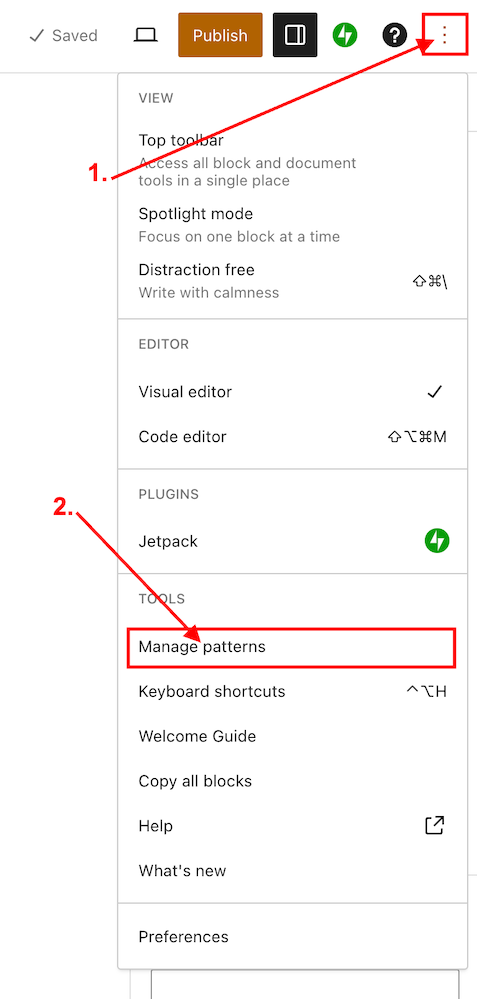
On the draft page of a post, click the three dots (options button) in the top right-hand corner of the page.
Click ‘Manage Patterns‘ in the new menu that opens.
Click ‘Manage Patterns’ to manage reusable blocks.
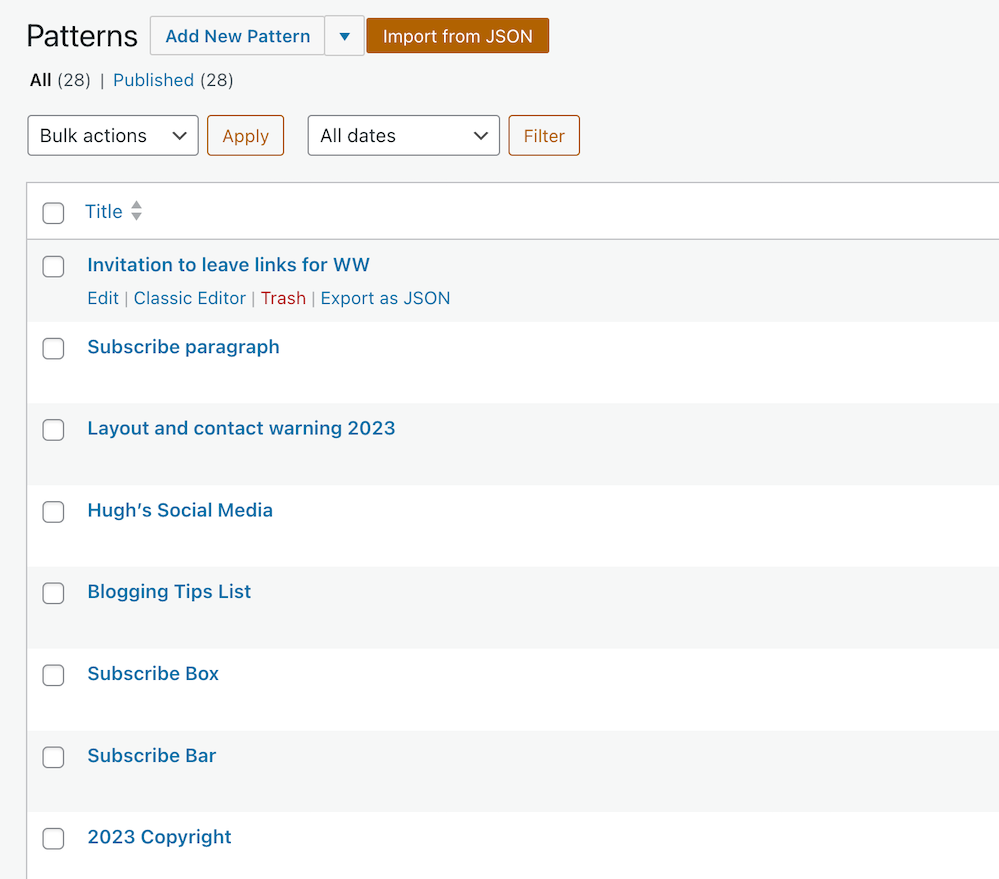
A page will open that lists all your reusable blocks. This is where you can edit or delete them.
A list of reusable blocks
IMPORTANT NOTICE – Please exercise caution when deleting a reusable block that has been previously used in your posts. Deleting a reusable block will result in its disappearance from all associated posts, and a notification will be displayed indicating that the block is no longer available. It is crucial to be mindful of this consequence to avoid any unintended disruptions to your content.
Have you explored any valuable new features on WordPress, or are you already utilising the ones I’ve mentioned? Are reusable blocks an essential part of your workflow? Feel free to share your thoughts in the comments section,and don’t hesitate to ask any questions.
Layout, content, settings, and format might differ on self-hosted blogs.
Follow Hugh on his social media platforms by clicking the buttons below.
Did you catch these 10 blog posts that got everyone talking, discussing, and wondering? Maybe you were part of the conversation, but if not, jump in and share your thoughts!
What’s underground may one day control what’s overground. Where do your roots lie?
Is the art of blogging commenting a dying art? Why do many bloggers feel they must leave short, non-engaging comments on every post they read? Two bloggers look into the world of blog commenting and ask some important questions. Join the discussions and have your say.
Does Your Shadow Look Like You? Let me know what your shadow last saw and how it felt in the comments section. Share a picture of your shadow if you have one.
It’s happening again. Bloggers are saying that blogging is stressful or makes them feel guilty.
Blogging is becoming a chore.
They don’t have time to read and comment on all the blog posts of all the blogs they follow.
They’re constantly apologising for not reading, commenting or publishing new blog posts.
They don’t have time to keep up with a blogging schedule they set themselves.
They feel obliged to read and comment on everything because those bloggers read and comment on their blog posts.
Let’s get something straight about blogging. Nobody expects you to read and comment on all their blog posts.
Do you suffer from blogging stress or guilt? Read this post.
Just because Susan and Jenny read and comment on all of each other’s blog posts doesn’t mean you have you. And believe me when I say that Jenny and Susan won’t have always read each other’s blog posts. They may have left comments, but those comments don’t prove they read the post.
Nobody cares if you don’t read and comment on all their posts.
Nobody says it’s your obligation to read and comment on all their posts because they read and comment on all your posts.
Nobody? Well, not quite. The only person who may feel obliged or think they must read and comment on all the posts of the blogs they follow is you.
One of the biggest pitfalls of blogging is feeling obligated.
Once again, I’ve been reading blog posts, comments, and social media posts where people ask for advice because blogging has got to the stage of stressing them out and/or making them feel guilty.
They seem to feel that not reading and commenting on every post is some kind of a blogging crime and will land them in blogging jail.
I’ve written before about the stress and guilt blogging can bring (if you allow it) and know exactly how these bloggers are feeling, having been through the whole blogging ‘feeling guilty’ trip myself.
So, allow me to explain why you never need to feel stressed or guilty about blogging or never need to apologise for not reading, commenting or publishing blog posts.
Why did you start your blog?
One of the reasons why I signed up for WordPress was because I thought blogging would be fun.
One year in, I became very stressed and guilty because I couldn’t keep up with reading all the new blog posts published by the bloggers I was following.
I was following way too many blogs, many of which didn’t interest me anyway.
Some days, I found myself doing little else but reading and leaving non-engaging, spammy comments on blog posts. You know the types of comments. Things like ‘Great post,’ ‘I enjoyed this’, or one-worded comments that meant nothing.
Some of the bloggers I was following were publishing more than one post daily, and I soon found myself apologising to people for not reading their posts or not being on WordPress 24 hours a day!
Then it struck me that I was not doing the main thing I’d come here to do – write!
Although I possess a few superpowers, I’m afraid that one of them is not being able to read every new blog post from bloggers I follow.
I began to see this as a problem. Blogging was becoming a monster, and I was doing everything possible to make me want to fight it.
Then, one morning, I woke up, switched on my computer and got that horrible feeling I would get when I didn’t want to go to school or go to work.
I soon realised that I had two choices about blogging. Either I gave it up, or I had to change the blogger I had become.
It didn’t take me long to make my choice. After all, I’d created my blog to write and share my thoughts with anybody who stopped by and wanted to listen to what I had to say.
I decreased my reading time and began to write more.
I stopped following every single blogger who followed my blog. If they didn’t have an ‘about me‘ page so I could find out more about who they were, or they blogged about subjects that did not interest me, then I did not follow back.
If bloggers kept sending me messages begging me to follow their blog, I ignored them.
I stopped feeling guilty for not following back.
As time passed, I began to unfollow bloggers whose blog content I didn’t find interesting anymore.
I stopped reading blog posts that did not interest me, regardless of who had written and published them.
I unfollowed some bloggers who continued to fail to respond to questions or acknowledge comments other bloggers and I were leaving on posts.
I didn’t feel guilty about this because it freed up time for me to write, read, and comment on blog posts that interested me.
If you find yourself in a situation where blogging makes you feel guilty and/or stresses you out, then you need to face the questions I was asking myself.
I’m afraid there’s no magic answer.
What worked for me may not work for you, but whatever you do, ensure you do all you can to make blogging fun again.
Isn’t that the reason why you came here in the first place?
Take control of your blog and stop feeling guilty about not reading and commenting on every blog post or for unfollowing blogs that you no longer have any interest in.
Sure, you may lose some followers along the way (don’t we all?), but it’s not going to finish you off as a blogger.
In fact, they probably didn’t read your blog posts anyway and will have left short, non-engaging comments just to prove they visited, so it’s no big deal (unless your only interest is how many followers you have).
If, like me, you decide to stay (and I hope you do), your blogging passion will return.
Remember – Blogging is a marathon, not a sprint!
Have you ever found yourself feeling guilty or stressed out because of blogging? Are you somebody who keeps apologising because you’ve been unable to spend as much time as you like reading and commenting on posts? How did you get over feeling guilty or stressed out by blogging? Leave me a comment and join the conversation.
Blogging should always be about enjoyment and fun.
Follow Hugh on Social Media. Click on the links below.
I’ve written about comments a lot over the last few months, so this seems like the ideal opportunity to discuss some problems with commenting on WordPress.
First, I want to discuss a problem with getting email notifications from WordPress whenever comments are left on my blog posts.
Are you experiencing any of these problems with comments on WordPress?
I’ve stopped getting email notifications whenever anyone comments on one of my posts, so I have had to revert to checking for new comments on my blog’s dashboard.
It’s not a huge problem, but the email notifications act as a backup, so I know when comments have been left, and they also serve as a reminder that I have comments to respond to. I don’t delete an email notification until I’ve replied to a comment. That way, I don’t miss any.
I reported the problem on the WordPress Forum. That was over two weeks ago, and whilst I’ve had a lot of contact from WordPress staff, the problem is currently with their developers.
Is anybody else having problems getting email notifications of comments left on their blog posts? Or is it just me?
I’ve also reported another issue to WordPress. I’m wondering if any of the following are happening to you when leaving comments on other blogs?
Other problems with commenting.
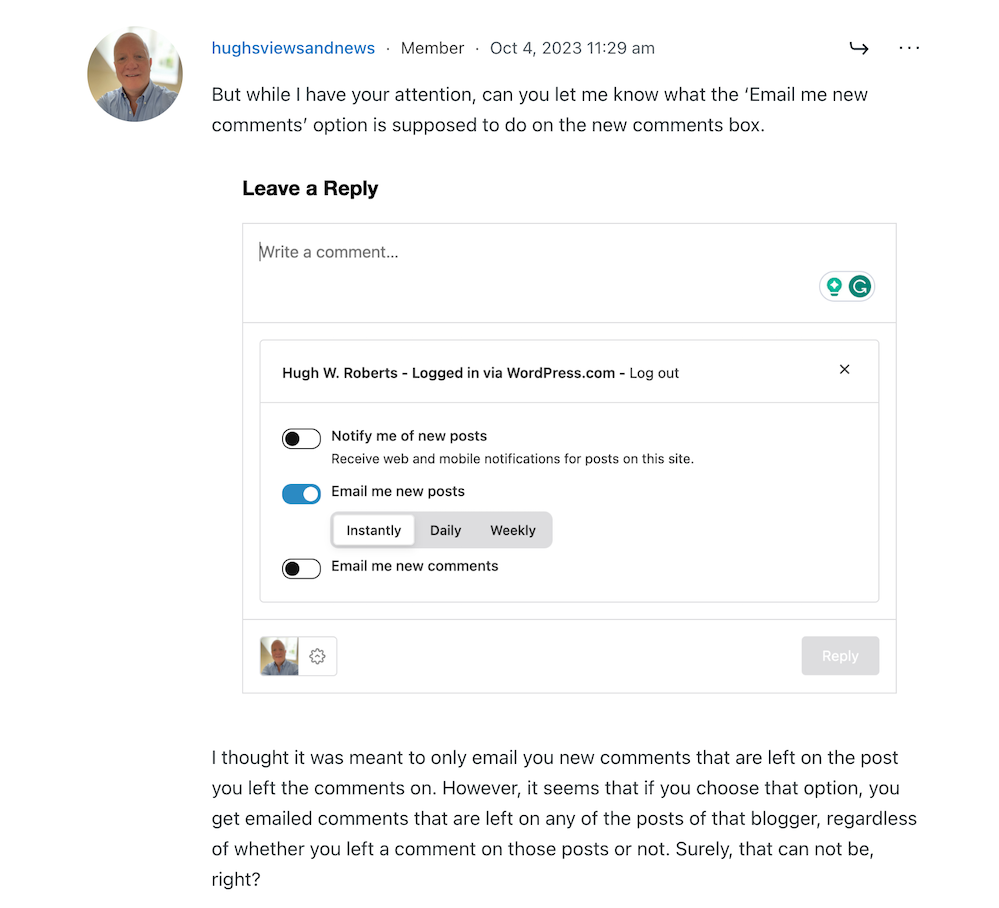
Have you noticed that the comments box on WordPress has changed? The old comments box has been replaced with a new one (see the following image), but it seems to be causing me a few problems.
Have you noticed the new comments box on WordPress?
The above new style comments box has gradually been introduced to most blogs on WordPress.
You can write a comment, press the reply button, and move on pretty swiftly, but my concerns are with something hidden behind the settings (cog) button next to the icon that displays your Gravatar image. When you press the cog, you’ll see this.
There are three options to choose from in the new-look comments box.
See those three new options at the bottom of the comments box? Not only can you now get web and phone notifications of new blog posts from the blog you’re leaving a comment on, but you can set how often you get notifications of new posts.
These are not new, though. They’ve been available for use on WordPress for a long time but were buried deep in our blogs’ dashboard settings. Now, they’re much easier to find and use.
So far, so good, you may think, but it’s the ‘email me new comments‘ button that is causing me concern.
You see, I’m one of those bloggers who like to receive an email whenever anyone replies to a comment I’ve left on their blog or when anyone else leaves a comment on the post I’ve already commented on. It’s my way of knowing that not only have they responded to my comment but also a way for me to either reply to or ‘like’ the comment. I do not like the thought of any blogger thinking I’ve ignored their comment.
The problem now is that when you slide the ‘email me new comments‘ button on, not only do you get emailed comments for the posts you’ve left comments on, but you’ll get email notifications of any comment left on any of the posts on that blog regardless of whether you left a comment or not.
If the blog you’ve left a comment on is huge and gets hundreds of comments, this could become a big problem with your email box filling up quickly.
Needless to say, that is something I do want. I only want email notifications of comments left on the posts I left a comment on. Why? Well, I find that reading comments can sometimes be as interesting as the post they’re left on, plus comments often give me new ideas for blog posts.
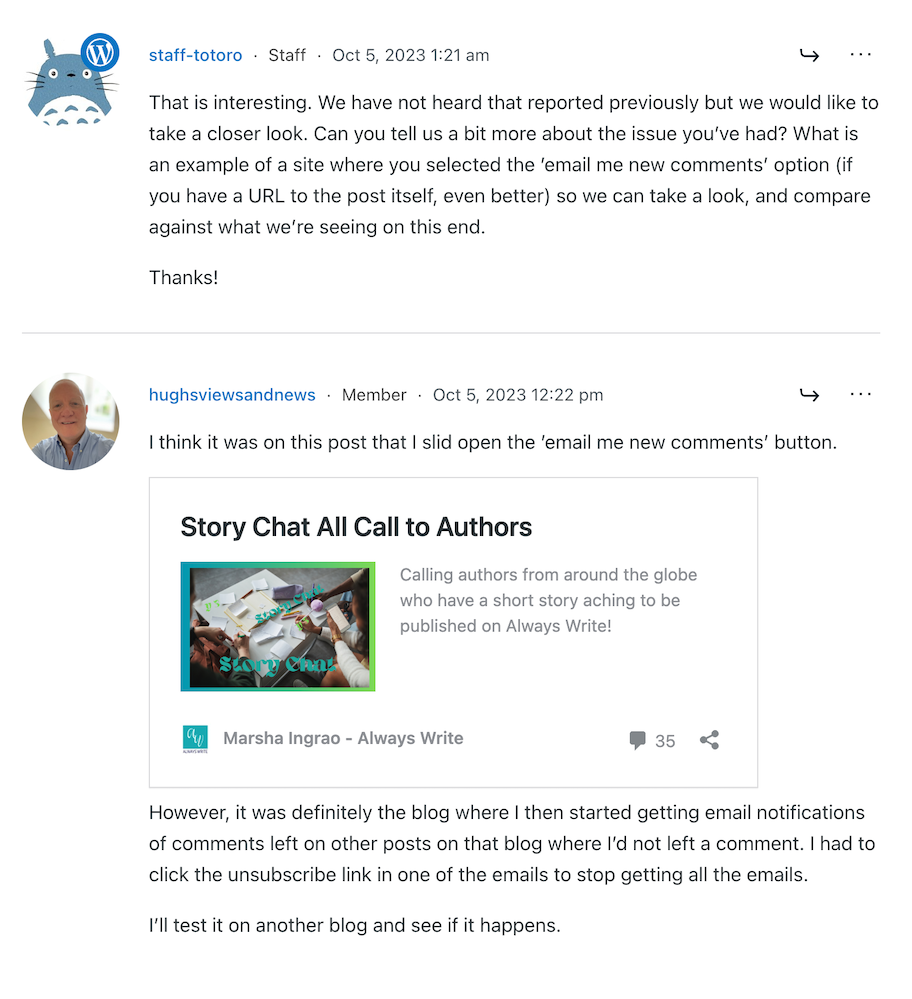
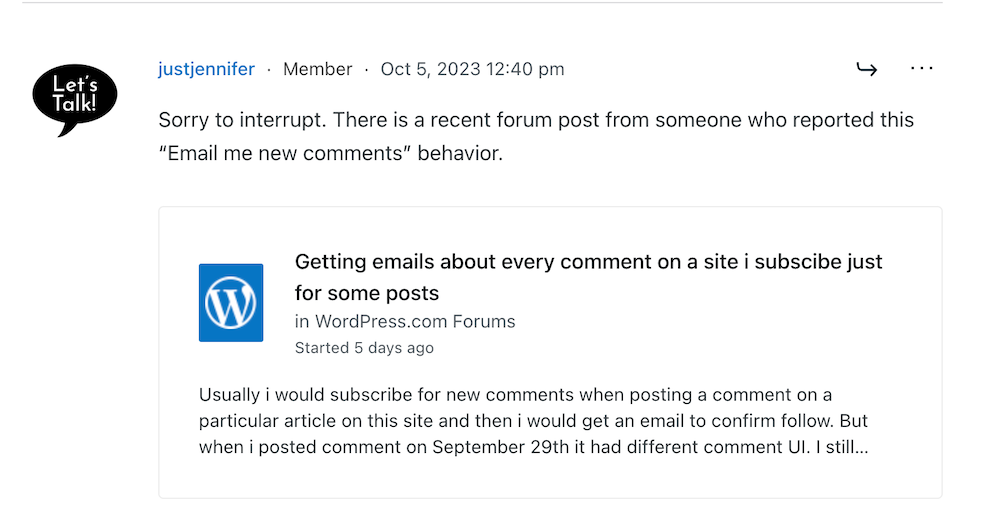
I’ve reported the issue to WordPress, and they’ve replied. See the screenshots below. However, I’m not the only one who reported this particular problem.
Somebody else has reported the same problem.
A response from a member of staff at WordPress
That was the last response from WordPress, but I’ll update this post with any developments.
Some good news – My spam box is empty!
Is it only me, or has anyone else seen a drastic reduction in spam since the new comment box appeared? I used to get hundreds of spam messages to scroll through every day, but now my spam box is empty almost every day – hooray!
So, there is no need to close comments off posts anymore if WordPress has waved a magic wand and stopped the spam once and for all. Hooray – that means I can leave comments on blog posts that are more than a month old.
Are you having any of the problems described in this post or any issues with leaving comments or receiving WordPress notifications as a whole? Has the amount of spam you’re getting plummeted? Let me know in the comments section.
Follow Hugh on Social Media. Click on the links below.
Comments play a vital role in fostering vibrant discussions within the blogosphere. They are the lifeblood of meaningful engagement, adding depth and diversity of perspectives to any topic.
But recently, commenting on blogs seems to be going in the wrong direction.
My recent blog post, ‘What Kind Of Comments Are The Best To Leave On Blog Posts?‘ got many of you discussing various types of comments, but more importantly, the non-engaging comments that sadly seem to have become more popular than comments that spark valuable engagement, discussions and conversations.
If you haven’t read the post, please do and add your voice to the various debates.
Today, I have the pleasure of presenting two captivating blog posts penned by talented bloggers about the subject of comments.
These insightful pieces delve into the diverse range of comments they receive on their blogs, offering a glimpse into their personal perspectives and emotional experiences.
The first is from blogger and writer Brenda, who blogs at Curiosities, Castles and Coffee Shops. Click the following link to read Brenda’s post and join the discussions her post has sparked.
I urge those of you who enjoy engagement, discussions and conversations on blog posts to read both posts and add your thoughts to the discussions that Brenda and Erika have ignited on their posts.
I’m closing comments off here so that comments can be left on the posts I’m promoting today.
A big thank you to Brenda and Erika for taking the courage to open up about leaving comments – a subject many bloggers shy away from.
Follow Hugh on Social Media. Click on the links below.









 Hugh's Views & News