
Imagine having a blog where nobody wants to engage. It’s a thought that’s hard to fathom. After all, what’s the point of writing and publishing blog posts if there’s no one to interact with?

As bloggers, we can spark curiosity and questions in our readers, even when publishing informative posts. And that’s where the actual engagement begins. It’s our responsibility to set the stage for meaningful interactions. One way to do this is by asking open-ended questions at the end of your posts or inviting readers to share their thoughts or experiences related to the post’s topic. It can encourage more in-depth and meaningful discussions.
Those bloggers who blog to make money will only care a little about the interaction. For them, making a living out of blogging is more important. Good for them if they are successful, but take your readers seriously, especially if they want to engage with you. Consider removing the comments section from your blog if you’re going to refrain from engaging or responding to questions.
What’s the right way to engage with readers? Is there a right way?
I’ve always craved engagement, but over the ten years I’ve been blogging, the type of engagement I crave has changed.
I’ve become more of a ‘discussion’ blogger. By that, I mean a blogger who likes to discuss the subject of a post rather than just leaving a comment that only confirms I visited. It’s about sparking a conversation, sharing different perspectives, and learning from each other. This type of engagement is more valuable than a simple ‘I agree’ comment, as it adds depth and richness to the post’s content.
Over the past year, I’ve made a conscious effort to reduce the number of non-engaging comments on my blog, a decision I’m proud of. I’ve aimed to break free from the cycle of leaving comments solely to prove a visit or just for the sake of doing so.
This shift has decreased the overall number of comments I get but has made me feel like a more thoughtful and influential blogger. It’s not about the number of comments but the quality of the interactions. This change has helped my personal growth in writing and blogging.
Should we always try to engage? No!
Of course, just because I don’t leave a comment on a blog post does not mean I’ve not read it. Likewise, I know many people read my posts but want to avoid engaging. There’s nothing wrong with that. These silent readers are still part of the blogging community; their support is as important as active engagement. So, let’s recognise their presence and continue to create content that resonates with them.
If you’re new to blogging, leaving an engaging comment every once in a while is far more beneficial than leaving short, non-engaging comments on every post you read in an attempt to get noticed.
Are you approving spam comments without realising it?
Imagine my concern when I came across this comments section on a recently read post.

I was appalled to see these comments and could not understand why they’d been approved. Given that the blog’s posts would probably be full of these types of comments, I also decided not to follow it.
Spam comments not only detract from the quality of a blog but also discourage meaningful interactions. Let’s keep the blogging community free from such spam and focus on producing meaningful engagement. Your thoughts and ideas are too valuable to be drowned out by spam.
Other examples of spam comments.
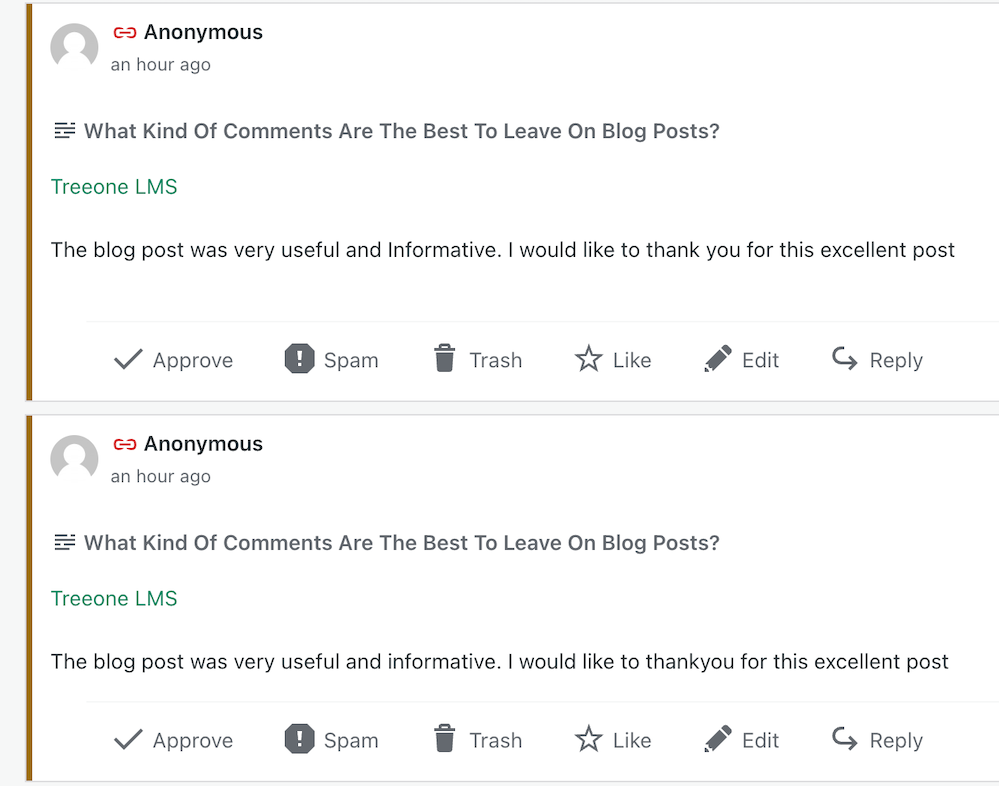


Some may look genuine, but they’re not. Spammers and spambots are getting cleverer at fooling us into approving their comments, so beware.
Thank you
I want to express my deep appreciation to all of you who support and interact with me here. Your engagement is not just a number on a screen but a vibrant testament to the joys and value of blogging. I especially want to acknowledge those who actively interact with me, as your contributions are the lifeblood of my blog.
Remember, it’s not just about the numbers but the profound connections we build through interactions. For instance, when a reader shares a personal experience related to a blog post or when we engage in a thoughtful debate about a controversial topic, these are the types of interactions that genuinely enrich the blogging community.
Let’s wrap it up.
This post delves into the importance of engaging with readers and other bloggers, offering insightful strategies to spark meaningful interactions.
Avoid leaving short, non-engaging comments on all the posts you read. Instead, leave a thoughtful comment every now and again.
Don’t leave a comment just to leave a comment or prove you’ve visited.
Never feel obligated to comment because they always comment on your posts.
There’s nothing wrong with not wanting to engage. Some readers are more comfortable reading a post without saying anything.
Take your readers seriously by responding to or acknowledging their comments.
Never approve spam comments. Mark them as spam and delete them.
Consider closing comments off if you do not want to engage with your readers or respond to any questions.
If you crave engagement, ask open-ended questions at the end of your posts or invite readers to share details of their experiences with the subject you’ve discussed in the post.
Do you enjoy engaging with your readers and other bloggers? What type of commenter are you? How do you deal with spam comments and the spammers? Share your knowledge and ideas in the comments section.
Click the buttons below to follow Hugh on Social Media
Copyright @ 2024 hughsviewsandnews.com – All rights reserved.
Discover more from Hugh's Views & News
Subscribe to get the latest posts sent to your email.
 Hugh's Views & News
Leaving comments after reading a blog is another example of quality versus quantity and I’m with you that I’d rather receive less comments that are meaningful, than heaps of “empty” ones. The same goes for followers. I’d rather have less of them that actually read the posts than ones who just click the “like” button without actually checking the story and photos out.
I think less people read my blog these days, but when they leave a comment I can tell that they care and are curious about our lifestyle and experiences. Like you demonstrate with each visit to Roaming About, Hugh. There rarely is “small talk” to approve. It’s a win-win situation that way.
I have traveling friends who blog and have turned the comment section off for two reasons: because of the incredible amount of spam they receive and because they never really took the time to respond to comments.
Some of us, nomads, just share stories and experiences for friends and family and that’s where it stops. They don’t care about interactions or discussions and therefore, I feel, they blog for different reasons. I just go with the flow and am happy to interact and answer questions when those opportunities arise. But sometimes I’m so busy that I have to postpone these interactions. Yet, I will never ignore or discard them, because I value and respect readers of my blog.
You’ve covered a lot of different scenarios towards comments in your comment, Liesbet.
I couldn’t agree more with you, Liesbet, on the significance of meaningful comments. It’s disheartening to hear that some bloggers use the ‘like’ button as a generic show of support, even without reading the post. This practice undermines the value of genuine engagement and is one of the most peculiar aspects of blogging I’ve come across.
When I leave a comment, I make a point to express my genuine appreciation for the post by providing specific details about what I enjoyed. Brief, non-engaging comments can leave the author questioning whether the commenter truly read the post, which is why I rarely leave them.
Spam can be a problem, but I’m delighted that whatever WordPress did last year to eliminate most of the visible spam I see is much welcomed. I see 5-10 spam comments a week, if that. It used to be hundreds a week.
There is no problem with delaying responses to comments. The problem is only when comments are never responded to unless they are short comments, in which case all I can do is click ‘like.’ I hate doing that, so I’m doing all I can to stop non-engagement comments from being left. It’s working, but I still get a few, although I don’t mind them so much on my Wordless Wednesday posts.
Yeah, sometimes people have nothing to say (including me), so they leave a quick appreciative comment to show they liked the photo or the blog post. I always try to add a few extra words for you, though, because I know you hate the quick and non-committal “nice photo” or “great post”. Plus, by adding a few words, I prove I’m not a spammer or bot. :)
I don’t mind the odd short comment. It’s when it’s the same bloggers always leaving those short non-engaging comments that I dislike. I see them all over the world of blogging. Same people leaving the same short non-engaging comments. If only they used up all of that time leaving all those short comments on leaving one meaningful engaging comment once in awhile. It would make such a big difference.
Hi Hugh, I don’t believe I’ve read any of your blog posts before. I was led here by DJKayeWriter.com. I like your post and learned so much today. The following quote of yours caught my attention. “There’s nothing wrong with not wanting to engage. Some readers are more comfortable reading a post without saying anything.”
I follow several blogs and try to read what they post. So many things prevent me from commenting. I’m just too tired, stressed, ill, overworked that day or any number of things. On my good days, I leave a reply but only if I can write more than good post or like it. I love to read the comments from other people also. Thanks.
Hi Kay,
Thank you for reading this post and for leaving a comment. Welcome to Hugh’s Views And News.
I’m delighted that you got something out of this post. I don’t know why some bloggers believe they have to comment on every post they read to prove they visited. Some seem obliged to do so because the blogger leaves comments on their posts or they fear upsetting somebody for not commenting.
Reading the comments sections has given me many ideas for future blog posts. It can be a treasure trove of ideas and inspiration.
Thanks, Hugh. I’ll be visiting your blog often. I noticed you cover some topics that I need help with, so I plan to read them soon. 😊
Hugh, this is such a smart, genuine, to the point post covering the engagement essentials. Most do it wrong because they have no clue that they are not doing it right. Bloggers typically want to get traffic and income through a comment as prime drivers; mistakes follow, because they mainly want to get something, give little value and wind up in the spam or trash folders more often than not.
Excellent job with this post.
Thank you.
We all start by leaving short, non-engaging, spammy comments. But then we go on to find out that genuine, engaging comments work much better because those reading them know that we’re the type of blogger who not only engages with those who leave comments but also engages on other blogs. I also believe that leaving somebody a short, non-engaging comment on a post they’ve spent hours or even days working on isn’t very respectful of that blogger’s work.
I always leave a conclusion part in all of my posts and I encourage readers to post their comments with their thoughts about the post or if they have any similar experiences with the topic of the post. Unfortunately it doesn’t seem to be working.
All of those spam comments, I had the exact same ones in the spam folder. They are so obvious to spot. Especially when you see the exact same comment made by different usernames. LOL!
Great post Hugh. 🍻
Have you tried asking questions at the beginning of a post? Getting readers hooked is also the key to keeping them reading. I’ve also found that some readers can be discouraged from leaving comments if they have to sign in to comment or leave their email addresses and contact details. Make it as easy as possible for readers to engage.
I also leave at least a couple of engaging comments on other blogs a few times daily. Not only does that make it likely they’ll visit your blog, but other people seeing your engaging comments may also visit, although it’s no guarantee that they will visit, and, of course, not everyone will find the content we publish interesting enough to follow and engage.
I might start adding something at the beginning of the post. Never had this issue in the past.
Hugh, I agree that WP has done a great job eliminating spam comments. I get few these days – most of them are obvious and worded similarly to your examples (low hanging fruit). Thanks for the reminder to purge new ‘followers’ who aren’t legitimate. I have been remiss about that lately. I will be reading your post on that subject next. Thanks for including the link.
I’ve just updated that post, Suzanne. I also plan on resharing it, given that many don’t know how to unsubscribe fake followers and spambots from their blogs. Wouldn’t it be great if WordPress found a way to unsubscribe spammers and fake followers from our blogs without us having to do it? Hopefully, one day, it’ll happen.
Hugh, you inspired me to do a bit of housekeeping. Deleting as we speak! Thanks
I don’t get much spam and I am grateful to Askimet for catching the ones that come in. I go through my followers frequently, and many are bots which I delete them. No sense in having a bunch of fake followers.
I try to leave constructive comments when I enjoy the content and there are like interests. IMO, one of the joys of blogging is a discussion. My pet peeve is many likes in sequence from a blogger because it’s obvious they didn’t read what I wrote.
Thank you for your advice and helpful post, Hugh.
Engagement is at the heart of blogging unless you’re only doing it to earn money, Eugi. In my experience, bloggers who earn a living from their blogs do not engage. If they do engage, it’s usually just a ‘thank you’ and nothing more because they are churning out so many posts.
I have also started deleting obvious spam comments. Another thing I find mildly irritating are those bloggers who like 5 or more of my posts in the same minute. I find it insulting that someone would pretend to read my posts. What is the point of that? Does it affect SEO? I’m much more like you and prefer meaningful interaction than “nice post” comments or a bunch of likes.
Yeah, those spam likers are a nuisance, Pete. Although they’re trying to get noticed by doing what they do, there’s no way they’ll ever get my attention. But if they left me a valuable and engaging comment occasionally, they’d stand a better chance of getting my attention and that of those who read their comments. It’s a sheer act of desperation what they do.
Those are the type that never stay around for long.
That’s true. And they’re not missed when they do disappear.
I’m very happy with the spam blocker on WP, one or two might slip though occasionally but it seems to catch most of the spam.
It does a great job catching and getting rid of the spam, Cathy. Now, if only it could catch fake followers and spambots that try to follow our blogs. I hope it’ll happen one day so we don’t have to worry about fake followers.
As you say, Hugh, it’s not about the number of followers it’s the supportive ones who engage with us in a meaningful way.
If I get a new follower, I check them out and delete them if they’re spammers. Perhaps this is the reason I rarely get comments from spammers.
As far as commenting goes, when I first started blogging, it was nerve-wracking, finding the right words when acknowledging a blog post I’ve read.
I shake my head when I hear bloggers say it’s rude not to follow back anyone who follows them, and this is usually without even checking them out first, Suzanne. Not only can it lead to lots of spam comments and more fake followers, but it can also become overwhelming, which can lead to blogging burnout. I’ve seen many blogging folk give up because they become overwhelmed with blogging.
When I first started blogging, I loved every comment, but when somebody pointed out that many of the non-engaging comments were from people who probably hadn’t even read the post, my heart dropped. Even back then, they were fake followers and spammers.
I agree, people don’t have to engage at all. But I too prefer that compared to those only leaving an emoji or a stereotype “nice, lovely, beautiful, true,…”
So far I think I have overlooked such spam comments. WP seems to be good in sorting them out into the spam folder. Also, I check on all comments and such comments only come from new readers that ARE under moderation. They get in the “trash” or I put them under spam.
WordPress updated its Akismet software last year, resulting in most bloggers seeing much less visible spam. Of course, the doubters said it wouldn’t last long, but a year on, and I’m only seeing around 5-10 spam comments a week in my spam folder. The odd one slips through into the moderation queue, but they never make it through.
I share your experience. It is fantastic not see houndreds of spams flooding the folder anymore. Plus, the comments of my followers are not put in spam accidentially anymore.
A win/win, then, Erika. It’s been a while since I found a genuine comment in my spam folder.
WordPress has been pretty good at identifying spammers (much better lately) but, every once-in-a-while something gets through, and I have to delete it.
Recently I’ve been getting a large number of new followers that are obviously not really interested in my blog. In fact, it’s hard to believe they have ever visited at all. Although I don’t follow back, it’s a bit annoying anyway. Any insight there?
I agree that WordPress is getting better at dealing with spam, Janis. They did some kind of update last year that kicked in and eliminated most visible spam. I used to get hundreds of spam comments daily in my spam folder; now, I get maybe 5-10 a week.
As for the fake followers and spambot followers, I’d recommend unsubscribing them from your blog. They may refollow but keep unsubscribing them. They’ll soon get fed up with trying to follow your blog.
I hadn’t thought about spam comments, so thank you for that, Hugh. Your posts always give me something new to think about.
I’m glad this post has helped with spam comments, Esther. They are getting cleverer at trying to deceive us with their comments. I won’t approve it if I’m not 100% sure it’s a genuine comment.
Researching the commenter is a great idea. I just deleted 3 followers, all spammers. They all have WP sites, but either the sites are under construction or have one suspicious post, or just plain marketers. Nope!
My Jetpack app shows me some strange comments but that’s when I see they’re in another blogger’s comment.
I get a lot of comments from bloggers whose blogs are still under construction, Terri. To me, that’s a big warning sign. And so far, I’ve never seen any of them return with a second comment.
It is about the profound connections! You are so right, Hugh. I’ve pulled back with posting with summer to spend more time writing. I’m still hosting Tanka Tuesday, but it’s been a busy summer. Thanks for saying it like it is. xx
A summer of writing sounds perfect, Colleen.
I’ve always said (and believe) that finding the right blogging balance is difficult, but it’s good to hear that you have slowed down with blogging. There’s nothing wrong with that, providing you feel good about it.
I’m always careful not to let any spam comments through, and I try to leave meaningful comments on other people’s posts, but I’m curious how you are able to reduce the number of non-engaging comments on your own blog? Do you actively delete comments that are brief and non-engaging but polite? I get a lot that say things like ‘Great post’ or ‘Nice photos’ and I always leave a brief ‘thank you’ without saying more, but I wouldn’t delete them unless they were rude / irrelevant / promoting their own site while ignoring what I had to say.
When I get comments like ‘Nice post’ or ‘great story/photos’, I respond by asking what it was about the post that made them say that. So if somebody leaves a comment on one of my flash fiction stories that says ‘Great story,’ I’ll thank them and ask what it was about the story that made them think it was great. I’ve found that those who are genuine in what they say will respond with more details, and they will then leave more feedback in future comments. Those who probably did not even bother to read the story don’t respond and soon get fed up with me asking them to give more detail.
However, I delete one-word comments or any comments that only have emojis. If they keep sending the same comments, I mark them as spam.
I hope that helps.
Definitely, thank you :)
I have to chuckle at the (shall we say?) stupid blog comments you shared, Hugh. Nowadays, we all get hammered by SPAM in emails, on social media, etc. The more I get, the more jaded I become when I see an odd comment on my post. And like Dan mentioned, sometimes the spam comment is left on my comment on someone else’s post! I can’t delete it, but c’mon, people, read your own comments and delete the spam. We all love engagement and this has allowed me to become friends with many bloggers online or IRL!
I am eternally grateful for you showing us how to delete spam subscribers, as well as determining that they are spammers. I must delete at least two a day. Those pom pup scammers get more clever every day. Also, and hopefully no one takes offense to this, the non-English-speakers who leave short comments are on my radar. More bloggers really need to spend more time on the back end of their blogs and remove those subscriptions. You should re-post that post–it s gold!
Thank you again for your thoughtful how-to posts, Hugh. You cut right to the chase while providing excellent examples of an issue along with an easy solution to fix it!
When I saw the comments I included in the image on the blog I mentioned, Terri, I couldn’t understand how the blogger allowed those comments to appear. I can only guess that he approved comments from the same spammers before and that any comments the spammers now leave don’t need approval. But still! You’d think he checks the comments section of his posts, wouldn’t you? But given he hasn’t responded to those comments, maybe he doesn’t?
I just shared that post you mentioned to another blogger in the comments here, but I will take another look at it and update it (if necessary). Then, I’ll share it again.
The spammers are getting cleverer at trying to fool us. However, even if I’m slightly doubtful about a comment being genuine, I’ll research the person who left the comment before approving their comment.
Spammers are like fleas, Hugh. I’ve gotten very cynical about almost everything! I do like to leave comments when the blog contents tickle my gray cells – this one did! And I also try to answer people who comment on my blogs. My biggest problem now is the people who sign up for contact from my blog – everything from people trying to sell services and beauty products to porn!
Don’t forget that you can unsubscribe followers from your blog, Noelle. This post may help –
As for anyone contacting you via your ‘contact me’ page, I never respond to anyone who sounds like a scammer or is only interested in selling me something.
I’m glad this post got you to comment. Discussion is at the very heart of my blog.
Thanks, Hugh. Now to get rid of them!
I love it when I unsubscribe them, as I feel I’m getting victory over them. However, some do resubscribe. I found that if you keep unsubscribing them, they’ll soon get fed up with following.
Absolutely excellent post! And huge thanks for showing what spam comments look like these days. People (including me) have been so fooled by them!
Like I’ve mentioned before to others, sharing the love in the community by leaving comments is absolutely great! I love WordPress even more for having this feature and also giving us such control of them as well.
Community is at the very heart of WordPress. That’s why many bloggers like it, even those who complain about all the updates and changes it makes.
Spammers are getting more clever in making us think their comments are genuine. I always say that if you’re unsure about a comment, don’t approve it.
Yeah, I’ve started doing the same. Or at least if I suspect something, I ask them to reply. If they do not within a certain time frame, I will block it as spam. So far that has worked well.
Good to hear. And the more comments you mark as spam, the more WordPress learns of what types of comments you class as spam.
Yep. I had to clear 5 just today. It comes and goes in waves it seems. I either get nothing for weeks on ends or loads in one day.
Yes, that seems to be how it happens. Thank goodness Akismet keeps the majority of spam from our eyes, though. I used to see hundreds of spam comments a day. Now, I see maybe 5-10 a week at most.
I enjoyed reading your article. Thank you Hugh.
Thout provoking indeed!
Both engaging comments and likes can help one enjoy blogging.
Short and non engaging comments can piss the author.
I do get comments straightaway asking me to follow their blogs without even leaving a comment for my post.
Neither do they realise that, I may not have any interest in the topics they cover.
As far as spams, Akismet doing a good job and almost 150 spams per day get filtered in my case. Why do you thing I attract that many spams?
Is this because I choose to allow search Engines to index my url.
How to stop this nuisance once for all?
Thanks again.
I’m truly grateful you enjoyed my post; thank you for your time and support.
I used to tolerate short, non-engaging comments until I realised they were coming from the same bloggers who were doing the same on other blogs. I don’t think some even read my posts; some were saying something, hoping they’d get noticed.
Likewise, I get comments telling me to check their blog, follow, like, and leave them comments, yet they don’t even mention anything about the subject of the post they’ve left their spam comment on. I mark them as spam, and WordPress seems good at knowing what I class as spam.
Posts can attract spam for many reasons, mainly because the title and content contain keywords that SEOs like. Spammers think many will read the post, so they try leaving a comment in the hope that some of those readers will click on their spam links or even visit their site, where they can be ripped off. They’ll do anything to get visitors.
All we can do to stop spam is ensure we have the least anti-virus software installed and never engage with the spammers or approve their comments.
My pleasure, Hugh.
Thank you so much for your explanation in detail.
You cleared my doubts.
👍👍👍
Your suggestion about removing spam comments is very good, Hugh. I don’t have many that sneak through, but lately, I’ve been seeing them show up as replies to other comments. They seem to look like the spammer knows my reader. It’s a cleaver tactic, but I still send them to the bin.
These spammers are getting cleverer, Dan. They’ll do everything they can to get somebody to click a link or visit their site. Akismet does a great job of all the work behind the scenes, so we don’t get to see all spam comments. I’m glad we get nowhere near as many spam comments as we used to get here on WordPress. It saddens me when I see bloggers approving and allowing spam comments to appear on their blogs.