Categorising and tagging blog posts are some of the most potent ways for bloggers to get their posts noticed. However, some bloggers don’t bother with either, meaning they’re losing the potential for new readers and followers. Are you one of them?

But what are categories and tags, and how do they work?
Light blue image with the words 'How To Make Categorising And Tagging Blog Posts Powerful' in white text
Do you categorise and add tags to all your blog posts?

What are blogging categories?

Blogging categories act like groups where blog posts that have a connection with each other are stored.

For example, if you’re a travel blogger, you could have The United Kingdom category and list the sub-categories Scotland, Wales, England, and Northern Ireland

Categories are important because they make finding specific blog posts more straightforward for visitors to your blog (especially first-time visitors).

Every blog post should have at least one category.

Unfortunately, if you don’t categorise blog posts, they will be uncategorised, which is no help to anyone.

Imagine going into a shop to find a particular book about dinosaurs and finding that none of the books has been categorised. You’d leave and go to another shop that helps customers by categorising its books to find what you’re looking for much easier.

I never return to blogs that do not categorise posts.

How to add a category to your WordPress blog post

This tutorial uses an Apple iMac desktop computer and the WordPress ‘Default’ dashboard.

  • While drafting a blog post, you’ll see a toolbar in the settings area on the right-hand side of the page. This is where you can add categories.
Image highlighting where to find the category box on the draft page of a WordPress blog
Every blog post should have at least one category.

If a blog post doesn’t fit into one of your existing categories, click ‘Add New Category‘ and create a new one.

Remember to do some housekeeping regularly for the categories on your blog. For example, delete categories that are no longer being used or update categories by giving them a new name if something works better. 

How to edit the categories on your blog.

  • On your blog’s dashboard, click on Posts to open a submenu, and click on Categories.
Image highlighting where to find Categories on the dashboard of a WordPress blog.
Click Posts and Categories.
  • To edit a category, click the three verticle dots (meatball menu) next to the category you want to edit.
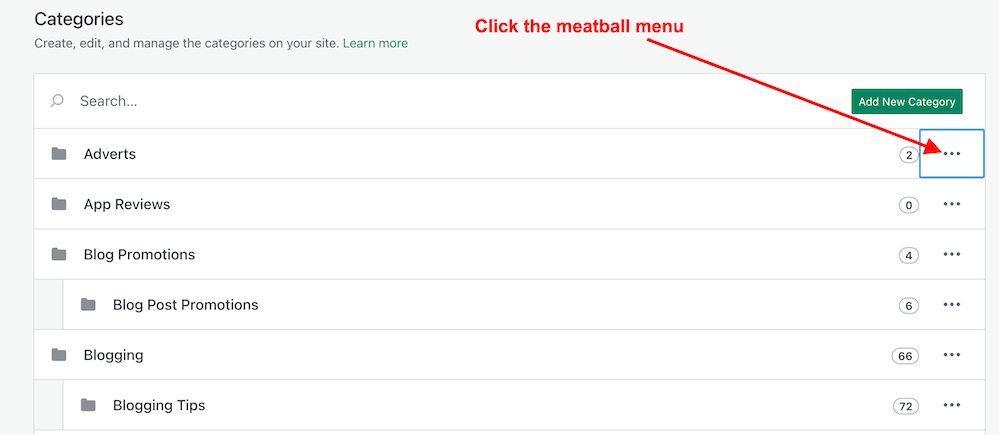
Image highlighting the meatball menu in Categories on a WordPress blog.
Click the meatball menu to edit a category.
  • The meatball menu displays four options: edit, delete, view posts, and set as a default.
  • Edit – Edit the name or description of the category.
  • Delete – Delete the category.
  • View posts – View a list of all your posts under the category.
  • Set as default – Useful when most posts fall under a particular category.
  • Remember to click the ‘Update‘ button to save any changes you make.

The number next to each category tells you how many posts are under that category. I recommend deleting any categories that are not being used.

Any sub-categories will show under each category.   

Tip: Setting your default category to ‘Uncatorigised‘ allows you to search for any blog posts you may have forgotten to categorise.

What are tags?

Tags are popular keywords that can be added to a blog post. For example, some of the tag words I’ve added to this post are –

  • blogging
  • bloggingtips
  • categories
  • tags
  • WordPress
  • HowTo

Each tag should be separated with a comma or by pushing ‘Enter’ on your keyboard.

Tags containing more than one word (such as ‘Blogging tips’) act as one tag word, but you must add them without any space between the words, i.e., ‘ blogging tips’ becomes ‘bloggingtips.’

Generally, tags do not need to connect with each other, but when used correctly, they can generate a lot of extra traffic to a blog post.

Like categories, tags can be added to blog posts in the settings area toolbar on the right side of a draft post. 
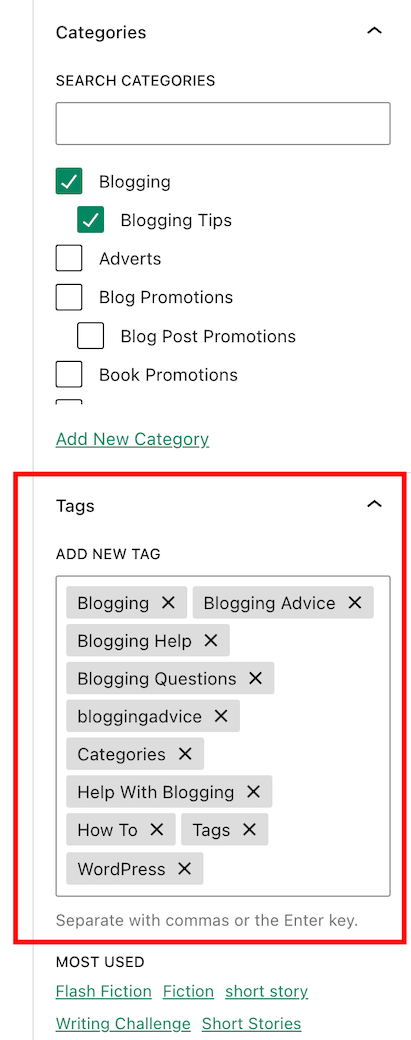
Image highlighting where to add tags on a WordPress blog post
Always add keywords (Tags) to your blog posts.

When adding tags to your post, consider the keywords somebody would add to the WordPress search bar when looking for specific blog posts. Or think of words you would use to search for your post.

Check out the tags I’ve added for this blog post. They appear at the end of every post.  

Important information – Did you know this…?

The cardinal tagging rule on WordPress.com is that you should never add more than 15 tags and categories (combined) to your post; otherwise, it won’t appear in the WordPress Reader. This cap prevents spam posts from appearing on the reader list, as spammers and spambots tend to use many categories and tags to lure readers in

15 tags and categories can seem like a lot, but you don’t need to use all of them.

Never tag your blog post with words that have nothing to do with the post’s subject. Otherwise, visitors will come to your blog under false pretences and probably won’t return.

Generally, I add no more than three categories and between six and ten tags to my blog posts. 

As with categories, it’s also essential to do some housekeeping for the tags you use on your blog. 

How to delete and update tags

  • On the dashboard of your blog, click on Posts – Tags.
  • A page showing your tags and how many blog posts containing each tag appears.
  • To edit, view and delete posts containing a tag word, hover your mouse over each tag word and click edit, quick edit, view or delete.
  • You can also view the posts containing the tag word by clicking the number in the ‘Count’ column. I recommend deleting any tag words that are no longer being used.

Let’s wrap it up!

  • All blog posts should be categorised and tagged.
  • Categorising and tagging your blog posts makes them user-friendly, meaning people will likely return to your blog.
  • Not categorising your blog posts means they’ll be challenging to find.
  • When tagging posts, think of keywords others will use when searching for your blog post.
  • Don’t use tag words that have nothing to do with the subject of your blog post.
  • WordPress users – never add more than 15 tags and categories (combined) to your posts; otherwise, they won’t appear on the WordPress Reader.
  • Remember to perform regular housekeeping of categories and tags on your blog.
  • Adding the proper tags to your blog posts will increase the number of readers who find them. More readers mean higher stats, more comments, and new followers.

Do you categorise and add tags to all your blog posts? If not, why not? Which tags-words work best for you? Is there anything you’d like to add or ask regarding categories and tags in blog posts? Join the discussion by leaving a comment.


Did you enjoy reading this post? Then you may also like…

Layout, content, settings, and format might differ on self-hosted blogs.

Follow Hugh on social media. Click the buttons below.

Copyright @ 2024 hughsviewsandnews.com – All rights reserved.


Discover more from Hugh’s Views & News  

Subscribe to get the latest posts sent to your email.

59 responses to “How To Make Categorising And Tagging Blog Posts Powerful”

  1. Andrea Hunt Transformational Life Coach & EFT Practitioner avatar
    Andrea Hunt Transformational Life Coach & EFT Practitioner

    Super helpful! I like how you explained this in an easy to understand straight forward way. Very useful for someone trying to create categories thanks a lot for sharing!

    1. Hugh W. Roberts avatar

      Thank you for the great feedback on how easy the tutorial in the post was to follow, Andrea. I’m not keen on too much jargon, so your comment is helpful for future posts.

  2. Michelle (Boomer Eco Crusader) avatar

    Yes, I do categorize and tag all my posts. I didn’t know about the 15 maximum, although I’d be very surprised if any of mine had more than that. You’ve reminded me that I should be reviewing my tags when I refresh old posts. That’s something I never think to do.

    1. Hugh W. Roberts avatar

      It’s definitely worth reviewing the tags and categories in older posts. I always treat old posts as brand new, so I review the excerpt of the post, too. Good to hear you’re already tagging and categorising posts.

      1. Michelle (Boomer Eco Crusader) avatar

        It’s funny because I update the excerpt but never look at the tags when I refresh older posts. I’ll definitely make a point of doing that from now on. Thanks Hugh!

  3. Liesbet @ Roaming About avatar

    Super informative and insightful post, Hugh. Especially since I thought I knew all about categories and tags, but I did learn something new – like not adding more than 15 words combined (I always seem to do more, as in anything I can think about that fits my posts) and not adding a space in between two words that I use as a tag!

    So, if we delete tags or categories that are not used anymore, would they get deleted from older posts where we did use those specific terms?

    1. Hugh W. Roberts avatar

      Spammers and spambots always add more than 15 tags and categories to lure in as many readers as possible, Liesbet. So it’s best to add no more than 15, as SEOs could mark the post as not safe or as spam.

      I recommend only deleting categories and tags no longer used on blog posts. But in answer to your question, yes.

  4. Janis @ RetirementallyChallenged.com avatar

    This is great, Hugh. Although I always add categories and tags, I didn’t know about editing or deleting ones no longer needed. Sometimes I struggle to come up with appropriate/useful tags, so this post is helpful with that also.

    1. Hugh W. Roberts avatar

      Housekeeping of categories and tags is always a good option, Janis. I tend to do mine in December when the blogging world seems quiet.
      As for coming up with tag words, I ask myself which tags I would use if searching for the post on WordPress.

  5. Dan Antion avatar

    I recently added a category for Short Stories because I wanted to add a menu for them. Adding a category is easy. Finding all the posts you should have been putting in a category all along is not so easy. Great post, Hugh.

    1. Hugh W. Roberts avatar

      That’s true, Dan. I tend to add a new category to an old post when I’m going through old posts, deciding which ones to delete because they’re outdated and no longer relevant.

  6. Author Jan Sikes avatar

    Thanks so much for the tips, Hugh. I definitely recognize the value in categorizing and tagging blog posts.

    1. Hugh W. Roberts avatar

      Adding categories and tags to all blog posts is important, Jan. I don’t know why some bloggers refuse to add them. It just gives the impression that they don’t care about their readers.

  7. RasmaSandra avatar

    I do the best I can with tags but what I find funny is that on some of my blog posts when I publish they offer me tags to use and I accept but on other posts I am on my own. Very confusing.

    1. Hugh W. Roberts avatar

      Yes, that’s happened to me, too. In one case, I added the tags they suggested and ended up with more than 15 categories and tags combined, so I had to go back into the post and delete some.

  8. Esther Chilton avatar

    I always try and remember to use categories and tags. Thank you for the useful reminder. You explain it so well.

    1. Hugh W. Roberts avatar

      I’m glad it all makes sense in this post, Esther. I always try to explain everything in plain English and avoid jargon at all costs.

  9. Mac's Opinion avatar

    You should have pointed out that if you ‘delete’ any categories or tags that you will be penalized by search engines if you don’t add a permanent redirect when deleting (That is if they have been indexed already). You can do that manually or if your host (like mine) they have a feature to do it for you, and I believe there are plugins to do it also.

    1. Hugh W. Roberts avatar

      Thankfully, WordPress takes care of all of that for those who are WordPress.Com users (like me). But thanks for the reminder for those who self-host.

  10. Colleen Chesebro avatar

    I use categories and tags all the time. In fact, I think you were the first blogger to teach me about them! This is an excellent tutorial, Hugh. Thanks for your hard work.

    1. Hugh W. Roberts avatar

      I’ve unfollowed several blogs that do not categorise their posts, Colleen. They’re of no help to me if I can’t find what I’m looking for. I’d rather spend my time on blogs that help their readers rather than those where everything is just in one pile to sort through.

  11. Cathy avatar

    I wasn’t aware of the maximum number of tags and categories either, Hugh. Thanks for that.

    1. Hugh W. Roberts avatar

      You’re welcome, Cathy. It’s one of the reasons why a post may not show on the WP Reader.

      1.  avatar
        Anonymous

        I’ll definitely check in future.

  12. Jacqueline Lambert @WorldWideWalkies avatar

    Informative and useful as ever, Hugh, thank you.

    I do categorise and tag my posts, but didn’t realise categories could have sub categories. How do you do that?

    1. Hugh W. Roberts avatar

      Hi Jacqueline, To create a subcategory, first add it as a category. Then, go to the categories page on your blog’s dashboard, click the meatball menu next to the category you just created, toggle off the switch for ‘Top-level Category’, and choose the top-level category you want this subcategory associated with.

      I hope that helps.

      1. Jacqueline Lambert @WorldWideWalkies avatar

        Pawfect!

        That’s helped a lot, so I can tidy up my categories.

        Thank you :-)

  13. AM avatar
    AM

    Great tutorial and guide for newbies! I try and categorize as well, but I’m not sure if I have good enough of a system 😂. I do try and use very few tags per post, but I’m still not sure I’m using the right ones.

    1. Hugh W. Roberts avatar

      When tagging your posts, think of words you would use if you were trying to find the post on WordPress. Use those tags, and you should be doing alright.

      1. AM avatar
        AM

        That’s what I’m trying to do. I’ve looked through the WordPress reader and found popular tags to use, so I’ve used those for some of my posts. Thanks!

        1. Hugh W. Roberts avatar

          Proving those tags have a connection to the post you’re using them on, then that’s not a problem.

  14. bushboy avatar

    I wasn’t aware of the 15 count for categories and tags and the non appearance in Reader. Thanks Hugh

    1. Hugh W. Roberts avatar

      You’re welcome, Brian. I found out about this many years ago after some of my posts did not show up on the reader.

  15. Carol anne avatar

    I do tag and categorize posts, but some of mine could do with updating, I just havent gotten around to it yet!

    1. Hugh W. Roberts avatar

      It’s good to hear you categorise and add tags to your posts. Update a couple a day. You’ll soon get through them.

Leave a reply to Hugh W. Roberts Cancel reply

I’m Hugh

Welcome to my blog. I’m delighted to have you here. This is the place to discover tips on blogging and WordPress, flash fiction, photography, and more. I enjoy engaging with my readers, so please feel free to explore, join discussions, and contact me. I’m happy to assist! Find out more about me and my blog by clicking the ‘Meet Hugh’ button.

Let’s connect

Subscribe to Hugh’s Views And News

Latest Posts

Follow Hugh in the Fediverse

Hugh's Views & News  
Hugh's Views & News  
@hughsviewsandnews.com@hughsviewsandnews.com

WordPress & Blogging tips, flash fiction, photography and lots more!

403 posts
6 followers

Recommend Blogs To Follow


Boomer Eco Crusader
Boomer Eco Crusader
Live Green | Declutter | Simplify Life

Jacqueline Lambert
Jacqueline Lambert
Award-Winning Travel Humour Writer

Spo-Reflections
Spo-Reflections
To live is to battle with trolls in the vaults of heart and brain. To write; this is to sit in judgment over one's Self. Henrik Ibsen

Anne R. Allen’s Blog… with Ruth Harris
Writing about writing. Mostly.

Fancying France
The musings of a ‘femme d’un certain âge’ who divides her time between SW France and SE England

SONGS AND SCRIPTS AND DUNKING BISCUITS
Every day tales of a winging-it creative

Marsha Ingrao         Always Write
Marsha Ingrao Always Write
Having fun blogging with friends

Curiosities, Castles and Coffee Shops
The musings of a curious mind

WrookieSchU
WrookieSchU
Live life 🙌🏼

WPcomMaven
WPcomMaven
Helping you make the most of your free WordPress.com website since 2011

Second Wind Leisure Perspectives
Fun, Photography & Friends

Share Your Light
Share Your Light
You are a miracle – Let it happen

No Facilities
No Facilities
Random thoughts, life lessons, hopes and dreams

Esther Chilton
Writer, Tutor and Editor

Roaming About
A Life Less Ordinary

Saying nothing in particular
Jan … JT Twissel

The Chicago Files
The Chicago Files
A Canadian Perspective on Living in the Windy City!

Thank you to all my visitors

469,721 hits

253,036 visitors

Most Viewed Posts & Pages

Copyright Protected Blog

COPYRIGHT ©2011-2031 Hugh’s Views And News BLOG – All Rights Reserved.

This work by Hugh W. Roberts, and/or Hugh’s Views And News blog, is licensed under a Creative Commons Attribution-Noncommercial-NoDerivatives 4.0 International License. Unauthorised use and/or duplication of this material (text and images) without express and written permission from this blog’s author and/or owner is strictly prohibited. If you want to use posts, excerpts, photos and links, you may contact me first. You must give full and clear credit to Hugh W. Roberts and Hugh’s Views And News dot com with links to the original content.