
Categorising and tagging blog posts are some of the most potent ways for bloggers to get their posts noticed. However, some bloggers don’t bother with either, meaning they’re losing the potential for new readers and followers. Are you one of them?
But what are categories and tags, and how do they work?
What are blogging categories?
Blogging categories act like groups where blog posts that have a connection with each other are stored.
For example, if you’re a travel blogger, you could have The United Kingdom category and list the sub-categories Scotland, Wales, England, and Northern Ireland.
Categories are important because they make finding specific blog posts more straightforward for visitors to your blog (especially first-time visitors).
Every blog post should have at least one category.
Unfortunately, if you don’t categorise blog posts, they will be uncategorised, which is no help to anyone.
Imagine going into a shop to find a particular book about dinosaurs and finding that none of the books has been categorised. You’d leave and go to another shop that helps customers by categorising its books to find what you’re looking for much easier.
I never return to blogs that do not categorise posts.
How to add a category to your WordPress blog post
This tutorial uses an Apple iMac desktop computer and the WordPress ‘Default’ dashboard.
- While drafting a blog post, you’ll see a toolbar in the settings area on the right-hand side of the page. This is where you can add categories.

If a blog post doesn’t fit into one of your existing categories, click ‘Add New Category‘ and create a new one.
Remember to do some housekeeping regularly for the categories on your blog. For example, delete categories that are no longer being used or update categories by giving them a new name if something works better.
How to edit the categories on your blog.
- On your blog’s dashboard, click on Posts to open a submenu, and click on Categories.

- To edit a category, click the three verticle dots (meatball menu) next to the category you want to edit.
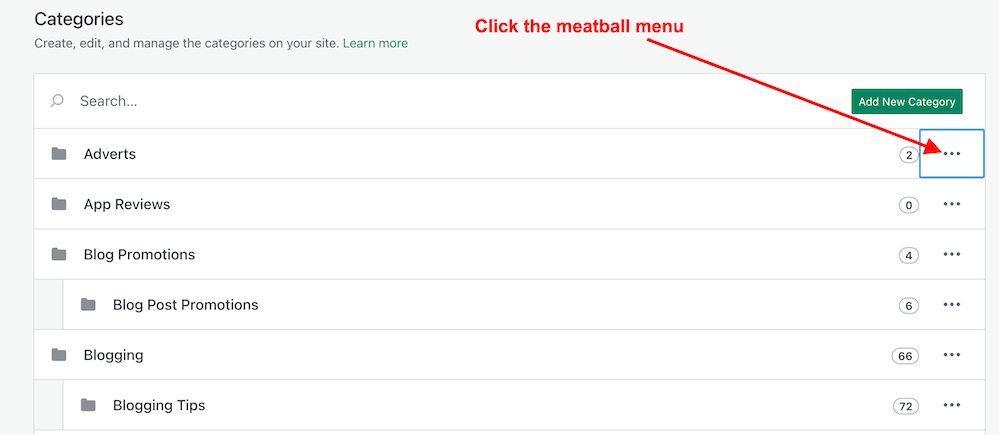
- The meatball menu displays four options: edit, delete, view posts, and set as a default.
- Edit – Edit the name or description of the category.
- Delete – Delete the category.
- View posts – View a list of all your posts under the category.
- Set as default – Useful when most posts fall under a particular category.
- Remember to click the ‘Update‘ button to save any changes you make.
The number next to each category tells you how many posts are under that category. I recommend deleting any categories that are not being used.
Any sub-categories will show under each category.
Tip: Setting your default category to ‘Uncatorigised‘ allows you to search for any blog posts you may have forgotten to categorise.
What are tags?
Tags are popular keywords that can be added to a blog post. For example, some of the tag words I’ve added to this post are –
- blogging
- bloggingtips
- categories
- tags
- WordPress
- HowTo
Each tag should be separated with a comma or by pushing ‘Enter’ on your keyboard.
Tags containing more than one word (such as ‘Blogging tips’) act as one tag word, but you must add them without any space between the words, i.e., ‘ blogging tips’ becomes ‘bloggingtips.’
Generally, tags do not need to connect with each other, but when used correctly, they can generate a lot of extra traffic to a blog post.
Like categories, tags can be added to blog posts in the settings area toolbar on the right side of a draft post.
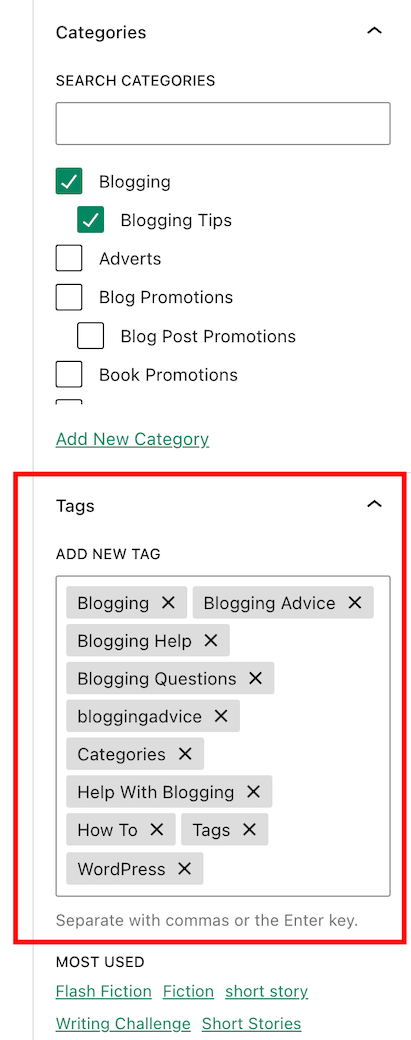
When adding tags to your post, consider the keywords somebody would add to the WordPress search bar when looking for specific blog posts. Or think of words you would use to search for your post.
Check out the tags I’ve added for this blog post. They appear at the end of every post.
Important information – Did you know this…?
The cardinal tagging rule on WordPress.com is that you should never add more than 15 tags and categories (combined) to your post; otherwise, it won’t appear in the WordPress Reader. This cap prevents spam posts from appearing on the reader list, as spammers and spambots tend to use many categories and tags to lure readers in
15 tags and categories can seem like a lot, but you don’t need to use all of them.
Never tag your blog post with words that have nothing to do with the post’s subject. Otherwise, visitors will come to your blog under false pretences and probably won’t return.
Generally, I add no more than three categories and between six and ten tags to my blog posts.
As with categories, it’s also essential to do some housekeeping for the tags you use on your blog.
How to delete and update tags
- On the dashboard of your blog, click on Posts – Tags.
- A page showing your tags and how many blog posts containing each tag appears.
- To edit, view and delete posts containing a tag word, hover your mouse over each tag word and click edit, quick edit, view or delete.
- You can also view the posts containing the tag word by clicking the number in the ‘Count’ column. I recommend deleting any tag words that are no longer being used.
Let’s wrap it up!
- All blog posts should be categorised and tagged.
- Categorising and tagging your blog posts makes them user-friendly, meaning people will likely return to your blog.
- Not categorising your blog posts means they’ll be challenging to find.
- When tagging posts, think of keywords others will use when searching for your blog post.
- Don’t use tag words that have nothing to do with the subject of your blog post.
- WordPress users – never add more than 15 tags and categories (combined) to your posts; otherwise, they won’t appear on the WordPress Reader.
- Remember to perform regular housekeeping of categories and tags on your blog.
- Adding the proper tags to your blog posts will increase the number of readers who find them. More readers mean higher stats, more comments, and new followers.
Do you categorise and add tags to all your blog posts? If not, why not? Which tags-words work best for you? Is there anything you’d like to add or ask regarding categories and tags in blog posts? Join the discussion by leaving a comment.
Did you enjoy reading this post? Then you may also like…
Blogging Simplified: It’s Easy, Isn’t It? Things I’ve Learned
Do you like talking about blogging? I do, and I’ve lots to say about it. What about you?
Keep reading
How To Use This New Easy Feature For Your Blog’s Settings On WordPress.
This new WordPress dashboard feature includes settings like privacy, site tools, and domain management for your blog
My post tells you where to find it and how to use it.
Keep reading
3 Quick And Easy Ways To Promote Your Old Blog Posts
Are you making use of your old blog posts?
My three quick and easy tips to bring old blog posts alive again are easy to follow and will deliver results.
Keep reading
Layout, content, settings, and format might differ on self-hosted blogs.
Follow Hugh on social media. Click the buttons below.
Copyright @ 2024 hughsviewsandnews.com – All rights reserved.
 Hugh's Views & News