How to Prevent This Horrible Blogging Nightmare From Happening

Imagine turning on your computer, laptop, or phone and discovering that your blog had vanished without a trace. What a horrible nightmare, yes?

In the 12 years I’ve been blogging, it has never happened to me, although there was an occasion when the setup of my blog (and that of many others) changed completely overnight, all due to a bug that affected many WordPress blogs. Fortunately, it was fixed quickly, even though it caused many users a nightmare they never thought would happen.

If you’re a WordPress.com blogger, be assured that if your blog and all its content suddenly vanish, WordPress will have a backup. Regardless of your WordPress plan, WordPress backs up every blog and keeps a copy, just in case it is ever needed. All you need to do is contact WordPress and request the file. They will send you a file containing the most recent backup they made. However, as we will discuss later, backups do not include everything.

But there’s no need to contact WordPress

If you’ve ever had a bad experience contacting WordPress or don’t want to contact them, there is another step you can take to ensure you have a backup of your blog. I’m using an Apple iMac desktop computer for the following guide.

How to backup your WordPress blog.

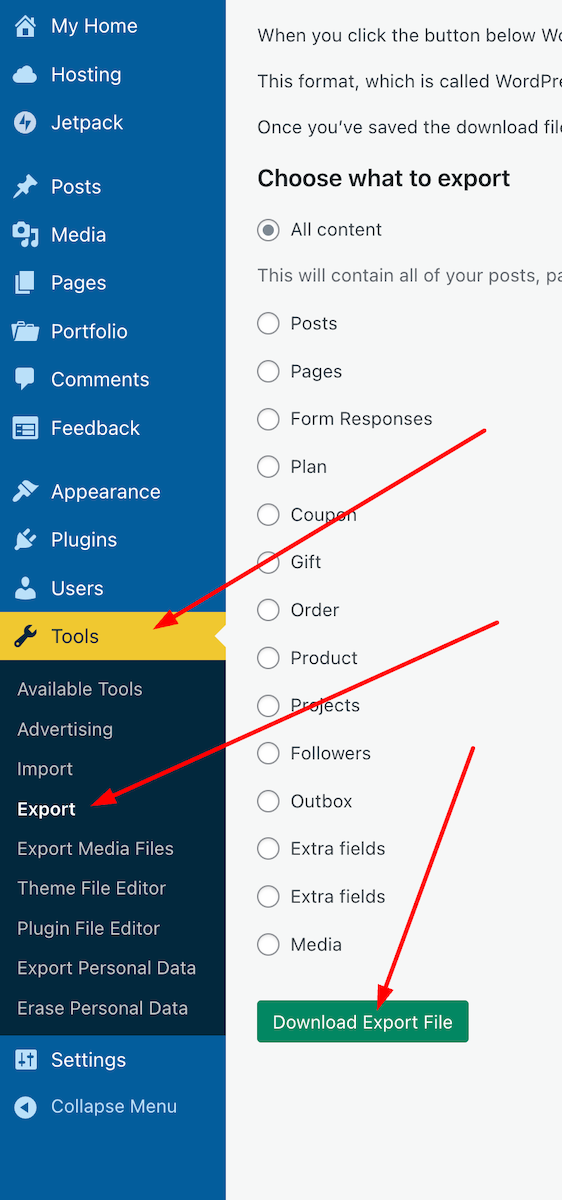
  • On the dashboard of your blog, go to Tools – Export.
  • Choose the items you wish to export (I recommend ‘All content‘) and click the ‘Download Export File‘ button.
An image showing Tools - Export' on the dashboard of a WordPress blog.
Press these buttons to begin the process of backing up your WordPress blog.
  • You will see a message informing you that your export file is being processed, along with the email address where a download link will be sent once the process is complete.
  • Access your email account where the link is sent, locate the email, and open it. Click on the ‘Download‘ button within the email.
An image showing the Download button in the email sent from WordPress when backing up your blog.
Click the ‘Download’ button in the email.
  • The file will be downloaded to your device. Ensure you remember its location and move it to another folder if necessary. I’ve created a file on my computer called ‘WordPress Backups’. Note that the file is only available for download for 7 days.
  • Remember to delete any previous WordPress backup files to free up memory on the device you are using.

The backup file you have downloaded does not include any media such as images, videos, or photographs. To back up media, follow the above instructions but select ‘Export Media Files‘ from the Tools menu – Tools – Export Media Files.

Do the backup files include everything?

It depends on which WordPress plan you have.

Users on a Free, Personal, or Premium plan can back up content and media. However, themes and plugins are not included in the backup. Therefore, if you ever need to download a backup file and have been using a retired theme that WordPress no longer supports, you will need to choose a new, current theme that is still supported. You’ll also need to download any plugins your blog uses.

Those with Business or Commerce plans have access to Jetpack Vault Backup, which allows them to view and restore backups at any time from their blog’s dashboard. This can be accessed at Jetpack – Backup. These backups include everything, including the theme and any plugins you use.

An image highlighting jetpack - Backup on the dashboard of a WordPress blog.
Click the Backup link to access the Jetpack Vault backup file.

Should I need to worry about backing up my blog?

Given that WordPress backs up your blog, no! However, for total peace of mind, and depending on how often you publish posts, you might consider backing up your blog at least once a month. If you publish posts daily or more frequently, I’d recommend backing up your blog at least once a week. However, after performing a backup, remember to delete the previous backup file.

Most likely, you’ll never need a backup copy of your blog, but I suggest you save a copy of this post in case you ever lose all the content of your blog.

All WordPress blogs also come with an ‘Activity Log‘ feature where bloggers can reinstall posts they have deleted by mistake. However, this feature is limited by the extent to which you can recover posts, depending on the WordPress Plan you have.

An image highlighting the Activity Log link on the dashboard of a WordPress blog.
Click the Activity Log button to see the most recent activity on WordPress.

Conclusion:

  • WordPress automatically backs up WordPress.com blogs, but it doesn’t include everything.
  • Users can contact WordPress and request a copy of the backup file.
  • Users can backup their blogs via the dashboard.
  • For backing up media files, remember to perform a backup by going to Tools – Export Media Files.
  • What is backed up depends on your WordPress plan.
  • Business or Commerce plan users have access to Jetpack Vault Backup, which includes everything (themes, plugins, etc.) and can be accessed at any time via the dashboard.
  • Backup links are only valid for 7 days.
  • Remember to delete previous backup files to free up space on your device.
  • While WordPress does back up your blog, regular manual backups (such as monthly or weekly) are recommended for added peace of mind.
  • The Activity Log feature allows recovery of accidentally deleted posts, with limitations based on your plan.
  • Keep a copy of this guide for future reference.

Have you ever lost content on your blog? If so, how did you handle it? What has been your experience with WordPress backups? Have you ever had to restore a backup? Are there any specific plugins or tools you recommend for backing up a self-hosted blog? Would you prefer to rely on WordPress’s automatic backups, or do you believe manual backups are essential? Join the discussion and leave your comments and answers.

Layout, content, settings, and format might differ on self-hosted blogs.

The featured image in this blog post is taken from Pixabay. AI checked spelling and grammar mistakes.

Click the buttons below to follow Hugh on Social Media

Copyright @ 2025 hughsviewsandnews.com – All rights reserved.

Now This Is Why Keeping Your WordPress Site Updated Matters

WordPress has introduced a useful new feature that benefits all users, including those with a ‘Free’ plan.

With just a few clicks, you can check whether the version of WordPress you are using is up to date, whether any plugins you have installed are current, and if the theme of your WordPress site is the latest release.

Here’s how to verify that all your WordPress installations are up to date. I am using an Apple iMac desktop computer for this guide.

  • Go to the dashboard of your blog and click on Dashboard – Updates.
An image emphasising the 'Update' button on the dashboard of a WordPress blog.
Click the ‘Update’ button.
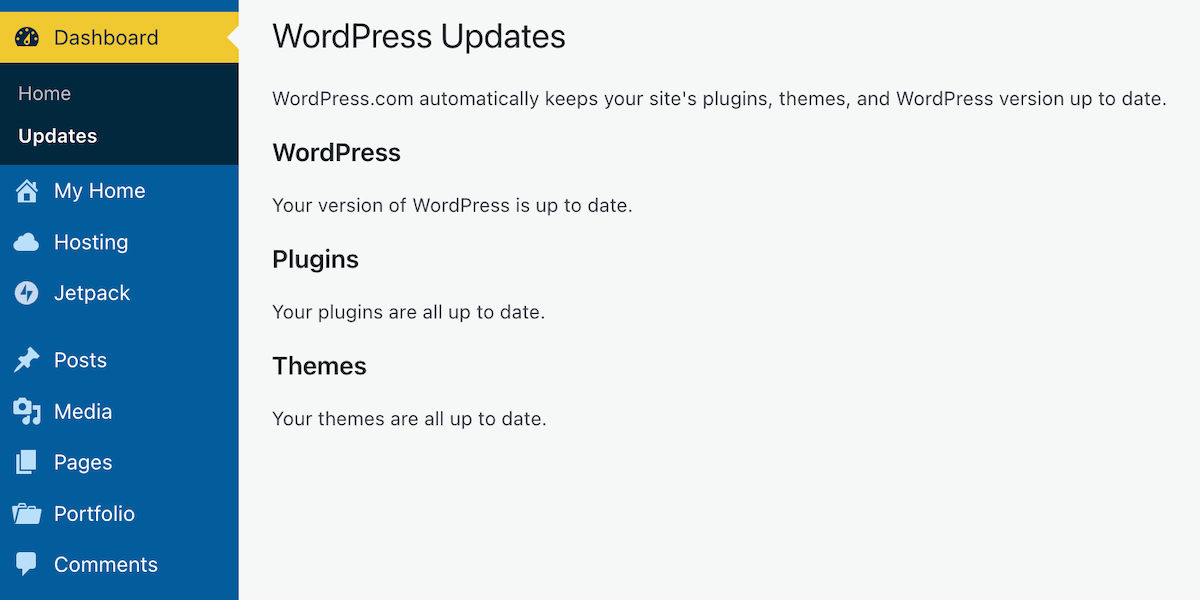
  • After clicking on Updates, you will see a page that informs you whether you are using the latest version of WordPress, plugins, and the WordPress theme you have installed.
An image of a page on a WordPress blog informing if WordPress, plugins and themes are all up to date.
Is everything on your WordPress blog updated?

If, like me, you are a WordPress.com user, WordPress will keep all these items up to date for you. So, why am I then informing you of this feature? Well, it’s all about retired themes and plugins that cause problems.

If you are using any plugins or a theme that has been retired, even if it appears you have the latest versions, any bugs affecting the theme or plugin since the final update will no longer be fixed because WordPress has withdrawn support.

How do I find out if the WordPress theme I’m using is still supported?

To find out if the WordPress theme you are using is still supported (and receiving updates), visit your blog’s dashboard and click Appearance – Themes. You will see a message indicating your theme is retired if it is no longer supported by WordPress. As we all know, using outdated themes can cause numerous problems for users.

Although a retired theme might not cause problems now, it could in the future. Some users attempt to use a workaround to avoid issues, but this is not advised, as it may lead to further problems. Instead of a workaround, switch to a current theme fully supported by WordPress. You don’t have to move to a Block theme if you prefer not to, since many Classic themes remain supported by WordPress. I am still using a Classic theme (Toujours) on my blog, which is fully supported.

Using an outdated, unsupported theme can lead to several issues. Here are a few.


1. Security vulnerabilities: Without ongoing updates, the theme may become prone to security risks that could compromise your blog.
2. Compatibility issues: As plugins and WordPress itself update, an outdated theme may not function correctly with newer versions, causing layout glitches, functional problems such as not being able to leave comments and issues with WordPress believing you are not logged in.
3. Lack of support: You won’t have access to official support for troubleshooting any issues or queries that arise with the theme. WordPress will advise you to change to a supported theme.
4. Performance issues: Unsupported themes may not be optimised for speed and performance, leading to slower load times.
5. Missed features: Regular updates often include new features and improvements; sticking with an unsupported theme means missing out on these enhancements, which could benefit your blog’s features and user experience.

If you are using a retired theme and refuse to switch to a supported one, there’s no point in blaming WordPress for any problems with your blog. It’s not their fault if you continue to use something they no longer support.

How do I change my WordPress theme?

Refer to the ‘Change Your Theme‘ page for complete details.

How do I change a retired plugin?

The best approach is to find a new plugin that provides similar functionality. You can search the WordPress plugin repository or other trusted sources for alternatives. 

Conclusion:

  • Many users often blame WordPress for blog-related issues, which are frequently due to user error or outdated software on their devices.
  • WordPress has introduced a new feature that allows users, even on the free plan, to check if their WordPress version, plugins, and theme are up to date.
  • To check for updates, navigate to Dashboard – Updates in your blog’s dashboard. If everything is updated, great!
  • However, if you’re using retired themes or plugins, you won’t receive support or fixes for any issues that arise.
  • Unsupported themes can lead to security vulnerabilities, compatibility issues with newer updates, a lack of support, performance problems, and the omission of key features.
  • To determine if your theme is still supported, navigate to Appearance – Themes in the dashboard.
  • If it’s retired, consider switching to a supported theme or plugin for better performance and security.

Have you ever faced issues with outdated themes or plugins on your WordPress blog? How did you go about resolving them? Which themes are you currently using, and have you checked if they are still supported? Do you have any WordPress tips to share with others?

Layout, content, settings, and format might differ on self-hosted blogs.

I’m getting tough with non-engaging comments. Comments such as ‘Nice post’ are marked as spam.

The featured image in this blog post is taken from Pixabay. AI checked spelling and grammar mistakes.

Click the buttons below to follow Hugh on Social Media

Copyright @ 2025 hughsviewsandnews.com – All rights reserved.
Did You Miss Any Of These? Monthly Round-Up – June 2025

We’ve reached the halfway point of the blogging year. How are your stats for 2025? Are you happy with them?

Including this post, I’ve published 26 posts so far this year. It appears likely that my viewing stats are running at the same level as those of 2024, although this time last year, I had published 62 posts! Although there has been no increase in viewings, I’m pleased with how my blogging year is going so far.

This month, I bucked the trend and published more posts than previuos months this year. I ventured back into ‘Wordless Wednesday’ and published five posts.

I also wrote and published a piece of flash fiction. Even though my flash fiction posts do not get as much viewing or engagement as my blogging tips posts, it was great to be back with my flash fiction hat on.

Here’s your opportunity to catch up on my five blog posts from June 2025.

  • Blogging can connect you with thousands of people worldwide. However, oversharing personal details poses significant privacy risks, negatively impacts professional reputation, harms relationships, and may lead to legal issues. Are you taking enough precautions to keep yourself and your identity safe online?

How To Make Yourself Safe Online: 7 Ways

  • What lies beyond the hedge?

Wordless Wednesday – What’s Beyond There?

  • Monitoring blog followers is crucial; spam-bots dilute engagement, pose security risks, harm SEO, and diminish your blog’s credibility. Do you know who is following your blog and how to remove unwanted subscribers? Read my post for further details.

Look! Blame Me For A Painful Drop In Blog Subscribers

  • Mike embraces change and love, symbolised by blue skies and blue wings. But where will they lead him?

Flash Fiction – Blue Sky

  • We all want to help other bloggers succeed. This is the one thing you can do to help every blog and blogger you visit.

This Is The One Thing You Can Do To Help Bloggers

Follow Hugh On Social Media.

Don’t forget to add a BlueSky sharing button to your blog.

Copyright @ 2025 hughsviewsandnews.com – All rights reserved.

This Is The One Thing You Can Do To Help Bloggers

We all know that comments play a crucial role in fostering community and enhancing conversations within the blogging world. When someone takes the time to engage thoughtfully with you, the impact is significantly greater than mere participation. But how?

An image depicting colourful individuals with vibrant comment boxes above them.
Image by Gerd Altmann from Pixabay

Imagine meeting a friend for coffee and hearing the same thing from them every time you meet. It would soon get boring, wouldn’t it? That’s what leaving the same comments on the blogs you visit can seem like.

I remember the first time somebody left me an engaging comment. I felt like they were not only listening to me but were interested in what I had to say. They were taking an interest in me instead of trying to get me to take an interest in them.

The benefits of leaving engaging comments, as opposed to short, non-engaging ones, are not only startling, but they help propel those receiving those types of comments into a whole new dimension of blogging.

Let’s examine some of the ways leaving thoughtful, engaging comments helps.

1. Enhances Community Interaction

Engaging comments foster a vibrant community atmosphere, often sparking discussions between those who leave the comments. When readers share their thoughts, experiences, or questions, it sparks conversation and encourages others to participate; even those who would not usually want to speak may be tempted to talk. This collaborative environment is crucial for fostering relationships among readers and between bloggers and their audience.

Short, non-engaging comments tend to have the opposite effect, creating off-page questions such as ‘did this person really read the post?’ or ‘is this person interested in my content or just proving they visited?’

2. Provides Valuable Feedback

When readers leave detailed, constructive comments, they provide valuable insights into your content. This feedback can help bloggers refine their writing and tailor future posts to better serve their audience. This is especially true for those who write fiction or poetry in helping them become even better at what they write.

Short comments like “Great post!” “Great story,” or “These are lovely photos,” may be easy to type, but they don’t offer the depth of feedback that engaging comments can provide.

Next time you want to tell a blogger that their story, post, or photos are great, explain why you think they are wonderful. By doing so, you’ll be providing them with much higher quality feedback and likely brightening their day even more.

3. Boosts SEO and Visibility

Did you know that certain comments, especially those containing valuable feedback and questions, can enhance a blog’s SEO rankings? Search engines not only favour blogs with dynamic content, but an active comments section filled with meaningful discussions can improve visibility. Engaging comments indicate to SEOs that the blog is active and has a thriving community.

4. Encourages More In-Depth Discussion

Thoughtful comments often contain questions or points that invite further discussion and exploration. This creates an opportunity for dialogue and deeper exploration of the topic at hand. As discussions develop, so can connections and friendships. After all, trying to make connections with those who keep telling you the same thing can be much more difficult when all they are doing is taking you down a dead end every time they leave a comment.

5. Builds Blogger Credibility

When a blogger responds to engaging comments, they can demonstrate their expertise and invest in their readers. This back-and-forth not only shows that the blogger values their audience’s input but also positions them as knowledgeable in their field. Leaving engaging comments or questions can help boost a blogger’s confidence and encourage them to write and share more content.

Disengaged comments may go unnoticed and fail to establish any genuine connection between a blogger and their reader. When this occurs across all their posts, it can lead to the blogger feeling disconnected from their audience, which may result in their blog being abandoned or deleted.

6. Increases Reader Retention

Readers who leave engaging and thoughtful comments are more likely to attract new visitors, encourage them to return, read future posts, and join in the discussions. They develop a sense of ownership and connection to the content they’ve interacted with. When other readers see their comments, they are more likely to view that blogger as friendly, engaging, and interested in expanding their audience. Their blog will seem like a fun place to visit.

Many visitors who encounter the same brief, uninspiring comments from the same individual are unlikely to wish to connect, unless they, too, post similar types of comments.

Time isn’t the enemy!

Many will say that they don’t always have the time to leave thoughtful, engaging comments. Instead, they tend to leave numerous short, unengaging comments everywhere. However, if they invested the time they spend leaving all those unengaging, brief comments to write just one thoughtful, engaging comment each day, they’d make a significant difference to the blogs and bloggers they visit.

Blogging isn’t a sprint to dash through all the blogs you follow, leaving brief, disengaging comments; it’s a space to take your time, enjoy what you read, and show other bloggers that you are genuinely interested in the content they create by offering valuable feedback that will help them craft and publish even better blog posts. Moreover, other visitors will perceive you as someone who seeks to engage with others.

Absolutely, you should feel free to engage or not, based on your desire! Always share your thoughts if you have something valuable to contribute to the conversation. Your insightful comments will be warmly welcomed and cherished by those who receive them.

And remember that there is nothing wrong with not leaving a comment if you have nothing of value to add.

Conclusion

  • Engaging comments are more than mere feedback; they are an essential part of the blogging ecosystem.
  • While short, unengaging comments have their place with some, the advantages of leaving thoughtful, engaging comments are much more powerful.
  • When you leave a thoughtful, engaging comment, you are not only enriching the conversation, but also enhancing SEO for that blog and providing valuable feedback for the blogger.
  • A blog with a comment section full of thoughtful and engaging comments is viewed by SEOs as having a thriving community.
  • As readers, taking the time to contribute meaningfully can transform a blog into a vibrant hub of interaction and knowledge sharing. It can also help boost the author’s confidence in their writing.
  • The next time you read a blog post, consider the impact of your comments—make them count!

How do you feel about the quality of the comments you receive? Do they inspire you to write more? What strategies do you employ to create engaging comments on other blogs? Have you ever felt discouraged by short or generic comments, and how did that affect your motivation? What tips would you offer someone who struggles to leave meaningful comments? How do you balance leaving thoughtful comments with limited time when visiting multiple blogs?

I’m getting tough with non-engaging comments. Comments such as ‘Nice post’ are marked as spam.

The featured image in this blog post is taken from Pixabay. AI checked spelling and grammar mistakes.

Click the buttons below to follow Hugh on Social Media

Copyright @ 2025 hughsviewsandnews.com – All rights reserved.

Look! Blame Me For A Painful Drop In Blog Subscribers

Do you know who follows your blog? Do you care about who is following you? If not, you ought to.

I’ve recently gained many new followers. Delighted, you may ask? Far from it. You see, I’ve noticed a trend among these followers. They all have a lot of random numbers (sometimes mixed with letters) in their profile names. Here’s an example:

An image displaying the details of a spam bot account that follows my blog. The profile name is made up of a combination of random numbers and a few letters.
An example of a recent spam-bot subscriber.

Not only that, but all of them ended with @gmail.com or @hotmail.com. And they follow in batches.

They not only seemed strange to me, but I also had no way of discovering who these new followers were, as none of them had any links in their Gravatar profile apart from their email address.

I soon realised that most of these new followers were spam-bots. What’s wrong with that, you may ask? There are several reasons why permitting spam-bots to follow and subscribe to your blog is not advisable.

Reasons to Not Allow Spam-Bots to Follow Your Blog

  1. Reduced Engagement
    • Spam followers do not contribute meaningful interactions, which can skew your engagement metrics and give a false impression of your blog’s popularity. They will, however, try to bombard your blog with spam comments and try to spam the comments box of your readers, too.
  2. Dilution of Community
    • Genuine followers are lost in a sea of spam accounts, making it harder to build a real community around your blog.
  3. Potential Security Risks
    • Spam-bots may pose security threats, as they can be linked to malicious activities such as hacking attempts or phishing schemes.
  4. Impact on SEO
    • Search engines may see high numbers of spam accounts as a sign of poor-quality content, which can negatively affect your blog’s search ranking.
  5. Email Spam
    • Spam-bots can lead to unwanted comments and email communication, and may even compromise your email’s reputation if they harvest your blog’s content.
  6. Negative Perception
    • A blog with many spam followers can create a negative impression on potential genuine followers, who may question the legitimacy of your content, especially if lots of spam comments show up on your posts.
  7. Lack of Valuable Feedback
    • Engaging with real readers provides valuable feedback and insights, whereas spam accounts offer no legitimate input on your content.

It’s simple to unsubscribe anyone (including spam-bots) from following your blog. Here’s how to do it. I’m doing this using an iMac Desktop computer.

  • On your blog’s dashboard, select Jetpack – Subscribers.
An image showcasing Jetpack - Subscribers on a WordPress blog's dashboard.
Click on Jetpack – Subscribers
  • You will see a list of all your subscribers.
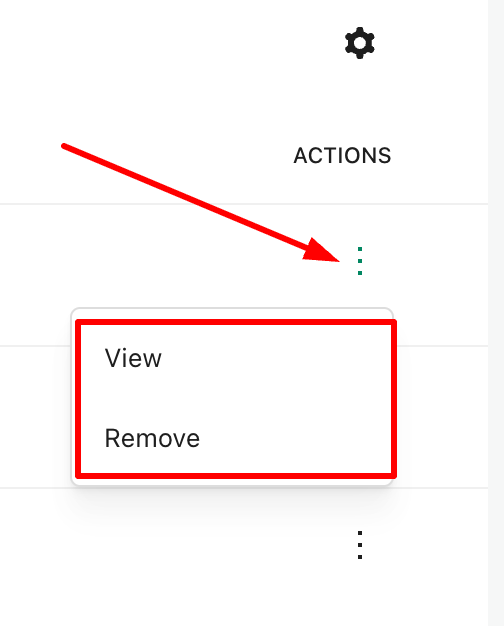
  • Click on the three dots (also known as a kebab menu) next to the subscriber you wish to delete and select ‘Remove.’ You have now unsubscribed the account from your blog.
  • If you wish to discover more about the subscriber, click the ‘View‘ button. Doing so allows you to gather further information about the subscriber, including whether they have a WordPress blog.
An image displaying the Remove and About links on a subscriber list of a WordPress blog.
Click the view or remove button.

While removing these spam-bots from my blog, I noticed that WordPress had also been busy informing me of purged subscribers.

An image of a suspended WordPress account.
WordPress has also been working to suspend suspicious accounts on my behalf.

I had no idea WordPress did this. However, I still had to unsubscribe the purged accounts and remove them from following my blog.

By being vigilant in monitoring your followers, you can help ensure that your blog remains a vibrant and secure space for genuine interaction.

And here’s what happened when I unsubscribed these spam-bot and purged accounts.

An image depicting a sudden decline in subscribers on a WordPress blog.
Sometimes, a drop in subscribers is a sensible thing.

Summary

  • Allowing spam-bots to follow your blog can lead to several issues.
  • They don’t contribute meaningfully, skewing your metrics.
  • Genuine followers can be lost among fake accounts.
  • Spambots may be linked to malicious activities.
  • High numbers of spam followers may harm your blog’s search rankings.
  • They can lead to unwanted communication and damage your email reputation.
  • Many spam accounts can diminish your blog’s legitimacy.
  • Real readers provide insights; spam accounts do not.
  • Unsubscribing spam-bots is straightforward through the Jetpack – Subscribers section on your blog’s dashboard.
  • After removing these accounts, you may notice a decline in subscribers, which, although concerning, can be a healthy sign of clearing out ineffective followers.
  • Staying vigilant about your follower base is key to maintaining a genuine and engaging blog.

Are you aware of who is following your blog? How do you protect your blog from unwanted subscribers?

Layout, content, settings, and format might differ on self-hosted blogs.

The featured image in this blog post is taken from Pixabay. AI checked spelling and grammar mistakes.

I’m getting tough with non-engaging comments. Comments such as ‘Nice post’ are marked as spam.

Click the buttons below to follow Hugh on Social Media

Copyright @ 2025 hughsviewsandnews.com – All rights reserved.

    How To Make Yourself Safe Online: 7 Ways

    In this digital age, sharing personal stories and experiences has become a hallmark of blogging, but it comes with its dangers.

    It’s not something I do much, as I prefer to keep my personal life offline. However, I also don’t want to share personal information that anyone could use to scam me, others or steal my identity. Additionally, I don’t want that to happen to anyone who visits or leaves comments on my blog posts.

    However, while authenticity can resonate with readers, there can be hidden dangers in revealing too much personal information in blog posts.

    1. The Privacy Risks

    When you share intimate details about your life, you may inadvertently attract unwanted attention. After all, do you know the identity of everyone who visits your blog? No! And how many of you get unwanted direct messages?

    Scammers and trolls are always on the lookout for information that users freely share about themselves online. This could lead to online harassment, being scammed or identity theft, particularly if you disclose sensitive information such as your full name, location, birthdate, or financial details.

    I’ve no problem with bloggers announcing it’s their birthday, but when they also disclose their age, I ask myself if they would give out their name and full date of birth to a room full of strangers.

    A dark image of a sponge cake with candles that spell out 'Happy Birthday.'
    Image by Pexels from Pixabay

    Of course, if they don’t use their real name on their blog, then it’s not a problem; however, some bloggers seem to want to share as many details about themselves as possible online, believing they are only talking to family and friends, when the reality is that many people reading their posts are likely strangers.

    Always remember that the internet is a public space, and once information is shared, it can be challenging to retract.

    Don’t be tempted. Keep in mind who is reading your posts. Keep your personal details safe.

    2. The Professional Consequences

    Many bloggers use their platforms to advance their careers, but sharing too much personal information can harm their professional reputation, especially when they leave comments or say things considered discriminatory or hateful towards others. Potential employers or clients may judge you based on your blog and the comments you leave, including those on social media.

    I’ve witnessed professional people leave discriminatory comments on various social media platforms, despite their bio listing the name of their employer. It’s important to ensure that your personal narratives align with your professional image. Maintaining professionalism in your blogging and online presence can protect your career and help you present yourself in a positive light.

    3. Impact on Relationships

    Blogging about personal experiences can impact your relationships, as friends, family, and work colleagues may be uncomfortable with how you portray them. It’s important to seek their consent before sharing their stories and to communicate openly about your blogging intentions to maintain healthy relationships.

    If you are considering blogging about personal experiences that affect family, friends or anybody from your past, consider using a pseudonym for those people so that visitors to your blog cannot trace themselves or people they know to what has been said about them.

    Also, think about any photos you publish on these kinds of posts and whether they show the identity of the people you are talking about in your posts.

    4. Legal Implications

    Just because your blog is small, don’t believe that facing legal implications will never happen to you.

    While you may be familiar with the defamation laws in your country, they can vary by region. Sharing certain personal details about others without their consent can result in legal action.

    Now, I do not want to alarm anyone, but please exercise caution when discussing events or situations that might portray someone in a negative light. Always consider the potential legal implications of your content before publishing it. If you are not happy with it, don’t publish it.

    If you want to write and publish a post about another blogger, always ask for their permission first, even if what you want to write is giving them lots of praise. After all, they may not want any praise or be in the limelight.

    Ask first, then consider your actions.

    5. Images and photos

    Be careful with what images or photos you include in blog posts. They may contain personal information about you that you never considered unsafe. For example, I’ve seen pictures on blogs that show a blogger standing by the front door of their home. On the wall next to the door is a number and the name of the street on which they live. Nothing too bad, you may think, but on their ‘about’ page, they inform visitors of the city, town and country where they live. Now, anyone visiting that post and checking their ‘about’ page will have their full home address.

    Think before you include any images or photos and ask yourself, ‘Does this reveal any personal information about me or my family that I do not want revealed?’

    6. Going away?

    If you are taking a break from blogging, there is nothing wrong with informing your readers that you will be away from the blogging world for a while. A simple notice can help maintain transparency and keep your audience informed about any pauses in your content schedule.

    However, you do not need to disclose any personal reasons for taking a break to them, especially if it means you are going away; it’s perfectly acceptable to keep the specifics private.

    Your readers likely understand that life can get busy. Amid daily activities, it’s essential to communicate concisely while maintaining clarity. However, suppose you have disclosed personal information about your location on your blog (including in photos) and informed readers that you will be away from home for an extended period. In that case, there is a potential for anyone reading the post to know your home is empty.

    An image of a burglar holding a SWAG bag and a torch.
    Image by katigori from Pixabay

    This can inadvertently expose you to risks, as not only are you sharing your plans, but you are also providing a crucial piece of information that can be misused. This is why it’s vital to exercise discretion when discussing your travel plans publicly; consider omitting specific details about dates and duration to ensure your privacy and security remain intact. Ultimately, while it’s important to engage with your audience and keep them informed, maintaining your home’s safety should always be a priority.

    7. Moving Forward

    Connecting with your audience is essential, but just as when checking comments on your blog, moderation is key. Share relatable experiences without revealing too much personal information. Consider using pseudonyms or altered details to disguise identities while still sharing relatable stories. Consider the potential consequences of your content before publishing it.

    Summary

    • Over-sharing personal details can attract unwanted attention and increase the risk of scams, harassment, or identity theft. The internet is public, and once shared, it’s hard to retract information.
    • Excessive personal sharing can affect your professional reputation. Employers may judge you based on your blog content, including comments that could be seen as discriminatory.
    • Blogging about personal experiences may strain relationships, especially if friends, family or work colleagues are depicted in ways that make them uncomfortable. It’s important to obtain consent and clearly communicate your intentions.
    • Even small blogs can face legal consequences for sharing personal information about others without consent. Be cautious when discussing sensitive topics or portraying individuals in a negative light.
    • Photographs can inadvertently reveal personal information. Consider whether photos might disclose details about your location or identity before including them in posts.
    • Informing readers about breaks is fine, but keep personal reasons private. Avoid sharing details about travel plans that could risk your home security.
    • Engage your audience while being mindful of privacy. Use pseudonyms or alter details to protect identities and think through the consequences of your posts.
    • While blogging fosters connection, it’s essential to share experiences without compromising privacy or safety. A balanced approach helps maintain your integrity as a blogger.

    Are you disclosing too much personal information regarding yourself and your family online, or do you consider what you are disclosing to be safe? What safeguards have you implemented to shield both yourself and your audience from potential scams, identity theft, and unwarranted scrutiny?

    The featured image in this blog post is taken from Pixabay. AI checked spelling and grammar mistakes.

    I’m getting tough with non-engaging comments. Comments such as ‘Nice post’ are marked as spam.

    Click the buttons below to follow Hugh on Social Media

    Copyright @ 2025 hughsviewsandnews.com – All rights reserved.
    Did You Miss Any Of These? Monthly Round-Up – May 2025

    How is your blogging year going so far? It’s hard to believe that by this time next month, we will be upon entering the second half of 2025. It appears that my blog is on track to receive around the same number of views as it did last year, despite publishing significantly less content. I’m pleased that engagement remains high.

    In May 2025, I published three posts, the same as I did in April. However, this post increases that figure by one.

    My last post this month resulted in quite a shock, as the number of bloggers who either did not know what Alt-Text was or who don’t use it was pretty high. Read the post to find out more, as given all the engagement, I’m not convinced that the blogging community is as inclusive a place as it should be.

    In the meantime, here’s your opportunity to catch up on my three blog posts from May 2025.

    • Are you eager to reduce spam on your blog and connect with like-minded bloggers and writers? Are you excited about the possibility of updating your blog’s theme and curious about how to navigate any challenges that come with using an unsupported or retired WordPress theme? Read on for more details.

    Simple Blogging Tips And Insights Every Blogger Needs To Know

    • Her special place held happy memories, but it wasn’t all that it was meant to be. Could she find an escape route?

    Flash Fiction – Special Places

    • Do you add alt-text to the images and photographs you include in your blog posts? If not, my post outlines why you should.

    The Best Ultimate Guide To Why Alt-Text Is Important

    Follow Hugh On Social Media.

    Don’t forget to add a BlueSky sharing button to your blog.

    Copyright @ 2025 hughsviewsandnews.com – All rights reserved.

    The Best Ultimate Guide To Why Alt-Text Is Important

    What answers would you provide if I asked you what alt-text means and what advantages it offers to bloggers?

    What is alt-text, and why is it important?

    Alt-Text (short for alternative text) is a commonly used term. It is essential to include it in posts that contain pictures, images or photographs. This unsung hero of the digital world ensures that everyone can access and benefit from the images included in your blog posts.

    Blog posts that contain images, pictures, or photos attract, on average, 70% more traffic and clicks than those that do not. However, how many bloggers include alt-text information for these images, pictures, and photos? Unfortunately, the answer is not many. Furthermore, bloggers who fail to add alt-text to the images in their posts are missing out on providing some visitors with additional and important information.

    Alt-Text assists those with vision impairments understand the content of the images and photos used in your blog post. Without it, they would be unaware, potentially missing out on crucial information. Imagine you’re showing off a brand new cover for your next book and don’t add alt-text to the image. They won’t have any idea what that new book-cover looks like. But that’s not all.

    Utilising alt-text enhances your blog’s SEO rankings and helps search engines understand the content of your images. How will search engines determine what your pictures depict if no information is provided?

    Search engine crawlers extract several key details from an image, including its file name, captions, title, and alt-text. When these details are absent, the post containing the images is ranked significantly lower. Visitors using a screen reader or other devices that inform them of the image’s content will remain unaware of what those images depict.

    How to write alt-text.

    When writing alt-text, keep it descriptive and straightforward—ensure it aligns with the content on the page. Include some keywords where appropriate, but avoid overdoing it. Keyword stuffing is not advisable, as it disrupts the user experience and can lead search engines to consider your site spam. Trust me, you don’t want that!

    But where and how should you add alt text to your images, photographs, and pictures?

    How to add alt-text to your images, photos, and pictures.

    • Click on the image you have uploaded to the media library.
    • On the right-hand side, you will see several boxes to which you need to add information.
    • Alternative Text – In this box, add information that describes what is in the image.
    • Title – Give the image a title.
    • Caption — Add a caption to the image, although you don’t need to if it’s unnecessary.
    • Description — Describe what’s in the image. You can use the same information you added for alternative text if you like.
    • File URL – This information will already be populated.

    Here’s an example from my media library for the following photo.

    A photo of two Welsh Cardigan Corgis sitting on a sandy beach, gazing towards the camera. In the background, there are several buildings of a city and some mountains. There are a few white clouds in the sky.
    A walk on the beach with Toby and Austin, the Welsh Cardigan Corgis.
    • Here are the details of the alt-text and information I added to the photo.
    An image provides information about the Alt-Text added to a photo in the WordPress media library.
    Always add Alt-Text information to images, pictures and photos

    The next time you add an image, photo, or picture to your blog post, don’t just add the image and run. Make sure you include the details outlined in this post.

    Summary

    • Alt-Text, or alternative text, is crucial for bloggers who include images in their posts.
    • It enhances accessibility for those with vision impairments, ensuring they understand the content represented in images.
    • Additionally, it plays a significant role in improving SEO rankings by helping search engines identify image content.
    • Despite these advantages, many bloggers neglect to add alt-text to their images, missing out on valuable audience engagement and search engine visibility.
    • To effectively write alt-text, it should be descriptive, straightforward, and relevant to the content, with a mindful inclusion of keywords.
    • Bloggers can easily add alt-text by accessing the media library and providing a title, caption, and description of the images.
    • Overall, including alt-text enhances the user experience and optimises blog performance.

    Do you add alt-text and other details to the images and photos included in your blog posts? If not, what’s holding you back?

    The featured image in this blog post is taken from Pixabay. AI checked spelling and grammar mistakes.

    I’m getting tough with non-engaging comments. Comments such as ‘Nice post’ are marked as spam.

    Layout, content, settings, and format might differ on self-hosted blogs.

    Click the buttons below to follow Hugh on Social Media

    Copyright @ 2025 hughsviewsandnews.com – All rights reserved.

    Simple Blogging Tips And Insights Every Blogger Needs To Know

    Occasionally, I receive questions or comments about blogging and social media that inspire me to share key insights with my readers. Here are three recent examples of those topics. Hopefully, you’ll learn something from them.

    How to get less spam!

    In my recent post, “Astonishing! Some Bloggers Disable Comments on Their Blogs. Why?” many readers mentioned that they turn off comments due to the overwhelming number of spam comments that often come through. This is a valid concern! However, it’s worth noting that WordPress offers a setting that can help prevent you from seeing most spam comments. Activating this feature is simple.

    • On your blog’s dashboard, go to Jetpack – Akismet Anti-spam.
    Image highlighting Jetpack - Akismet Anti-spam on the dashboard of a WordPress blog
    Click Jetpack – Akismet Anti-spam
    • On the page that opens, look for the Settings box. Under Spam Filtering, ensure ‘Silently discard the worst and most pervasive spam so I never see it‘ is selected.
    Image highlighting the 'Silently discard the worst and most pervasive spam so I never see it' setting on WordPress.
    Ensure ‘Silently discard the worst and most pervasive spam so I never see it’ has been selected.
    • Click the ‘Save changes‘ button.

    You’ll now see much less spam in your blog’s spam folder. On average, I’m seeing no more than a few spam comments every week.

    For more details, check out my post, ‘Turn This Setting On To Stop Seeing Too Much Spam On Your WordPress Blog.’

    How do you find the people you want to follow?

    Author Liz Gauffreau recently left a comment on my post, ‘The Ultimate Guide to Engaging on Bluesky: Tips, Features, and Strategies for Success,’ saying she was struggling to find other users on Bluesky who read or write literary fiction.

    I asked Liz if she had checked out the Bluesky Starter Pack directory, where users can search for other users with similar interests. I included a link to the directory. This is how Liz replied.

    An image showing a reply from a blogger thanking me for the information I sent her.
    Job done!

    If you’re a Bluesky user, I recommend checking out the information about Starter Packs. They are an excellent way to discover other bloggers, writers, authors, photographers, and more. Starter Packs are also great for getting noticed and connecting with other users. Click the following link.

    What are Bluesky Starter Packs?

    And click the following link to check the Bluesky Starter Pack directory I sent to Liz.

    Bluesky Starter Pack Directory.

    I recently passed a milestone on Bluesky: getting over 5,000 followers. Given that I’ve only been on Bluesky since November 2024 and it took me nearly 12 years to reach 9,000 followers on X, I can’t emphasise enough how every blogger and writer should consider using Bluesky.

    If you haven’t already, give Bluesky a go.

    How to stop the theme you’re using from crashing your blog.

    Amanda, who blogs at ForestWood, recently published a post titled ‘It’s Time For A Change Of Theme.’ She was referring to a change of blog theme. I’d recently published a post about WordPress themes, so I was interested in what Amanda had to say. Needless to say, Amanda’s post inspired me (and many others) to leave a comment.

    You’ll have to read Amanda’s post to find out what she and I had to say, but it contained an important lesson some readers may have forgotten or may not know about regarding WordPress themes. Do not attempt to change your WordPress blog’s theme unless you’re using a theme still supported by WordPress.

    If, like Amanda, you are using a retired theme and click ‘activate’ on any of the current themes WordPress offers, you won’t be able to return to your retired theme!

    If you are using a retired WordPress theme that isn’t causing you any issues, you can continue using it. However, be cautious, as there are drawbacks to using a retired theme, including those related to online security. For more information, check out my recent post, “WordPress Themes: Something Exciting Is Happening,” which provides further details.

    Let’s wrap it up!

    • Use WordPress’s Jetpack – Akismet Anti-spam feature to significantly reduce spam comments. By enabling the option to “silently discard the worst and most pervasive spam,” users can keep their spam folder manageable.
    • Use the Bluesky Starter Pack Directory to connect with other users with similar interests. This resource helps you discover other bloggers, writers, authors and photographers and gain visibility.
    • If you are thinking of changing the theme of your WordPress blog, be aware that if the current theme you are using is retired and no longer supported by WordPress, you won’t be able to return to it.

    Do you have any questions about blogging or social media? Leave them in the comments section.

    The featured image in this blog post is taken from Pixabay. AI checked spelling and grammar mistakes.

    I’m getting tough with non-engaging comments. Comments such as ‘Nice post’ are marked as spam.

    Layout, content, settings, and format might differ on self-hosted blogs.

    Click the buttons below to follow Hugh on Social Media

    Copyright @ 2025 hughsviewsandnews.com – All rights reserved.

    Did You Miss Any Of These? Monthly Round-Up – April 2025

    In April 2025, I published three posts. I seem to be settling into a schedule of three posts per month, much less than what I was doing this time last year. However, engagement and views remain high, which I’m delighted about, given that I was concerned a drop-off in posts would mean fewer views and engagement. But that’s not true.

    My last post, in April, was about commenting, which received the most comments. It’s a hot topic among bloggers, so I wasn’t surprised by the results. If you’ve not read the post and comments yet, check it out and join the discussion.

    In the meantime, here’s your opportunity to catch up on my three blog posts from April 2025.

    • We all make mistakes while blogging. But what are these mistakes, and how can we resolve them?

    7 Common Blogging Mistakes and How to Avoid Them for a Successful Blog

    • Are you having any issues with your current WordPress theme? Are you using a Classic or Full Site Editing theme? Would you let AI help you change your blog theme? Join the discussion.

    WordPress Themes: Something Exciting Is Happening

    • Some bloggers are turning off comments due to time constraints. Are you one of them?

    Astonishing! Some Bloggers Kill Off Comments On Their Blogs. Why?

    Follow Hugh On Social Media.

    Don’t forget to add a BlueSky sharing button to your blog.

    Copyright @ 2025 hughsviewsandnews.com – All rights reserved.